Want to reach readers in Spanish, Arabic, and Japanese without running three separate news channels? You can do it - and it’s easier than you think. Telegram’s channel system lets you build a single news feed that automatically delivers content in multiple languages, using nothing more than an RSS feed, a bot, and a few smart tools. No need to hire translators. No need to post manually. Just set it up once, and let automation handle the rest.
How It Works: The Core Architecture
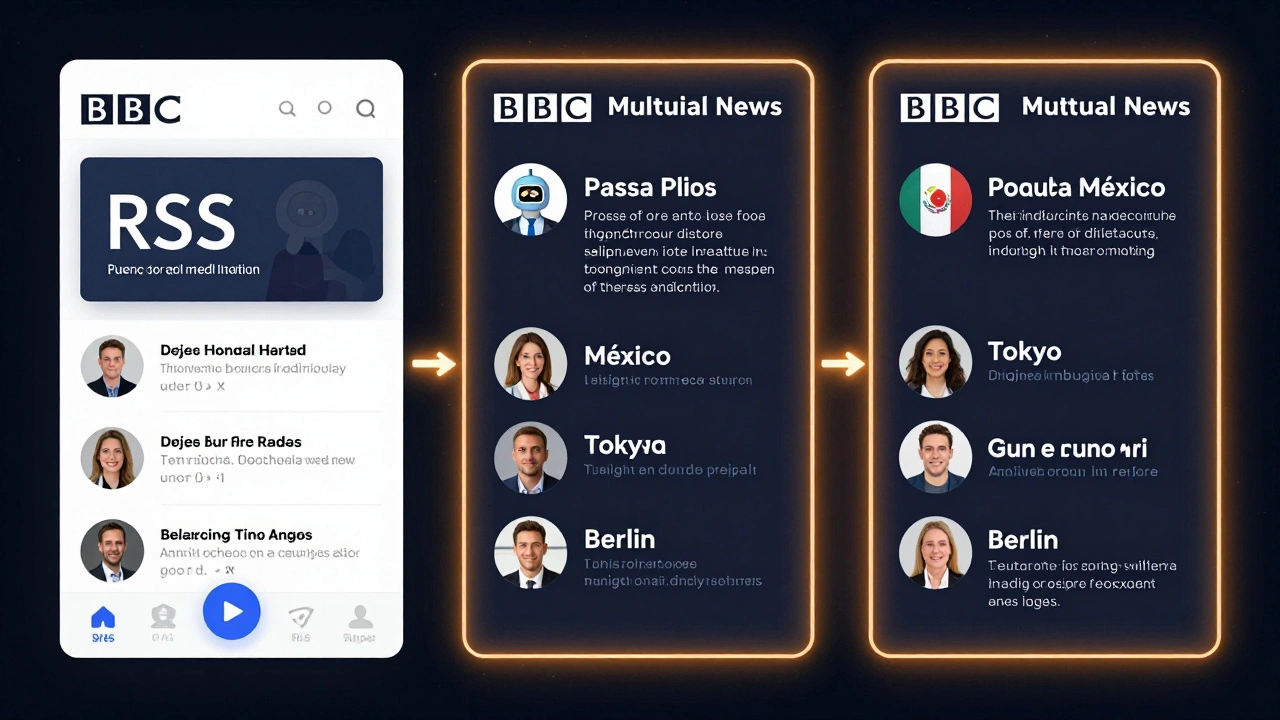
At its heart, this system runs on three simple parts: a source, a translator, and a delivery channel. You start with an RSS feed from a news site - say, BBC or Al Jazeera. Every time they publish a new article, the RSS feed updates. A bot picks up that update, translates the headline and summary, then posts it to your Telegram channel. The whole process takes under 30 seconds.Telegram channels are perfect for this because they support rich formatting. You can bold the headline, add emojis for visual hooks, include a clean excerpt, and link directly back to the original article. Readers get a polished, mobile-friendly update - not a raw copy-paste.
What makes this truly powerful is that you can serve multiple languages from the same channel. A user in Mexico sees the article in Spanish. A user in Tokyo sees it in Japanese. Same channel. Same feed. No confusion. No duplication.
Setting Up the Automation: Tools You Can Use
You don’t need to code from scratch. Three tools make this doable for anyone:- RSS.app: Paste any news site URL, click "Translate," choose your target languages, and it generates a custom RSS feed in each language. You then connect that feed directly to a Telegram channel. It’s the simplest option - no setup, no login, no coding. Perfect for beginners.
- Zapier or Make: These platforms let you build workflows. Trigger: new item in RSS feed. Action: send message to Telegram. You can customize the message format, add emojis, pull the first 150 words of the article, and even include a "Read More" button. Both platforms support language detection and basic translation via third-party APIs like Google Translate.
- n8n: For advanced users, n8n lets you build full multilingual logic. You can store a dictionary of translated messages in NocoDB, use JavaScript to dynamically load the right version based on the user’s language preference, and route content without creating separate workflows. One bot. Unlimited languages.
The key advantage of n8n? You can add a new language - say, Ukrainian or Swahili - by just updating a single JSON file. No reconfiguring the bot. No restarting the system. It just works.
Language Handling: Don’t Make Users Choose
One big mistake people make? Asking users to pick their language. It creates friction. Instead, use automatic language detection.Telegram bots can read the language setting of a user’s device. If someone’s phone is set to French, the bot sends the article in French. If it’s set to Korean, it sends in Korean. If the translation isn’t ready yet? Default to English or the original language. This keeps the flow smooth.
Advanced setups use a dictionary-based approach. Think of it like a master spreadsheet:
- Column 1: Message key (e.g., "headline", "excerpt", "read_more")
- Column 2: English version
- Column 3: Spanish version
- Column 4: Arabic version
- ... and so on.
Your bot pulls the right column based on the user’s language code (like "es-ES" for Spanish, "ar-SA" for Arabic). No branching. No complexity. Just a clean lookup.
Personalization: Go Beyond Translation
Translation is just the start. The best multilingual feeds do more:- Topic filtering: Let users say, "Only send me tech news," or "Skip politics." This reduces noise and boosts retention.
- Scheduled digests: Instead of pushing every article, send a daily summary at 8 AM local time. Users get one clean update - not 10 scattered alerts.
- Ad filtering: Use bots like neural-news-feed (from GitHub) to detect and remove promotional content. Many news sites bury ads in their feeds. A smart bot can flag them.
- Quality ranking: Let users rate articles (👍/👎). Over time, the bot learns what content performs best and prioritizes it.
These features turn a simple feed into a personalized news assistant. People don’t just subscribe - they come back.
Real-World Example: How a Small Publisher Does It
A blogger in Berlin runs a site about sustainable tech. They use RSS.app to pull articles from five English-language sources. Then they use n8n to:- Translate headlines into German, French, and Polish
- Store translations in a Google Sheet
- Send the right version to users based on their Telegram language setting
- Filter out any posts with "buy now" or "discount" in the title
- Send a weekly digest every Monday at 9 AM local time
Result? 12,000 subscribers across 17 countries. Zero manual posts. Zero translation costs. And a 78% open rate on their digests.
What to Avoid
Don’t make these mistakes:- Don’t use free translation APIs without limits: Google Translate and DeepL have usage caps. If your feed gets popular, you’ll hit them fast. Use paid tiers or self-hosted models like LibreTranslate.
- Don’t skip link testing: Broken links kill trust. Always test a few posts manually. Make sure the "Read More" button points to the right article.
- Don’t overload the channel: One post per hour is enough. Too many = unfollow.
- Don’t ignore error logs: Set up alerts if the bot fails to post. Use Telegram’s built-in logging or a simple email trigger.
Future of Multilingual Feeds
This isn’t just about translation anymore. The next step is context-aware curation. Imagine a bot that:- Knows you read mostly about AI in the morning and climate news at night
- Adjusts tone - formal for business readers, casual for students
- Summarizes long articles into 3-line bullet points
- Answers simple questions like, "What’s the latest on EU AI laws?"
That’s already possible with FastAPI backends and local LLMs. You don’t need to be a developer to try it - tools like n8n now have AI nodes built in.
Start Small. Scale Fast.
Don’t try to launch 10 languages on day one. Pick one source. One language. One feed. Test it. See how people react. Then add another. The system scales effortlessly. Your audience will grow faster than you expect.Telegram channels don’t need to be perfect. They just need to be useful. And with this setup, they can be.
Can I use this without coding?
Yes. Tools like RSS.app let you generate multilingual feeds with zero code. Just paste a news site URL, choose your languages, and connect to Telegram. No login, no setup, no technical skills needed.
How many languages can I support?
Technically, unlimited. With dictionary-based systems like n8n, adding a new language means updating a single file. No extra bots. No new workflows. Just translate and go.
Do I need a Telegram bot?
You need a Telegram bot if you want to send messages to a channel automatically. But if you’re just posting to your own channel, you can use RSS.app or Zapier without creating a bot - they handle authentication for you.
Can I filter out ads and spam?
Yes. Tools like the neural-news-feed bot on GitHub scan incoming articles for common ad patterns - "limited time," "click here," "exclusive offer." They can automatically skip those posts. You can also set keywords to ignore in Zapier or n8n.
What if the translation is bad?
Start with machine translation - it’s good enough for headlines and summaries. For critical content, add human review: use a Google Sheet to flag low-quality translations, and assign volunteers to fix them. Over time, you’ll build a library of polished translations.
Is this legal? Can I republish news?
Yes, as long as you’re not copying full articles. Use headlines, short excerpts (under 100 words), and direct links to the original source. This follows fair use and avoids copyright issues. Always credit the original publisher.
Can I monetize this feed?
Not directly through Telegram - it doesn’t allow ads in channels. But you can drive traffic to your own website or Patreon where you offer premium summaries, ad-free versions, or exclusive analysis. The feed becomes a lead generator.
How often should I post?
One post per hour is the max. Most successful feeds post 3-5 times a day. Better to send fewer, higher-quality updates than flood users. Use scheduled digests for better engagement.
What’s the best tool for beginners?
Start with RSS.app. It’s free, works in minutes, and supports translation + Telegram export. Once you’re comfortable, move to Zapier or n8n for more control.
Can I combine multiple news sources?
Absolutely. Feed multiple RSS sources into one automation. You can even prioritize them - e.g., show breaking news from Reuters first, then tech updates from TechCrunch. Use filters to avoid duplicates.
Building a multilingual news feed on Telegram isn’t about technology - it’s about connection. It’s about letting someone in Nairobi, Jakarta, or Buenos Aires get the news they care about, in the language they understand - without you lifting a finger after setup. That’s the power of automation. And it’s available to anyone with a feed and a goal.
Latest Posts