Picture this: It is 2 a.m., and your Telegram news group has just posted a breaking story about a local election. Within minutes, the chat explodes. One user calls another a liar. Another posts an unverified screenshot from a rival channel. The comments section turns into a shouting match that threatens to derail the entire discussion. This is the reality of managing Telegram news debates, which are high-velocity discussions on current events within Telegram groups or channels where anonymity and speed often fuel intense interpersonal and informational conflicts. Without a clear plan, these moments can destroy community trust, spread misinformation, or even trigger legal issues depending on where your users live.
Many admins react instinctively-banning people, deleting messages in panic, or ignoring the chaos until it burns itself out. But effective community leaders know that you need a structured approach. You need conflict resolution protocols, which are explicit sets of rules, roles, tools, and procedures designed to prevent, manage, and resolve disputes in online communities while maintaining civility and accuracy. These protocols aren't just about keeping the peace; they are essential for protecting the credibility of your news source and ensuring that valuable insights aren't lost in the noise.
Why Telegram Needs Specific Conflict Rules
Telegram is not Facebook or X (formerly Twitter). Launched in August 2013 by brothers Pavel and Nikolai Durov, Telegram is a cloud-based messaging application known for its emphasis on privacy, security, and large-scale broadcasting capabilities through channels and supergroups. Because it lacks the automated content moderation filters found on other major social platforms, the burden of keeping debates civil falls entirely on you, the admin, and your moderation team. In high-stakes environments, such as political discourse during the Russia-Ukraine war, researchers have identified Telegram as a "crucial platform" for both state and non-state actors. This means your group could become a battleground for propaganda if you don't set boundaries early.
The stakes are rising globally. For instance, in Europe, regulators are scrutinizing Telegram for failures in moderating extremist material. Meanwhile, in Russia, the government began throttling the service in February 2026 and announced a full block effective April 1, 2026. If you run a news channel that touches on sensitive political topics, mishandled conflicts can lead to external sanctions or even legal trouble. A robust protocol helps you navigate these regulatory pressures by ensuring you have documented, consistent processes for handling harmful content.
Building Your Protocol: The Five Core Components
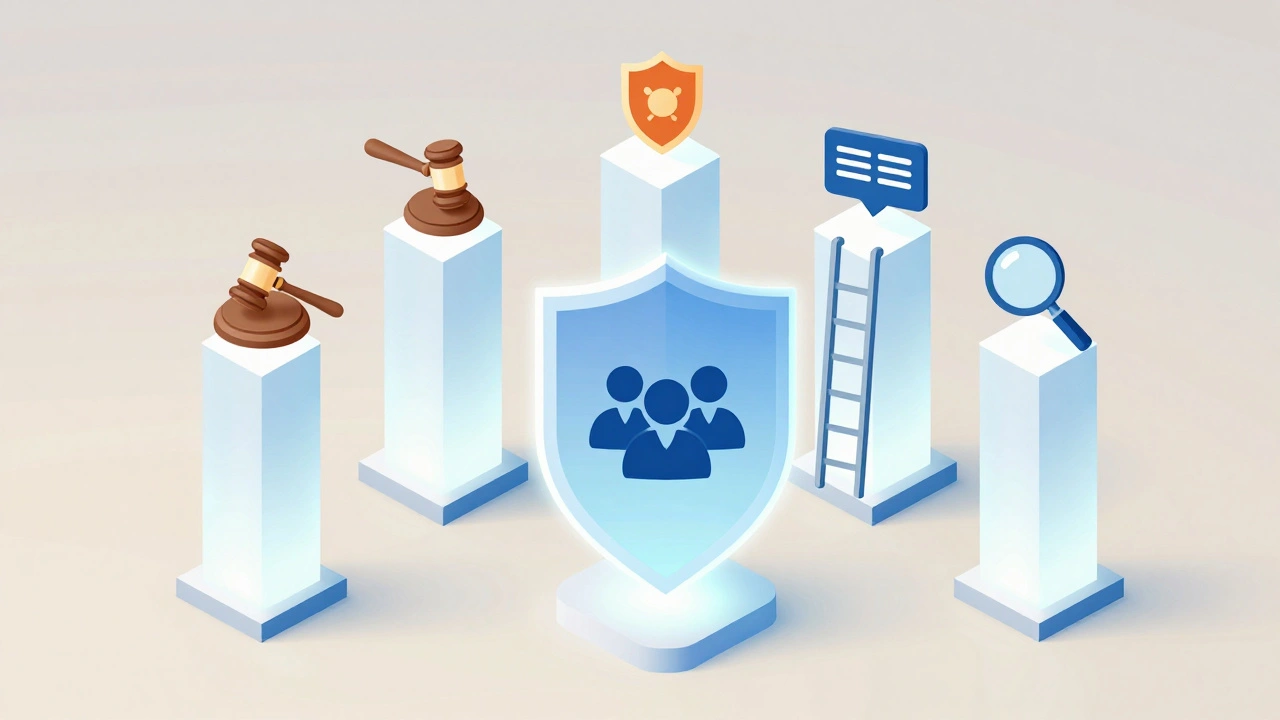
A strong conflict resolution protocol isn't a vague promise to "be nice." It is a technical and behavioral framework. To build one that works, you need to integrate five specific components into your group's structure.
- Codified Behavioral Rules: Clearly define what is acceptable. Ban personal attacks, hate speech, and doxxing. Encourage substantive disagreement but prohibit ad hominem attacks. Post these rules in the group description and pin them so new members see them immediately.
- Defined Moderator Roles: Don't let everyone be an admin. Create specific roles like "content editor," "fact-checker," and "community mediator." Each role should have distinct permissions. For example, a fact-checker might have the power to pin corrections but not ban users, while a mediator handles interpersonal disputes.
- An Escalation Ladder: Establish a stepwise process for violations. Start with informal warnings, move to formal logged warnings, then temporary restrictions (like muting), and finally permanent bans. This prevents overreaction and gives users a chance to correct their behavior.
- Evidentiary Standards: Decisions must be based on evidence, not feelings. Require moderators to use bots to log message IDs, timestamps, and screenshots before taking action. This creates an audit trail that protects your team from accusations of bias.
- Communication Templates: Prepare standard responses for common conflicts. Use language that emphasizes shared goals, such as "We are here to discuss facts, not attack each other." This de-escalates tension by reminding participants of the group's purpose.
Applying Conflict Management Theory to Chat Rooms
You don't need a psychology degree to moderate effectively, but borrowing from established conflict management models can save your sanity. Two frameworks are particularly useful for Telegram debates: Harvard’s Program on Negotiation strategies and the Thomas-Kilmann Conflict Mode Instrument.
Harvard’s guidance suggests focusing on underlying interests rather than surface positions. In a heated debate about a policy change, one side might demand "no taxes," while the other demands "more services." Instead of letting them argue over slogans, ask them to explain their core concerns. Often, both sides want financial stability or safety. Surfacing these shared interests breaks the "us vs. them" frame.
The Thomas-Kilmann model identifies five modes of conflict resolution: avoiding, competing, accommodating, compromising, and collaborating. Here is how you apply them in Telegram:
- Avoiding: Ignore low-stakes off-topic chatter. Not every argument needs intervention.
- Competing: Take immediate, unilateral action when safety or legal compliance is at risk, such as deleting illegal hate speech to comply with EU regulations.
- Accommodating: Defer to a user’s sensitivity if the issue is minor and preserving the relationship is more important than being right.
- Compromising: Find a middle ground when time is tight, such as agreeing to limit a controversial topic to a specific thread.
- Collaborating: Organize structured Q&A sessions or debates with clear speaking turns to integrate opposing viewpoints into a nuanced discussion.
| Mode | Best Used When... | Telegram Tool Example |
|---|---|---|
| Avoiding | Emotions are too high or the issue is trivial | Letting minor spam slide in a fast-moving thread |
| Competing | Legal compliance or immediate safety is required | Instant ban for doxxing or terrorist content |
| Accommodating | Preserving a long-term member's goodwill | Private warning instead of public shaming |
| Compromising | Time pressure exists and both sides need a win | Limiting debate length to 10 minutes per side |
| Collaborating | Complex issues require deep understanding | Structured AMAs with experts using threaded topics |
Leveraging Telegram’s Technical Features
Telegram provides several built-in features that act as natural conflict dampeners. Knowing how to use them strategically is part of your protocol.
Slow Mode is perhaps the most powerful tool for de-escalation. By forcing a minimum interval between messages (e.g., 5 seconds or 1 minute), you physically prevent users from flooding the chat with reactive, emotional replies. This mimics the "cooling off" period recommended by negotiation experts. Turn on slow mode proactively when a debate starts heating up, rather than waiting for chaos.
Threaded Topics allow you to segment debates. Instead of one massive, chaotic conversation, create separate threads for different news items. This prevents cross-contamination, where an argument about economics spills over into a discussion about foreign policy. It also makes it easier for moderators to monitor specific sub-debates and apply targeted rules.
Granular Admin Permissions enable you to distribute power safely. You can assign a "technical admin" who manages bot settings but cannot delete messages, or a "community mediator" who can mute users but cannot ban them permanently. This separation of duties reduces the risk of arbitrary or abusive moderation.

Handling Misinformation and Propaganda
In news debates, conflict often stems from differing realities. One user believes a story is true; another knows it is false. This is where your protocol must address content verification, not just behavior.
Implement mandatory source citation rules for breaking news. If a user posts a claim without a link to a reputable source, moderators should request proof before allowing the post to stay pinned or visible. Integrate fact-checking roles into your admin team. These individuals have the authority to edit captions, pin corrections, or lock comment threads while a story is under verification.
Be aware of organized influence operations. During conflicts like the Russia-Ukraine war, Telegram has been used by state-linked actors to push narratives. If you notice coordinated posting from multiple accounts promoting the same unverified claim, treat it as a potential disinformation campaign. Your protocol should include procedures for rapid correction, such as issuing a group-wide statement clarifying the facts and temporarily restricting posting privileges for users spreading the falsehoods.
Practical Implementation Steps
Ready to build your protocol? Start with these actionable steps:
- Draft a Mission Statement: Write a clear paragraph stating your group’s values, such as evidence-based discussion and respect. Pin this message.
- Define Numeric Thresholds: Specify exact triggers for action. For example, "Three documented personal attacks within 24 hours result in a 24-hour mute." This removes ambiguity and helps moderators act predictably.
- Set Up Moderation Bots: Use third-party bots to automate logging, warn users, and enforce slow mode. Ensure logs are stored securely for future reference.
- Train Your Team: Spend 2-4 weeks practicing active listening and reframing techniques. Role-play scenarios where moderators must choose between competing and collaborating modes.
- Create Appeal Processes: Allow banned users to appeal via direct message or an external form. This adds legitimacy to your decisions and reduces resentment.
Remember, the goal is not to eliminate all conflict-disagreement is healthy in news debates. The goal is to keep the debate civil, informative, and safe. By combining clear rules, smart use of Telegram’s features, and proven conflict management theories, you can turn a chaotic chat into a valuable community resource.
What is the first step in creating a conflict resolution protocol for a Telegram news group?
The first step is to draft a clear mission statement and codify behavioral rules. Define what constitutes acceptable disagreement versus unacceptable behavior like personal attacks or hate speech. Pin these rules prominently so all members understand expectations from the start.
How can I use Telegram's 'Slow Mode' to resolve conflicts?
Slow Mode forces a minimum time interval between messages from the same user. Activating it during heated debates acts as a cooling-off period, preventing rapid-fire emotional responses and giving participants time to think before replying. Set intervals to 5-60 seconds depending on the intensity of the discussion.
Why is an escalation ladder important in moderation?
An escalation ladder ensures consistency and fairness. Instead of jumping straight to bans, it guides moderators through progressive steps: informal warning, formal logged warning, temporary restriction (mute), and finally permanent ban. This reduces arbitrariness and gives users opportunities to correct their behavior.
How do I handle misinformation in my news debates?
Implement mandatory source citation rules and assign specific fact-checkers to your admin team. If a claim is unverifiable, request proof. If it is proven false, pin corrections and restrict posting privileges for those spreading the misinformation. Treat coordinated disinformation campaigns with heightened scrutiny.
What role does the Thomas-Kilmann model play in online moderation?
The Thomas-Kilmann model helps moderators choose the right strategy for each situation. It categorizes approaches into avoiding, competing, accommodating, compromising, and collaborating. For example, use 'competing' for illegal content requiring immediate removal, and 'collaborating' for complex debates needing structured dialogue.