Newsrooms aren’t just using Telegram to push out headlines anymore. They’re building real-time audiences that turn alerts into conversations. And the ones winning aren’t just posting more-they’re posting smarter.
Telegram isn’t Facebook or Twitter. It doesn’t reward viral hooks or trending hashtags. It rewards reliability. If your audience subscribes expecting breaking news at 7 a.m., and you don’t show up, they’ll find another channel. That’s why top news organizations treat Telegram like a live broadcast feed-not a social media post.
When Do News Outlets Post on Telegram?
There’s no universal schedule, but the most effective news channels follow a rhythm tied to human behavior, not algorithms. Morning posts hit between 6:30 a.m. and 8:00 a.m. local time. That’s when people check their phones before work, during coffee breaks, or while commuting. Evening posts, around 7:00 p.m. to 9:00 p.m., catch people winding down after dinner. These aren’t random-they’re calculated.
For example, The Guardian’s Telegram channel posts at 6:45 a.m. and 8:15 p.m. UK time. The Washington Post sends out a morning digest at 7:00 a.m. Eastern, followed by a breaking news alert around 1:00 p.m. if something major breaks. These aren’t coincidences. They’re based on open rates, click-through data, and user feedback collected over months.
Weekends? Less is more. Weekend posts are reserved for deep dives, investigative updates, or summaries of the week’s top stories. No breaking news unless it’s unavoidable. Subscribers expect rest on Saturday and Sunday-and they notice when you ignore that.
How Often Should News Outlets Post?
Posting every hour? That’s spam. Posting twice a week? That’s an afterthought.
News organizations that thrive on Telegram post between 4 and 8 times per day. That sounds like a lot-but each post serves a different purpose:
- Breaking alerts (1-3 per day): Short, urgent, one-sentence updates with a link. No fluff.
- Morning digests (1 per day): A curated list of top 3-5 stories from the night before.
- Midday updates (1-2 per day): New developments on ongoing stories-court rulings, official statements, live data.
- Evening summaries (1 per day): A recap of the day’s biggest moments, often with context or expert analysis.
- Weekly deep dives (1 per week): A long-form piece or video released on Sundays.
Channels that post less than three times a day lose engagement. Channels that post more than ten times risk overwhelming users. The sweet spot? Four to six consistent, meaningful posts per day.
Why Timing Matters More Than Volume
It’s not about how many posts you make-it’s about when they land.
A 2025 internal survey by Reuters found that posts sent between 6:00 a.m. and 8:00 a.m. had a 68% higher click-through rate than those sent at noon. Posts at 8:00 p.m. had 52% more shares than those at 3:00 p.m. Why? Timing aligns with attention cycles. People scroll fast in the morning. They read deeper at night.
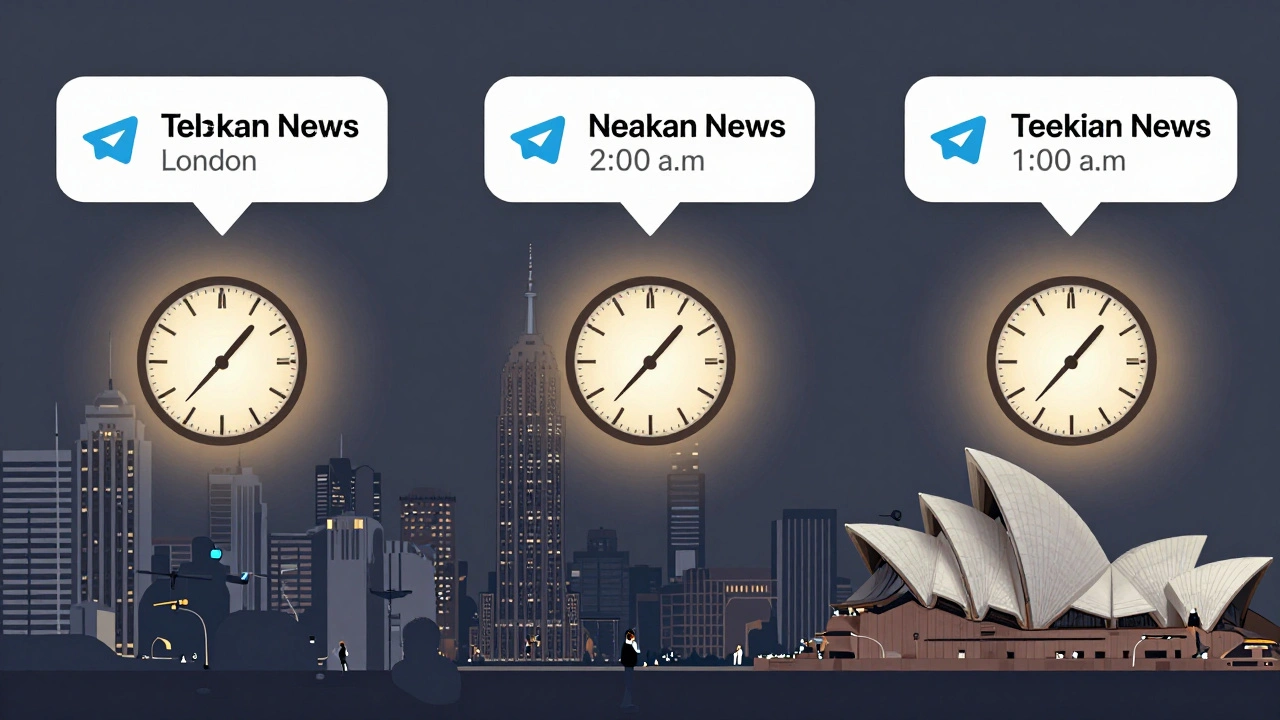
Newsrooms now use time-zone segmentation. A global outlet like BBC doesn’t send the same message to London, New York, and Sydney at the same time. They schedule localized bursts: 7:00 a.m. for London, 7:00 a.m. for New York (which is 12:00 p.m. in London), and so on. This isn’t automation-it’s strategy.
Breaking news? Send it immediately. But always follow up. A single alert without context gets ignored. A follow-up post 15 minutes later with a short explanation, a quote, or a map? That’s what turns subscribers into loyal readers.
What Makes a Telegram Post Work for News?
News on Telegram doesn’t live in long paragraphs. It lives in chunks.
The most effective posts have:
- A bold headline in all caps or with emoji (e.g., “BREAKING: POLICE CONFIRM ARREST”)
- One clear link to the full story
- A timestamp (e.g., “Updated at 6:42 a.m.”)
- Minimal formatting-no bold, no italics, no bullet points. Just clean text.
- A call to share at the end: “Forward to someone who needs to know.”
Visuals? Rarely used. Telegram users aren’t here for infographics. They’re here for speed. A screenshot of a press conference or a short video clip (under 15 seconds) works-but only if it adds something text can’t.
And never, ever copy-paste your website headline. Telegram readers hate that. Rewrite it. Shorten it. Punch it.
How Newsrooms Coordinate Across Platforms
Telegram doesn’t exist in a vacuum. The best newsrooms treat it as the frontline, not the afterthought.
Here’s how they sync:
- Website: The full story goes live on the site 10-15 minutes after the Telegram alert.
- Email newsletter: The morning digest is repurposed into the daily newsletter, with a note: “You got this on Telegram? Here’s the full version.”
- Twitter/X: A shortened version of the Telegram alert goes out, with a link back to Telegram: “For real-time updates, join our Telegram channel.”
- App push notifications: If the story is major, the mobile app sends a push-then immediately follows with a Telegram message.
This creates a feedback loop. People who see the alert on Telegram go to the website. People who read the website are reminded to join Telegram. It’s not a one-way broadcast-it’s a system.
What Fails on Telegram
Newsrooms that treat Telegram like a broadcast channel fail fast. Here’s what doesn’t work:
- Posting the same article across all platforms without adaptation
- Waiting hours to respond to comments or questions
- Using jargon like “developing story” or “source says” without context
- Ignoring time zones
- Posting during holidays or major events without acknowledging them
One outlet, The Daily Beast, tried posting 12 times a day for a week. Engagement dropped 40%. They realized they were drowning their audience in noise. They cut back to five targeted posts and added a weekly Q&A. Subscribers grew by 22% in two months.
Testing Your Own Cadence
Every audience is different. What works for a local paper in Ohio won’t work for a national outlet in California. Start here:
- Track your current posting schedule for two weeks.
- Use Telegram’s built-in stats (channel views, forward counts, link clicks).
- Try one new time slot per week: e.g., 6:00 a.m. on Monday, 7:30 p.m. on Thursday.
- Ask subscribers directly: “What time do you want updates?” Use polls.
- After four weeks, double down on what worked. Kill what didn’t.
No one has the perfect formula. But the winners? They test. They listen. And they never stop adjusting.
Telegram Isn’t a Platform. It’s a Relationship.
News on Telegram isn’t about virality. It’s about trust. If your audience knows they can count on you to show up at 7 a.m., they’ll stick with you through chaos, elections, disasters, and silence. That’s the real metric-not subscribers, not shares, not clicks. It’s reliability.
Build that. And the rest follows.
Latest Posts