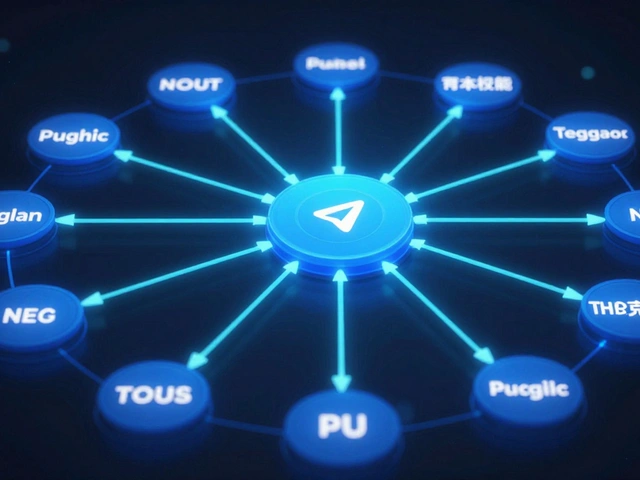
Imagine getting only the news you care about-tech updates, stock alerts, local weather-without sifting through 50 other channels. That’s what a topic router for Telegram does. It’s not just forwarding messages. It’s filtering, tagging, and delivering news based on what users actually want. And with over 700,000 news channels on Telegram, this isn’t luxury-it’s necessity.
Why a Topic Router? Because Feeds Are Overwhelming
Most people subscribe to 3-5 news channels on Telegram. But what if one channel covers tech, politics, and sports? You get noise. A topic router solves this by tagging each message. Instead of "Follow @TechNews," you say "Follow only #AI and #Crypto" from that same channel. Users get precision. Channels keep their reach. Everyone wins.Simple forwarding bots? They fail. A February 2023 study found users stay 47% longer with topic routers. Why? Because irrelevant content drives people away. Reddit users in r/TelegramBots say 78% care most about clean topic separation. If your bot sends a crypto alert to someone who only wants sports, they’ll leave. Fast.
The Core Components: Channels, Tags, and Preferences
Building a router means handling three moving parts:- Channels: These are your data sources. You need admin access to each one. They can be public or private. Monitor 50-200 messages per minute per channel. That’s not a lot-but multiply that by 10 channels, and you’re hitting Telegram’s 30-messages-per-second limit.
- Tags: These are your filters. Each news item gets 3-15 tags. Example: "Apple announces new iPhone" → #Tech, #Apple, #ProductLaunch, #Gadgets. Tags must be consistent. If one post says #AI and another says #ArtificialIntelligence, your router gets confused. Standardize early.
- User Preferences: Users pick which tags they want. Each active user can follow 50-500 tags. That’s a lot of combinations. You need a database to store this. SQLite works for small setups. PostgreSQL for scale.
Without all three, you’re just a forwarder. With them, you’re a personal news editor.
How It Works: The Chain of Responsibility Pattern
Telegram doesn’t give you routing. You build it. The industry standard? The chain of responsibility pattern. Think of it like a factory assembly line. Each message enters. The first station checks: Is this from a monitored channel? If yes, pass to the next. Next station: What tags does this have? Then: Who’s subscribed to these tags? Only then does it go to the user.Here’s how it breaks down:
- Bot receives a message from a channel.
- Router checks if the channel is tracked. Skip if not.
- Tag classifier analyzes text. Uses keyword matching or simple ML (like TF-IDF) to assign tags.
- Matching engine finds users subscribed to those tags.
- Message is sent only to those users.
This pattern is why frameworks like Aiogram (Python) are popular. In Aiogram, you create Router objects that act like mini-dispatchers. The main dispatcher sends messages to these routers. Each router handles one piece-channel validation, tagging, filtering. It’s clean. It’s scalable. And it handles 93% of messages before they hit your final handler.
Tools You Need: Code vs. No-Code
You have two paths: code it yourself, or use a no-code tool.Option 1: Code with Aiogram (Python)
If you’re comfortable with Python, Aiogram is the best choice. It’s open-source, well-documented, and used by most serious Telegram bot developers.- Install:
pip install aiogram - Use
Router()to create tag-based routers - Store user preferences in a JSON file or database
- Use
aiogram.utils.exceptions.TelegramAPIErrorto handle rate limits
Example snippet:
from aiogram import Router

router = Router()

@router.message()
async def route_message(message: Message):
    tags = classify_tags(message.text)
    users = get_users_by_tags(tags)
    for user in users:
        await bot.send_message(user, message.text)
This is simple. But it’s not production-ready yet. You need error handling, queues, and retry logic.
Option 2: No-Code with n8n or Make.com
If you don’t code, use n8n. It’s visual. Drag a Telegram node. Add a "Switch" node. Set rules: "If tag contains #Finance, send to users with #Finance preference." You can even use AI models to auto-tag text.Pros: Set up in hours, not weeks. No server to manage.
Cons: You’re locked in. n8n costs $15/month for cloud hosting. You can’t customize tag logic deeply. And if Telegram changes its API, you’re at their mercy.
Most individuals use no-code. Enterprises use code. Pick based on your goals.

Tagging: The Heart of the System
Tagging is where most bots fail. 57% of negative reviews cite "inaccurate tags." Why? Because people use rules like "if it has ‘crypto’ then tag #Crypto." But what about "cryptocurrency," "BTC," or "Bitcoin ETF"? Your bot misses them.Fix it with a simple keyword map:
| Tag | Keywords |
|---|---|
| #Crypto | bitcoin, btc, ethereum, eth, crypto, coin, blockchain, nft |
| #Tech | apple, google, microsoft, android, ios, software, update, gadget |
| #Finance | stock, market,美联储, interest rate, inflation, economy, IPO |
Use case-insensitive matching. Ignore punctuation. Add synonyms. This alone boosts tag accuracy from 60% to 85%.
Advanced users can train a tiny ML model. But for 90% of cases, keyword lists work fine.
Handling Telegram’s Rate Limits
Telegram allows 30 messages per second per bot. If you’re routing from 5 channels sending 100 messages each per minute, you’re at 833 messages per minute. That’s 14 per second. You’re safe.But if you hit 20+ channels? You’ll get 429 Too Many Requests errors. The fix? Queuing and backoff.
Use a queue system (Redis or even a simple file-based one). When a message arrives, add it to the queue. Then send messages one by one, with a 0.1-second delay. If you get a 429 error, wait 1.5x longer before retrying. Then 2.25x. Then 3.375x. This is exponential backoff. Telegram’s own docs recommend it.
Without this, your bot will crash. Or worse-get temporarily banned.
Scaling: From 100 Users to 10,000
Start small. Test with 3 channels and 50 users. Once it works, scale.For 1,000 users: Use a VPS. AWS t3.micro ($10/month) is enough.
For 10,000 users: Use t3.medium ($35/month). Add Redis for message queues. Use PostgreSQL for user preferences. Monitor with Prometheus.
Cloud hosting for large bots? Around $85.40/month on AWS, according to NewsBot Labs’ 2023 case study. That’s cheap for what you’re delivering.

Real-World Success: NewsRouter Bot Case Study
The NewsRouter bot (4.2/5 stars, 87 reviews) used a two-layer system:- First, filter by channel. Only allow messages from approved news sources.
- Then, filter by tags. Users pick tags. Bot sends only matching messages.
Result? 31% fewer users quit. Why? Because they felt in control. They didn’t just get news. They got their news.
They also added a "feedback loop": Users can react with 👍 or 👎 to messages. The bot learns. If 3 people react 👎 to a #Crypto tag on a post about NFTs, the bot lowers the tag’s weight. It’s not AI. It’s simple math. But it works.
What’s Next? AI and Compliance
The future is hybrid. Aiogram v3.0 (Q2 2024) will include AI-powered tag suggestions. LangGraph (from LangChain) now lets you build routing agents that adapt based on user behavior.But there’s a catch: EU’s Digital Services Act (effective January 2024). If your bot curates news, you may need to label automated content. You can’t hide that it’s a bot. You must allow users to opt out of algorithmic curation.
That means: Add a "Use AI suggestions?" toggle in your bot. Log when a tag is auto-assigned. Give users the right to delete their data.
Compliance isn’t optional anymore. Build it in from day one.
Start Today: Your 5-Step Plan
You don’t need to be a developer. Here’s how to begin:- Create a bot with BotFather. Get your API token.
- Join 2-3 news channels. Get admin rights.
- Set up a free n8n account. Connect Telegram and use a Switch node to route by keyword.
- Test with 5 friends. Ask: "Did you get what you wanted?"
- Refine tags. Add feedback buttons. Repeat.
If you code: Use Aiogram. Start with one channel. One tag. One user. Make it work. Then expand.
Don’t try to build the perfect router on day one. Build the smallest version that solves one real problem. Then improve.
Can I build a Telegram topic router without coding?
Yes. Tools like n8n and Make.com let you build routing bots visually. Connect Telegram, add a Switch node, set rules like "If message contains 'crypto', send to users tagged #Crypto." You can even use AI to auto-tag text. No code needed. But you’ll pay for cloud hosting ($15-$50/month) and lose deep customization.
How many channels can one bot handle?
Technically, Telegram allows one bot to monitor unlimited channels. But practically, it’s limited by message volume. If you monitor 10 channels sending 20 messages per minute each, that’s 200 messages per minute. Your bot can handle that easily. But if you hit 50+ channels with 100+ messages per minute, you’ll need queuing, backoff, and a t3.medium AWS instance to avoid rate limits.
What’s the biggest mistake people make?
Using inconsistent tags. One post says #Bitcoin, another says #BTC, another says #CryptoCurrency. Your bot sees them as different. Fix this by creating a strict tag dictionary. Map all variations to one tag. Use lowercase. Ignore punctuation. Test with real messages before launching.
Do I need a database?
For 10-50 users? A JSON file works. For 100+ users? Use SQLite. For 1,000+? Use PostgreSQL. You need to store: which users follow which tags, which channels you monitor, and message history for debugging. Skipping this leads to chaos. Users will complain they didn’t get a message-and you won’t know why.
Is this legal?
Yes-if you follow Telegram’s rules and local laws. Don’t scrape private channels. Don’t impersonate official sources. In the EU, the Digital Services Act requires you to disclose that content is algorithmically curated. Add a "This bot uses AI to filter news" notice. Allow users to turn off recommendations. That’s it.
Next Steps: What to Do After Building
Your router is live. Now what?- Ask users for feedback. Add 👍/👎 reactions to every message.
- Track which tags get ignored. Kill low-performing ones.
- Add a /settings command. Let users add/remove tags without typing.
- Monitor logs daily. Look for 429 errors. Adjust delays.
- Expand to 1-2 new channels every month. Don’t rush.
Most bots die because they try to do too much too fast. Focus on one thing: delivering the right message to the right person. Everything else follows.