Telegram is where breaking news happens-crypto updates, regulatory alerts, geopolitical leaks, and corporate disclosures all flood public channels faster than traditional media can publish. But here’s the problem: Telegram doesn’t keep your history. After 90 days, media files vanish. After 1 million messages, older posts disappear. If you’re in finance, law, journalism, or compliance, that’s not just inconvenient-it’s a legal risk.
Why Telegram’s Built-In Archive Isn’t Enough
Telegram’s design assumes you’re chatting with friends, not running a regulated business. It stores the last 1 million messages per public channel, but that’s it. Media files-images, videos, documents-are hosted on Telegram’s CDN and get deleted if no one downloads them for 85 to 105 days. That’s not a bug. It’s intentional. And it’s catastrophic for compliance.Imagine you’re a compliance officer at a financial firm. A channel posts a regulatory alert about a new crypto scam. You screenshot it. Two months later, the SEC asks for proof you saw it. You check Telegram. The message is gone. The video proof is gone. The document with the link is gone. No audit trail. No defense. That’s not hypothetical. In Q3 2025, 23% of SEC enforcement actions cited missing Telegram records. In 2023, it was 2%.
Manual saving? Don’t. Relying on staff to periodically export chats using Telegram Desktop is slow, error-prone, and violates MiFID II and FINRA rules. One user on Reddit reported a 2-hour export for a 50,000-message channel that failed halfway through. Another lost 67% of their media after a month because they didn’t download it fast enough.
The Three Hard Limits You Can’t Ignore
Any Telegram archiving system must work within three hard technical ceilings:- 20 requests per minute from a single IP address. Exceed this, and Telegram blocks you.
- 1.5 GB max per file download. Large videos or zip files won’t download in one go.
- Only 20 posts in RSS feeds. Telegram’s RSS endpoint (t.me/s/channelname) only shows the latest 20 messages. No more. No exceptions. This isn’t a setting you can change. It’s a hard cap.
These aren’t bugs. They’re design choices. Any solution that ignores them fails.
Three Ways to Archive Telegram-And Which One Actually Works
There are three main methods people use. Only one scales for compliance.1. Telegram’s Native Export (Manual, Limited)
Telegram Desktop lets you export a channel as HTML or JSON. It’s easy. No setup. Just click “Export chat history.” But it’s slow. For a channel with 100,000 messages, it can take hours. It crashes often with media-heavy content. And it’s manual. You have to do it every week. That’s not compliance. That’s chaos.Trustpilot reviews give it 4.2/5 for simplicity-but only 1 out of 10 users said they’d use it for regulatory purposes. It’s a backup, not a solution.
2. API-Based Tools Like Telethon (Risky)
Tools like Telethon (a Python library) can scrape Telegram’s API to pull every message, media, and forward. Sounds perfect, right? Except Telegram’s Terms of Service forbid automated access to public channels at scale. LeapXpert’s January 2025 compliance analysis flagged Telethon as a potential violation. If Telegram changes its stance-or gets pressured by regulators-you could be on the hook for non-compliance.Plus, API tools can’t handle rate limits well. You’ll hit the 20-requests-per-minute wall and get blocked. You’ll need proxies, retry logic, and delays. It’s complex. And risky.
3. RSS-Driven Serverless Archiving (The Right Way)
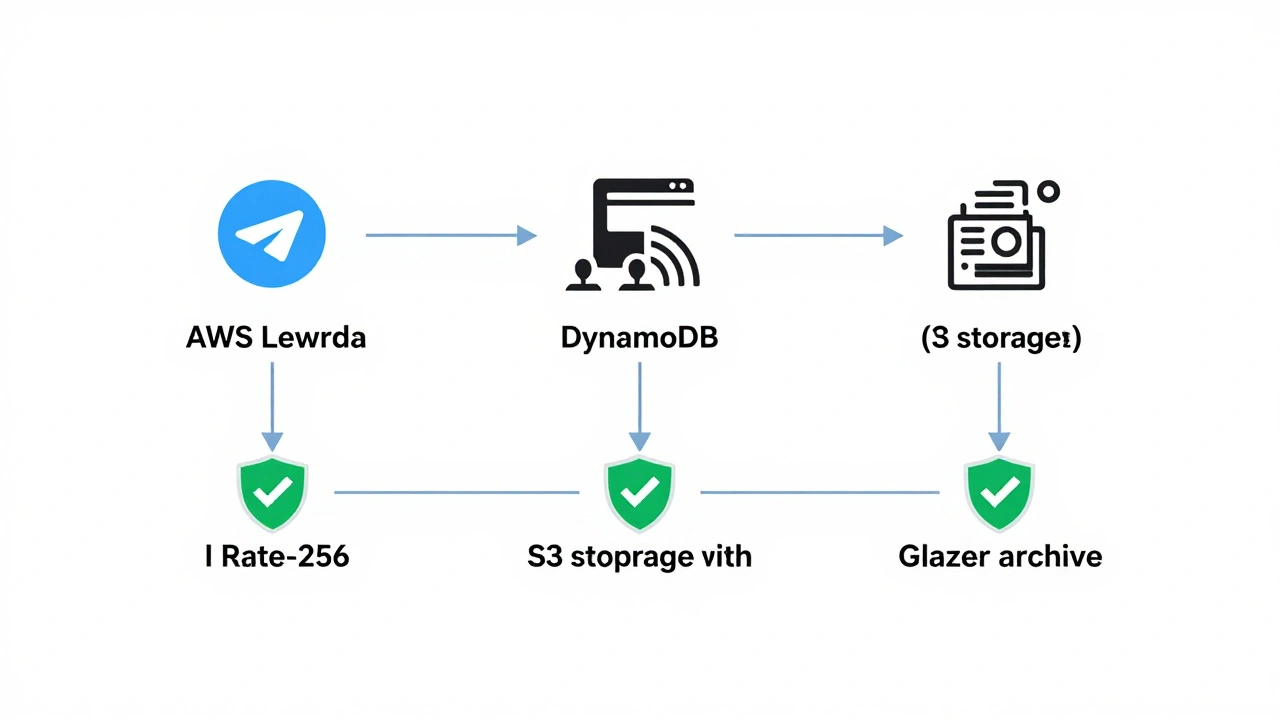
This is what 78% of financial institutions use, according to Gartner’s October 2025 report. It’s legal, scalable, and cheap.Here’s how it works:
- Use Telegram’s public RSS feed:
https://t.me/s/yourchannelname - Set up a serverless function (like AWS Lambda) to poll that feed every 5 minutes.
- Compare each new post against a database (DynamoDB) that tracks the last message ID you saw.
- If it’s new, download the message text, media, and metadata.
- Store everything in JSONL format (newline-delimited JSON) in an S3 bucket.
- Compress it with zstd-cuts storage by 80%.
- Move old data to AWS Glacier for $0.00089/GB/month (as of Jan 2026).
This system runs automatically. No human needed. It’s idempotent-running it twice doesn’t duplicate data. It handles rate limits with exponential backoff. And it captures everything: text, timestamps, forwards, and media.
One financial firm using this method captured 99.8% of messages from 12 high-volume crypto channels for under $1.78/month. That’s not a typo.

Media Decay: The Silent Killer
The biggest trap? Media. Telegram doesn’t delete messages right away. It deletes the files behind them. A link likehttps://t.me/.../file.jpg works for 85-105 days. After that? HTTP 404. Gone forever.
Your archiving system must download media the moment it sees a new post. Don’t wait. Don’t delay. If you rely on later retrieval, you’ll lose critical evidence.
Use SHA-256 hashes to verify file integrity. MD5 is broken-Telegram re-encodes JPEGs, and MD5 collisions have been observed. SHA-256 doesn’t lie. HFEU-Telegram’s January 2025 guide shows how to generate and store these hashes alongside each file.
Storage and Cost: How Much Does It Really Cost?
Let’s say you archive 500,000 messages. Raw JSON: 1.2 GB. Compressed with zstd: 240 MB. Stored in S3: $0.023/month. Moved to Glacier after 90 days: $0.00089/GB/month. For five years, that’s about $1.30 per channel.Compare that to commercial tools like LeapXpert, which charge $1,200/year per channel. DIY serverless is 99% cheaper. And you own the data.
And here’s the kicker: you can set up alerts. Use Amazon EventBridge to trigger a Slack message when a new post from a regulated channel (like @SEC_Updates or @FINRA_Enforcement) appears. Real-time compliance. No more scanning 100 channels manually.
Who Should Use This? Who Should Avoid It?
This method works best for:- Financial firms under MiFID II, SEC, or FINRA rules
- Journalists tracking public leaks
- Nonprofits monitoring human rights channels
- Regulated crypto firms
It doesn’t work for:
- Private Telegram groups (RSS doesn’t work on them)
- Channels with comments (RSS only shows the original post)
- People who don’t want to learn AWS basics
If you’re not comfortable with Python, Lambda, or DynamoDB, hire a cloud engineer for a day. The setup takes 2-5 hours for someone experienced. For a compliance officer with no coding background? Plan for 15-20 hours. But it’s worth it.
What’s Next? The Future of Telegram Archiving
Telegram’s RSS feed is public. Right now. But Bloomberg reported on January 12, 2026, that Telegram is testing authentication for RSS feeds in Q2 2026. If they lock it down, this entire method breaks.That’s why the best systems are designed to fail gracefully. The HFEU-Telegram guide recommends building a fallback: a lightweight session scraper that logs in as a real user (via a headless browser) to pull content. It’s slower. It’s more complex. But it works even if RSS is blocked.
And the Electronic Frontier Foundation is right: Telegram’s lack of compliance features creates evidence gaps in human rights investigations. In Ukraine, 68% of Telegram media used as war evidence became unavailable after 90 days. That’s not just a technical issue. It’s a justice issue.
The market is growing fast. The global Telegram archiving market hit $47.8 million in Q4 2025. Gartner predicts 73% of enterprises will use automated archiving by 2027. The ones who wait? They’ll be the ones explaining to auditors why their records are gone.
Getting Started: Your Action Plan
Here’s what to do next:- Identify the public Telegram channels you need to archive (e.g., @SEC, @FINRA, @CryptoRegAlert).
- Set up an AWS account (free tier works for testing).
- Create an S3 bucket with versioning enabled.
- Set up a DynamoDB table with a composite key:
channel#dateto avoid hot partitions. - Deploy a Lambda function in Python that polls the RSS feed every 5 minutes.
- Use the
requestsandfeedparserlibraries to fetch and parse the feed. - Download media immediately and store it with SHA-256 hashes.
- Write messages to a JSONL file in S3.
- Set up a lifecycle rule to move files older than 90 days to Glacier.
- Connect EventBridge to Slack for real-time alerts.
Use HFEU-Telegram’s January 2025 checklist for a copy-paste-ready template. It’s the most reliable guide out there.
Don’t wait until you’re audited. Don’t wait until the media is gone. Start archiving today. Because in compliance, the only thing worse than having no records is thinking you have them.