Imagine waking up to a flood of headlines. Most of them are noise-gossip about celebrities you don't follow, sports scores from teams you've never heard of, and market updates that have nothing to do with your portfolio. Now imagine opening your messaging app and seeing only three messages: a breakthrough in renewable energy, a policy change affecting your industry, and a tech launch you were tracking. That is the power of NLP topic tagging applied to Telegram news personalization.
This isn't just a theoretical concept anymore. Developers and data scientists are building architectures that combine automated topic detection with user-specific content delivery via Telegram bots. By using Natural Language Processing (NLP) to understand what a news article is actually about-and then matching that understanding to your specific interests-you can turn a chaotic information stream into a curated briefing. This guide breaks down how this system works, the technologies involved, and how you can build or implement it effectively in 2026.
The Core Architecture: How It All Connects
To understand how personalized news arrives in your chat, you need to look at the four main subsystems working behind the scenes. This architecture is not a single product but a composite pipeline that flows logically from data ingestion to user delivery.
- News Ingestion Layer: The system fetches raw content from sources like Google News APIs, RSS feeds, or specialized databases like GDELT (Global Database of Events, Language, and Tone).
- NLP Processing Pipeline: This is the brain. It cleans the text, extracts features, and assigns semantic tags to each article.
- User Modeling Engine: This component stores your preferences. It knows you care about "Climate Policy" and "AI Ethics" but ignore "Celebrity Gossip."
- Telegram Bot Frontend: The interface. It receives commands from you, queries the backend, and delivers filtered summaries directly to your chat.
The magic happens in the second step. Without accurate topic tagging, the bot would just be a dumb forwarder of links. With NLP, it understands context. For example, if you subscribe to "Electric Vehicles," a traditional keyword search might miss an article titled "New Battery Tech Boosts Range," because the words "electric" and "vehicle" aren't there. An NLP system using embeddings recognizes the semantic connection and includes it in your feed.
Building the NLP Topic Tagging Pipeline
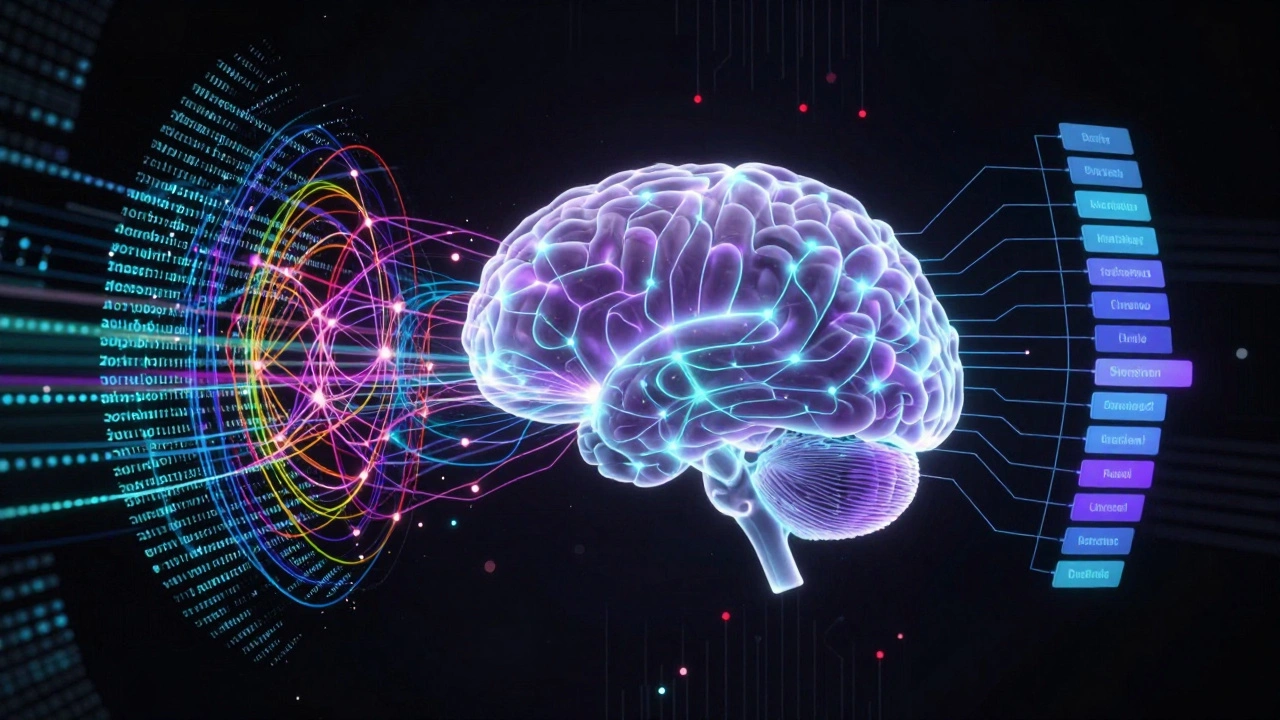
The heart of this system is the topic tagging pipeline. You can build this using Python, leveraging libraries like NLTK (Natural Language Toolkit) and sentence-transformers. Here is how the process typically unfolds, based on open-source implementations like the 'News-Summarization-Telegram-Bot' project.
1. Text Preprocessing
Before any AI can read an article, the text must be cleaned. This involves tokenization (breaking text into words), removing stopwords (common words like "the," "is," "and" that carry little meaning), and converting everything to lowercase. Libraries like NLTK handle this efficiently. If you skip this step, your model gets noisy data, leading to poor tag accuracy.
2. Feature Extraction and Embeddings
In the past, systems used Bag-of-Words or TF-IDF vectors to represent text. These methods count word frequency. While simple, they fail to capture meaning. Modern systems use S-BERT (Sentence-BERT) models to create dense vector representations.
Think of these embeddings as coordinates in a multi-dimensional space. Articles about similar topics land close together in this space. An article about "stock market crashes" and another about "financial panic" will have very similar vector coordinates, even if they share no common keywords. This allows for much more accurate topic clustering.
3. Topic Inference and Tag Assignment
Once you have embeddings, you need to assign tags. There are two main approaches:
- Unsupervised Learning (LDA/NMF): Algorithms like Latent Dirichlet Allocation (LDA) discover hidden topics within a large collection of documents without prior labeling. This is great for discovering emerging trends but can be unstable with short texts like headlines.
- Supervised Classification: You train a model on a labeled dataset where articles are already tagged with categories like "Politics," "Tech," or "Sports." This offers higher precision for known categories but requires significant effort to label training data initially.
For Telegram news bots, a hybrid approach often works best. Use embeddings for semantic similarity searches against user-defined keywords, and apply confidence thresholds to filter out low-relevance matches. This ensures that only high-quality, relevant articles make it to your inbox.
| Approach | Best For | Pros | Cons |
|---|---|---|---|
| Keyword Matching | Simple filters | Fast, easy to implement | Misses synonyms, context-blind |
| LDA / NMF | Discovering new trends | No labeled data needed | Struggles with short headlines |
| S-BERT Embeddings | Semantic personalization | Understands context and synonyms | Higher computational cost |
| LLM-Based Tagging | Complex reasoning | Highly accurate, nuanced | Expensive API costs, slower latency |

Integrating with the Telegram Bot API
The Telegram Bot API is surprisingly powerful for this use case. It’s not just about sending text; it’s about creating a conversational interface for preference management. Here is how the integration typically works in practice.
When a user starts the bot, they interact with inline keyboards to select their interest categories. The bot stores these preferences in a database, keyed by the user's unique Telegram ID. Every time new news is ingested and tagged, the system checks this database. If an article's tags match the user's selected categories, the bot formats a message-often including a concise summary generated by an LLM-and sends it via the API.
This setup allows for real-time push notifications. Unlike email newsletters that arrive once a day, a Telegram bot can deliver breaking news the moment it is verified and tagged. Users can also refine their preferences on the fly. If you suddenly lose interest in "Crypto,
Latest Posts