Most Telegram channel owners broadcast the same message to everyone. That’s a mistake. If you’re sending crypto updates to users in Tokyo, Lagos, and Toronto all at once, half your audience is reading it at 3 a.m. or ignoring it because it’s in the wrong language. Segmenting Telegram posts by region and audience isn’t just advanced-it’s the only way to get real engagement.
Telegram has over 900 million monthly active users as of early 2026. India alone accounts for more than 20% of them. Europe and Latin America each have tens of millions more. But here’s the catch: a post that goes viral in Brazil might get zero replies in Germany. Why? Time zones, language, culture, and behavior all differ. If you’re not segmenting, you’re wasting attention.
Start with the basics: location and language
Location is your first filter. You don’t need GPS data. Telegram bots can track user time zones based on when they interact. If 70% of your replies come between 7 p.m. and 10 p.m. UTC+5, you’ve got a strong cluster in India or Pakistan. If another 20% respond between 9 a.m. and 1 p.m. UTC-5, you’ve got users in the U.S. East Coast. Map those clusters. Then schedule posts to match.
Language matters just as much. If your channel is in English but 40% of your users are Spanish-speaking, you’re losing them. Use Telegram’s built-in translation tools or bots like Telegram Translate Bot a free automation tool that detects user language preferences and delivers messages in their native tongue. You can even create separate message threads for each language group. No need to send three versions manually-automate it.
Track behavior, not just demographics
Demographics tell you who they are. Behavior tells you what they care about. Look at three things:
- Click-through rates - Which links get clicked? Crypto price alerts? Event invites? Memes? Users who click on trading guides are different from those who only react to memes.
- Response frequency - Who replies every time? Who never responds? Tag your active users. Send them exclusive updates. Ignore the silent ones until you test something new.
- Message type engagement - Polls get 5x more replies than text posts. Videos get 3x more shares than images. Track what format works for each group. Then tailor your content accordingly.
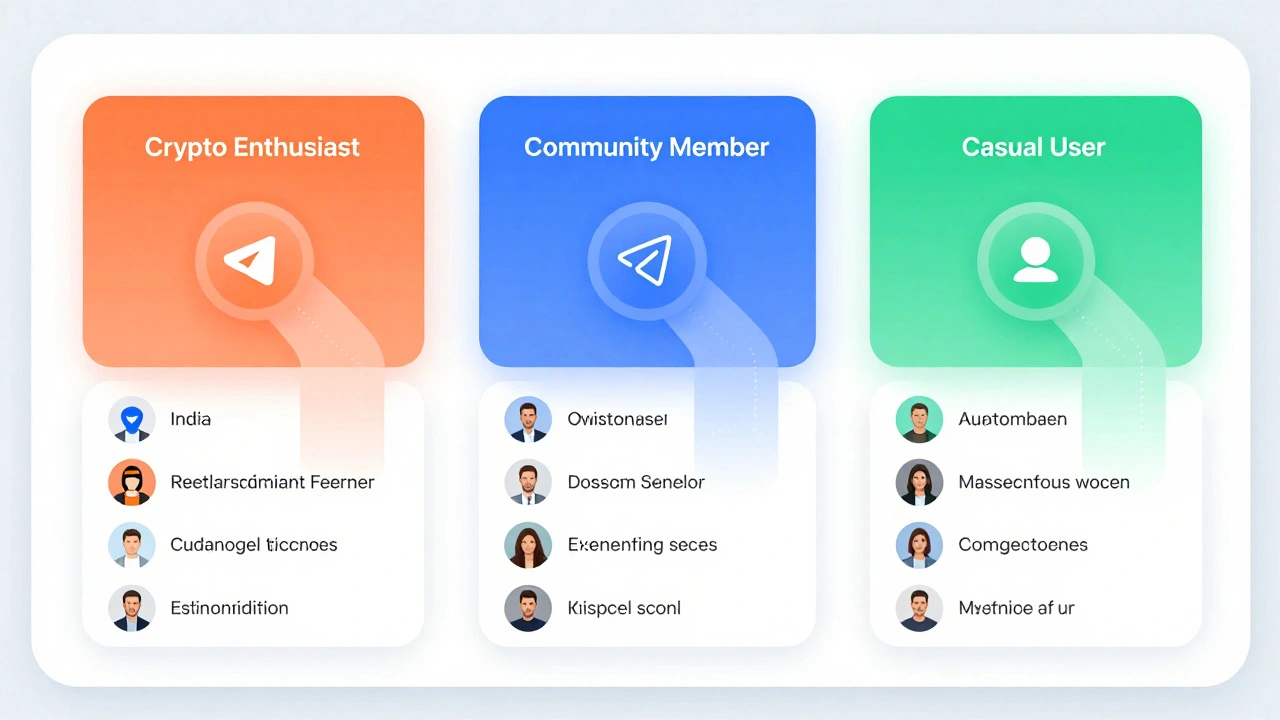
Use a simple spreadsheet or a free tool like CRMchat a platform that integrates with Telegram to tag users based on interaction history and behavioral patterns to auto-tag users. For example, if someone clicks three crypto links in a week, label them "Crypto Enthusiast." If they only reply to memes, label them "Community Member."
Schedule smart: time zones aren’t optional
You wouldn’t send a sales email at 2 a.m. in your own time zone. Why do it for your Telegram channel?
Here’s how to fix it:
- Export your message response data from Telegram’s analytics (available via bot logs or third-party tools).
- Group users by time zone: UTC+5 (Asia), UTC+1 (Europe), UTC-5 (Americas), UTC+8 (Southeast Asia).
- Schedule posts for peak hours in each zone: 7-9 p.m. for Asia, 12-2 p.m. for Europe, 6-8 p.m. for the U.S.
- Use a bot like Make (formerly Integromat) an automation platform that connects Telegram to calendar tools and triggers scheduled messages based on user location to auto-send messages at the right time for each group.
One channel I’ve seen increased open rates by 68% just by stopping global broadcasts and switching to region-specific timing. They stopped posting at 12 p.m. UTC and started sending tailored messages at 8 p.m. in India, 1 p.m. in Spain, and 7 p.m. in Mexico. Engagement jumped overnight.
Localize content-not just language
Translating "Happy New Year!" into Spanish doesn’t help if your audience in Mexico is celebrating Día de los Muertos next week. Cultural context matters more than translation.
Do this:
- Check local holidays. Use a calendar API to auto-schedule region-specific posts.
- Use local references. A meme about snow won’t land in Brazil. A meme about rain during monsoon season will.
- Adapt humor. Sarcasm works in the U.S. but falls flat in Japan. Use simple, visual humor for broader appeal.
- Highlight local events. If you run a tech channel, mention local meetups or regulatory changes in each region.
One travel channel I analyzed posted daily updates in English. Then they started creating weekly regional digests: "Top 5 Beaches in Thailand This Month," "Best Cafes in Medellín," "How to Use Public Transit in Istanbul." Their retention rate doubled. Why? People felt seen.
Use automation to scale
You can’t manually segment 10,000 users. You need bots.
Here’s the simplest setup:
- Telegram Bot API - Use it to track user interactions and assign tags.
- Zapier or Make - Connect Telegram to Google Sheets or Airtable to auto-update user segments.
- Custom message templates - Create 3-5 versions of your standard post: one for crypto fans, one for casual users, one for new members.
- Auto-scheduler - Use a tool like Telegram Scheduler Bot a free automation tool that sends messages at pre-set times based on user time zones and behavior tags to deliver the right template to the right group.
Example: A user joins your channel, clicks on a Bitcoin link, and replies "Thanks!" in Spanish. Your bot tags them as: Language: Spanish, Interest: Crypto, Activity: High. The next time you post about Bitcoin, they get a Spanish version with a price chart and a link to a local exchange. No manual work. Just automation.
Test, measure, repeat
Segmentation isn’t a one-time setup. It’s a loop.
Every two weeks, ask yourself:
- Which segment had the highest click-through rate?
- Which group stopped responding?
- Did a new region pop up in your analytics?
Adjust your tags. Tweak your timing. Update your templates. One channel I know updates their segments every 14 days. Their growth rate has been steady at 12% monthly for the last year. Others who post the same message to everyone? Their growth flatlined after three months.
Don’t just broadcast. Listen. Adapt. Repeat.