Why Telegram News Channels Are Switching to Series and Recaps
Most news channels on Telegram post breaking updates and hope for the best. But the top ones? They don’t just report news-they tell stories. And they do it using series and recaps to turn casual followers into loyal subscribers.
It’s not magic. It’s structure. A 2023 study of Russia’s top three Telegram news channels found that those using weekly recaps kept 37% more subscribers than those posting only daily headlines. Those recaps also got 2.3 times more shares. Why? Because people don’t want noise. They want context. They want to know how yesterday’s event connects to tomorrow’s.
Telegram isn’t Twitter. Threads there break after three parts. WhatsApp broadcasts can’t organize content. But Telegram lets you build narrative arcs-over days, weeks, even months. And the best channels are learning how to use it.
The Anatomy of a Successful News Series
A great news series isn’t just splitting one story into five parts. It’s a carefully paced journey. The most effective ones follow a simple pattern: three to five installments, spaced 24 to 48 hours apart.
Each part needs three things:
- A clear headline that tells readers where they are: “Part 3 of 5: How the New Tax Law Hits Small Businesses”
- A direct link to the last part so readers don’t get lost
- A teaser for the next part-something that makes them want to come back
Take “The Week Ahead,” a channel that grew from 12,000 to 87,000 subscribers in six months. Their Monday-to-Friday series on policy changes always ended with a teaser like: “Friday’s breakdown will show you exactly which industries will get hit hardest-and who’s already preparing.” That’s not just promotion. That’s storytelling.
And they didn’t stop there. Every Sunday, they sent a recap: the top five stories of the week, with analysis, not just summaries. Users called it “the only news I actually read.”
Recaps Are the Secret Weapon
Recaps aren’t summaries. They’re narrative glue.
Most channels send recaps as a list: “Here’s what happened.” The best ones send them as a story: “Here’s what it all means.”
Research from Junction Bot shows that recaps with 3-5 key stories and expert commentary get 68% more engagement than those listing 15+ items. Why? Because overload kills attention. People don’t want everything. They want what matters.
Also, timing matters. The highest open rates happen on Sunday evenings or Monday mornings. That’s when people are catching up before the week starts. Channels that send recaps at 8 AM local time (using bots like Newsmate) see 19% higher completion rates.
One user on Reddit said: “I used to get overwhelmed by 20 news alerts a day. Now I get one Sunday recap that connects the dots. I actually feel informed.” That’s the goal.

How to Organize Series with Telegram Topics
If your channel has over 10,000 subscribers, you get access to Telegram Topics. Most channels ignore this. The smart ones use it to turn chaos into clarity.
Think of Topics like folders in a filing cabinet. Business news channels use 5-6 Topics: “Market Analysis,” “Executive Moves,” “Policy Changes,” “Tech Disruptions,” “Global Impact.”
When you post Part 2 of a series on tax reform, you put it in “Policy Changes.” The next part? Same Topic. Readers can click in and see the whole arc. No scrolling through 50 unrelated posts.
Telegram’s own data says channels using Topics for series see 27% more message views. And it’s not just about organization-it’s about discovery. New followers can jump into a series mid-way and still follow along because everything’s labeled.
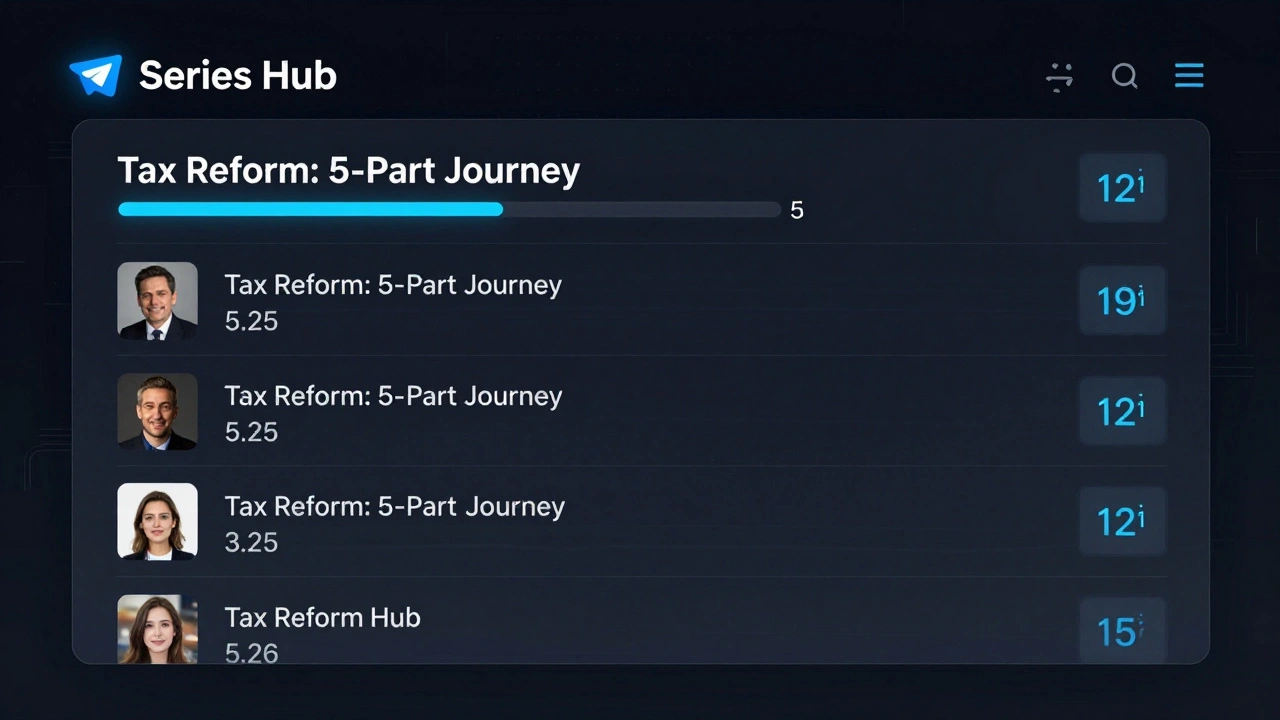
Top-performing channels pin a “Series Hub” message at the top of their channel. It lists all active series with links, part numbers, and expected release dates. It’s like a TV schedule for news.
The Tech Behind the Scenes
You don’t need to be a coder to use series and recaps-but you do need the right tools.
Most channels use bots. Newsmate, built by TwoSetAI, is the most popular. It pulls news from CNN, BBC, Reuters, and others. It reads 1,200 articles an hour. It filters by keywords. Then it sends out a personalized digest every morning at 7-9 AM-when people check their phones.
For advanced users, Telegram Bot API version 6.9 (released September 2025) lets you connect to your own content system. You can auto-schedule posts, tag series parts, and even trigger recaps based on calendar events. But it takes about 80 hours of setup. Only big channels bother.
Small channels? Start simple. Use Telegram’s built-in scheduling. Write your five parts in advance. Schedule them one day apart. Use a free tool like CronTab or Google Calendar to remind you when to post.
And don’t forget Instant View. If you link to full articles, make sure they’re formatted properly. Telegram’s rules say you can only add one “related articles” block at the end. So pick wisely. Link to the next part in your series.
What Happens When You Do It Wrong
Not every series works. Some fail hard.
A 2026 study found that 41% of news series lose quality by the third part. Why? Creators stretch thin stories to hit a five-part target. They add fluff. They invent tension. And subscribers notice.
One user wrote: “They turned a simple price hike into a five-day thriller. By day three, I was just waiting for the fake cliffhanger. I muted them.”
That’s why experts warn against artificial prolongation. The Journalists’ Union of Russia’s 2025 guidelines say: “Narrative tension must come from real developments, not made-up drama.” Channels that broke this rule saw 29% subscriber drops.
Another mistake? No navigation. If you don’t say “Part 2 of 5,” people won’t know where they are. A 2025 test with 500 users showed 73% needed clear part indicators. Without them, 78% gave up on multi-part stories.
And don’t ignore feedback. If your audience says “too long,” shorten it. If they ask “when’s the next part?”-you’re doing something right.
How to Start (Even If You’re New)
You don’t need a team. You don’t need a budget. You just need a plan.
Here’s how to begin:
- Pick one story that’s unfolding-maybe a new law, a company merger, or a protest movement. Something with layers.
- Break it into 3-5 parts. Each part should answer one question: What happened? Why does it matter? Who’s affected? What’s next?
- Write all parts in advance. Schedule them to post every other day.
- End each part with a teaser. “Tomorrow: How this affects your paycheck.”
- Send a recap after the last part. Summarize the whole arc. Add your take. Link to the full series.
- Pin a message with the series title and links to each part.
It takes 40-60 hours to set up your first series. But once it’s live, you’ll see the difference. Subscribers stay longer. They comment more. They share it.
And that’s the whole point.
What’s Next for Telegram News
Telegram is getting smarter about storytelling.
In January 2026, they rolled out “Series Progress” indicators-little bars that show users how far along they are in a series. Early data shows 19% more people finish the full story when they can see their progress.
By Q2 2026, they’re launching “Narrative Threads,” which will let you link related posts across weeks. Imagine a series on climate policy that connects a post from March to one in June. That’s the future.
Meanwhile, AI tools are coming. Newsmate’s beta feature, launching March 2026, will flag when your series lacks real developments. It’ll say: “Part 4 feels repetitive. Add a new source or insight.”
But the biggest risk isn’t tech. It’s trust. As journalist Anna Kovalenko said at the January 2026 Digital Media Summit: “When every news item becomes a five-part series, we risk teaching audiences to expect drama where none exists.”
That’s why the best channels don’t just use series-they earn it. They wait for stories that deserve to be told in parts. They don’t force it. They respect their audience enough to let the truth unfold.
Final Thought: Don’t Just Report. Connect.
Telegram isn’t a broadcast tower. It’s a conversation. And the most successful news channels aren’t the ones with the most posts. They’re the ones who make you feel like you’re part of the story.
Use series to build momentum. Use recaps to bring meaning. Don’t just tell people what happened. Show them why it matters-and what comes next.
That’s not journalism. That’s narrative leadership. And it’s working.
Latest Posts