Forget the boring "Yes/No" buttons we've seen in chat apps for a decade. Imagine opening a news channel on Telegram and finding a live, breathing digital twin of your city. You don't just vote on a policy; you trigger a simulation where thousands of AI personas-each with their own biases, job history, and political leanings-react to that policy in real-time. You can watch the sentiment shift, ask a specific virtual voter why they changed their mind, and see a predicted election result update instantly. This isn't science fiction; it's the shift toward interactive simulations in digital news.
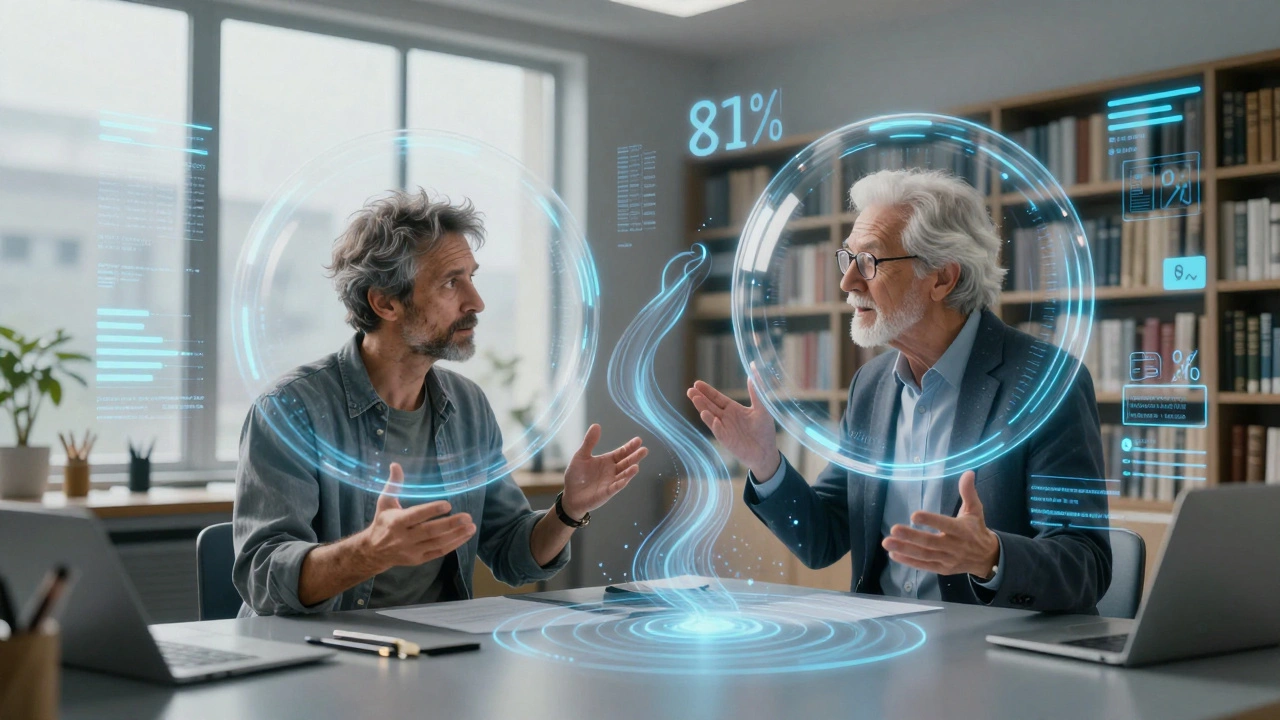
For years, we've relied on traditional polling, which is essentially a snapshot of the past. By the time a poll is conducted and published, the public mood has often already shifted. But we are entering the era of multi-agent simulation. Instead of asking 1,000 people what they think, developers are building virtual publics. These are thousands of AI agents designed to mimic real human demographics. When you feed a news story or a policy draft into these systems, the AI agents don't just give a generic answer-they argue, persuade each other, and evolve, providing a forecast of how a real population might actually behave.
The Tech Behind the Virtual Voter
The engine driving this change is Multi-agent simulation is a technology that creates virtual populations of AI personas with diverse personalities and biases to predict collective human behavior. . In the past, running these simulations was a luxury for big labs because the computational cost was astronomical. Now, the cost of running thousands of agents simultaneously has plummeted from hundreds of dollars to just tens of dollars. This price drop has opened the floodgates for developers to integrate these tools directly into platforms like Telegram.
Take MiroFish, a platform that went viral on GitHub in early 2026. It creates parallel virtual worlds. If a news channel posts a new tax proposal, MiroFish can seed that document into a simulation. It automatically generates personas-say, a struggling small business owner and a wealthy retiree-and lets them interact. The result isn't just a percentage; it's a detailed report on how the sentiment evolved over the discussion cycle. You can even engage in a one-on-one chat with a virtual agent, asking, "What specifically about this tax plan makes you feel pessimistic?"
| Platform | Primary Focus | Key Strength | Notable Validation |
|---|---|---|---|
| MiroFish | Collective Intelligence | Open-source, real-time variable injection | GitHub Global Trending (March 2026) |
| Aaru | Consumer & Political Behavior | Eliminates social desirability bias | Predicted 2024 NY Primary within 371 votes |
| Simile | Decision-Making Patterns | High-fidelity human cloning | Backed by Andrej Karpathy |
Why Telegram is the Perfect Lab
Why is this happening in Telegram and not just on a standalone website? Because Telegram is where political discourse actually happens in real-time. During the 2024 Brazilian elections, researchers found that Telegram news travels in "constellations." Some are nuclear, tightly packed around a campaign, while others are bipolar, creating ideological bubbles where people only hear what they already believe. By embedding simulations into these channels, news providers can break those bubbles. Instead of just showing a poll, they can show a simulation of how the "other side" is reacting to a piece of news.
Furthermore, Aaru is an AI simulation platform that extracts thousands of demographic-specific responses in minutes, bypassing traditional survey delays. can generate a virtual consumer-for example, a conservative 50-year-old father in Seoul-and predict his reaction to a policy in seconds. When this is integrated into a Telegram bot, a news editor can test three different headlines against a virtual audience before posting the one most likely to resonate, or conversely, the one most likely to spark a productive debate.
Breaking the "Social Lie"
One of the biggest headaches in traditional polling is "social desirability bias." This is when people lie to pollsters because they want to seem like a better person or follow social norms. For example, someone might say they support a green energy initiative in a survey but vote against it in the booth. AI agents don't have egos. They are programmed with raw biases and historical data. If an agent is designed to be a skeptical industrialist, it will act like one, regardless of whether that's "socially acceptable."
This honesty is why the predictive accuracy is skyrocketing. When you clone AI agents from real-world interviews-as seen in studies where 1,052 Americans were mirrored by AI-the agents replicate human patterns with startling precision. This allows Telegram news channels to move from "Reporting the News" to "Simulating the Impact."

The Limits: Where AI Hits a Wall
It sounds like a crystal ball, but it isn't. There are a few things these simulations still can't do. First, AI lacks physical sensation. An AI agent can simulate a person's reaction to the *idea* of a new electric car, but it can't feel the comfort of the seats or the smell of the interior. If a political movement is based on a visceral, physical feeling of a place or a product, the simulation will miss it.
Then there's the "Trump Factor." Predictors struggle with erratic, unpredictable human behavior that deviates from historical patterns. If a leader does something completely unprecedented-a "Black Swan" event-the AI agent, which relies on training data, will likely guess wrong. These tools are better for exploring probabilities ("If X happens, Y is likely") rather than claiming an absolute future.
What to Expect in 2026
With the South Korean local elections in June and the U.S. midterms in November, we're about to see a massive surge in these tools. We'll likely see Telegram news bots that allow you to "Stress Test" a policy. You'll enter a proposal, and the bot will run it through a simulation of 10,000 virtual voters and give you a heat map of the reaction. This turns the news from a passive reading experience into an active laboratory for civic engagement.
Traditional giants are already pivoting. Nielsen has introduced the BASES AI Screener, and Ipsos developed Personabot to allow real-time conversations with virtual consumers. The goal is the same: move faster and be more accurate than a phone call ever could be.
Will AI simulations replace real human polls?
Not entirely, but they will change the role of human polls. Humans will likely be used to "tune" the AI agents, providing the initial raw data that allows the AI to create accurate clones. The simulation handles the scale and speed, while humans provide the ground truth.
Can these simulations be manipulated?
Yes. The accuracy of a simulation depends on the "seed" data. If a news organization uses biased personas or excludes certain demographics, the simulation will produce a skewed result. Transparency in how personas are built is the only way to ensure credibility.
How does this work inside Telegram?
Typically, this is implemented through Telegram bots. A user interacts with the bot, which is connected via API to a simulation engine like MiroFish or Aaru. The bot then pushes the simulation results back into the chat as interactive charts, reports, or even chat interfaces with the agents.
Is my data safe if I use these interactive polls?
The simulations themselves use virtual personas, not necessarily your personal data. However, the bots collecting your interactions are subject to the privacy policies of the bot creator and Telegram's own encryption and data standards.
What is a 'Black Swan' event in AI polling?
A Black Swan is an event so rare and unpredictable that no historical data can account for it. Since AI simulations are trained on past behavior, they cannot predict a totally new type of political upheaval or a sudden, erratic shift in a leader's behavior that has no precedent.
Latest Posts