Telegram isn’t just a messaging app anymore. By 2026, it’s become one of the most powerful - and dangerous - platforms for spreading false information. Newsrooms around the world are scrambling to keep up. Reporters rely on Telegram to find breaking news, track government statements, and connect with sources. But the same channels that share legitimate updates also flood users with fake job offers, deepfake audio of journalists, and state-backed propaganda disguised as independent reporting. The result? A growing crisis where verifying truth takes more time, money, and risk than ever before.
Telegram’s Design Makes Misinformation Easy to Spread
Telegram’s architecture was built for privacy, not accountability. It allows channels with up to 200,000 members, and there are no public algorithms to prioritize or filter content. Unlike Facebook or Twitter, there’s no feed, no trending list, no warning labels. If someone posts a lie, it reaches thousands instantly - and there’s no way to trace who shared it or how far it went.A 2025 study from the Turing Institute analyzed 200,000 Telegram posts and found something surprising: misinformation doesn’t spread to everyone. It stays within small, tight-knit networks. But those networks are highly active. A single channel with 5,000 members can reroute false claims to dozens of larger groups, making it look like a viral trend when it’s really a coordinated push. Newsrooms can’t just monitor big channels - they have to track dozens of obscure ones, often in different languages, just to catch a single lie before it gets picked up by mainstream outlets.
Impersonation Is Now an AI-Powered Industry
Scammers on Telegram aren’t using basic templates anymore. They’re using AI to create fake journalists, editors, and PR reps. Deepfake voices mimic the tone of well-known reporters. AI-written messages copy the exact style of a newsroom’s official communications. One U.S. news organization received a message in February 2026 from someone claiming to be their own bureau chief, asking for an exclusive interview with a whistleblower. The voice matched perfectly. The photo was real. The request? A wire transfer to "verify" the source’s identity.These aren’t isolated cases. A 2025 report from cybersecurity firm Kaspersky showed a 300% increase in AI-driven impersonation scams targeting media organizations. Scammers use stolen logos, fake LinkedIn profiles, and even cloned websites to build trust. Once they get a journalist to engage, they extract contact lists, internal reporting systems, or sensitive documents. For newsrooms, this isn’t just about losing data - it’s about losing credibility. If readers think a reporter was tricked into publishing a fake story, trust erodes fast.
Disinformation Networks Are Organized Like Corporations
Russian state-backed disinformation campaigns have turned Telegram into a global broadcasting tool. After the EU banned RT in 2022, Russian operators didn’t disappear - they just moved. New Telegram channels labeled "MT" (for "Mirror of RT") began reposting Russian state content in English, French, German, and Spanish. These channels have small audiences - around 15,500 subscribers total - but they’re fed into larger pro-Kremlin networks that have millions. The goal isn’t to convince everyone. It’s to make people doubt what they see in official media.Newsrooms now have to verify not just the content, but the source’s origin. Was this claim first posted on a Russian channel? Did it get amplified by a Ukrainian activist group? Or is it a bot network pushing the same message across 20 different channels? The complexity has turned fact-checking into a full-time intelligence operation.
Scam Marketplaces Are Thriving on Telegram
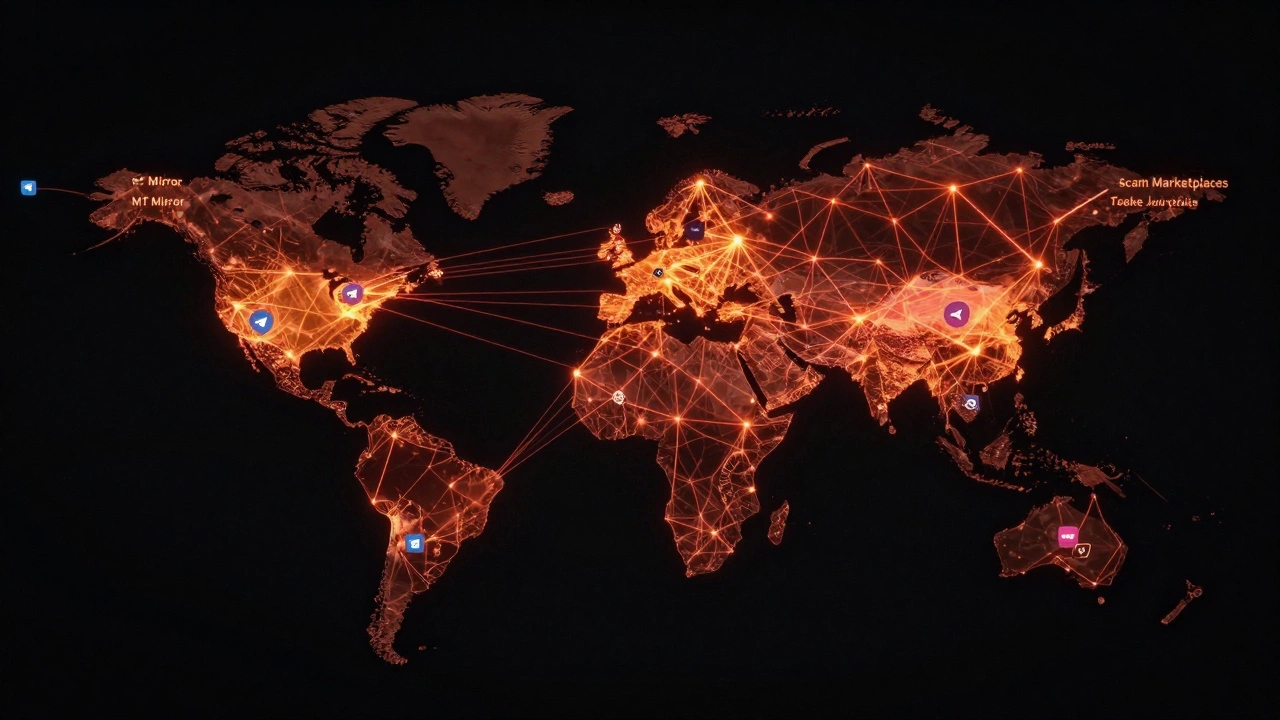
Telegram isn’t just about lies - it’s about money. In 2025, Telegram accounted for 40% of all scam activity across messaging apps, according to global fraud monitoring groups. There are entire marketplaces on the platform where scammers sell stolen login credentials, fake bank account details, and "sucker lists" - databases of people who’ve already been scammed and are easy targets.One newsroom in Spain reported that a reporter’s personal Telegram account was hacked after clicking a link in a group chat. The hacker used it to send fake job offers to other journalists, tricking them into sharing internal contact lists. The scam generated over $200,000 in losses across three countries. Banking institutions are now flagging any transaction linked to Telegram. Revolut, a major digital bank, saw a 230% spike in fraud tied to Telegram in late 2025. Now, if a source says they sent you money via a Telegram link, banks may freeze the transaction - and the reporter’s access to that source.
Newsrooms Are Forced to Become Cybersecurity Teams
The biggest shift? Newsrooms can’t just hire reporters anymore. They need IT staff, digital forensics experts, and cybersecurity analysts. Many small newsrooms now spend more on software to scan Telegram links than they do on travel budgets. Tools like Malwarebytes, Telegram-specific scrapers, and AI-powered fact-checking bots have become standard equipment.But even these tools have limits. Malware distributed through Telegram often hides in fake apps that claim to be "security tools" or "wallet verifiers." Journalists who install them unknowingly give attackers full access to their devices. In one case, a reporter in Germany lost access to her entire newsroom’s editorial system after clicking a link that looked like a shared Google Doc. The malware spread to 17 devices before it was detected.
Regulators Are Lagging - and Sometimes Making Things Worse
Governments are trying to act, but their efforts are clumsy. In March 2026, Russia began throttling Telegram’s speeds over alleged non-compliance with local laws. In February, Spain accused Telegram of spreading misinformation after Pavel Durov sent a message to users criticizing new digital media laws. Both actions backfire. When a government blocks a platform, it makes the platform seem more trustworthy to people who already distrust official sources.And there’s no global standard. The EU has rules. The U.S. doesn’t. India bans some channels. Brazil doesn’t. Newsrooms operating across borders have to navigate 10 different legal systems just to report on one story. There’s no playbook. No clear line between censorship and protection.
What Newsrooms Can Do - And What They Can’t
There’s no magic fix. Telegram won’t change. It doesn’t want to. Its core users value privacy over safety. That means newsrooms can’t rely on the platform to clean up its own mess.What works? Targeted monitoring. Instead of trying to track every channel, newsrooms are focusing on the top 50 that consistently spread verified falsehoods. They’re building internal databases of known scammer handles, fake journalist profiles, and suspicious link patterns. They’re training staff to spot AI-generated speech - unnatural pauses, robotic tone shifts, mismatched emotional cues.
They’re also working with banks. Some newsrooms now require sources to use verified payment channels before sharing sensitive information. No more "I sent you the documents via Telegram link." It’s too risky.
But none of this is cheap. It’s slow. And it’s exhausting. Journalists who used to focus on interviews and investigations now spend half their day verifying links, checking metadata, and warning colleagues not to click on "urgent" messages.
There’s no victory lap here. The fight against misinformation on Telegram isn’t about winning. It’s about surviving - one verified fact at a time.