Imagine scrolling through your favorite Telegram is a cloud-based instant messaging and voIP service that provides end-to-end encryption and supports large groups channel. A headline flashes: "Major Earthquake Hits Coast." Your heart races. You share it immediately. Ten minutes later, another message arrives: "False Alarm; Sensor Glitch." The embarrassment is real. The damage to your credibility? Even worse.
This scenario plays out thousands of times daily on Telegram. With over 1.2 million active news channels as of early 2025, the platform has become a double-edged sword. It offers speed, but at the cost of accuracy. Research from 2020 showed that junk news sources accounted for 33% of views across prominent news channels. That number hasn't gone down; it’s evolved. To survive in this noisy environment, you can’t rely on gut feeling. You need multi-source confirmation rules are structured verification protocols that require cross-validation of information across multiple independent channels before classifying content as verified breaking news. These aren't just nice-to-have guidelines anymore. They are the backbone of credible digital journalism.
Why Single-Source Verification Fails on Telegram
You might think, "I trust this source. Why check others?" Because trust isn't enough when algorithms and bots drive distribution. Telegram’s architecture allows anyone to create a channel with minimal friction. This openness fuels rapid dissemination but also enables malicious actors to flood the zone with noise. During the Hong Kong protests in 2019 and the Belarusian elections in 2020, unverified claims spread faster than facts could catch up. The result? Public confusion and eroded trust in legitimate media.
Single-source verification leaves you vulnerable to three major risks:
- Syndication Loops: One outlet picks up a rumor, and five others copy it without checking. Suddenly, a lie looks like consensus.
- Bot Amplification: Automated accounts can artificially inflate engagement metrics, making fake stories appear trending.
- Context Collapse: A true statement taken out of context can mislead audiences just as effectively as a falsehood.
Dr. Claire Wardle, co-founder of First Draft, puts it bluntly: "Multi-source confirmation isn't optional for Telegram news verification." Her point is simple. If you want to be trusted, you must verify beyond the first signal you receive.
The Core Components of Multi-Source Confirmation
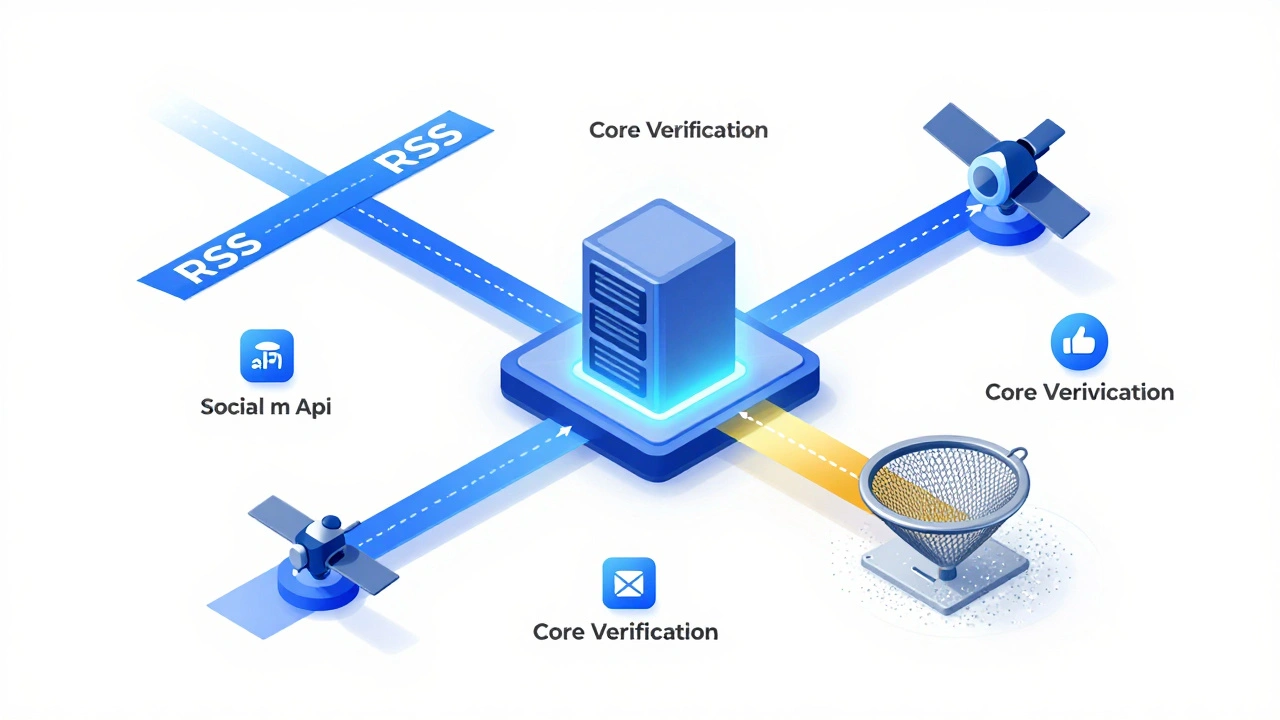
So, what does a robust verification system actually look like? It’s not magic. It’s engineering. At its heart, multi-source confirmation relies on a three-tier architecture designed to filter noise and confirm signals. Let’s break down how these systems work under the hood.
1. Primary Source Ingestion
Your system needs eyes everywhere. This means ingesting data from diverse feeds: RSS streams, official press releases, social media APIs, and even internal dashboards. The goal is diversity. Don’t just watch ten channels from the same network. Watch independent outlets, wire services, and local reporters. Tencent’s OpenClaw team recommends maintaining at least 15-25 independent sources to ensure coverage during major events.
2. Duplicate Detection and Deduplication
Once you have the data, you need to clean it. Most news stories get reposted dozens of times within minutes. How do you know if two posts are the same story or different angles? Systems use SHA-256 content similarity hashing. If the hash matches above a 95% threshold, it’s likely a duplicate. Tools like spaCy NLP models help extract entities (names, places, dates) to compare the core facts, achieving an 87.3% F1 score in recent tests. This prevents your system from counting the same rumor from five sources as five confirmations.
3. Confidence Scoring Algorithms
This is where the math kicks in. Not all sources are equal. A Reuters report carries more weight than an anonymous blog post. Modern systems calculate a verification score using a weighted formula:
(Source Reliability × 0.4) + (Cross-Source Confirmation × 0.5) + (Temporal Consistency × 0.1)
Here’s how it works:
- Source Reliability: Measured on a 0-100 scale based on historical accuracy. Has this source been wrong before?
- Cross-Source Confirmation: Do at least two independent, unrelated sources report the same fact?
- Temporal Consistency: Did the reports happen around the same time? If one source posted at 10:00 AM and another at 2:00 PM, there’s a gap that needs investigation.
When the score crosses a certain threshold-usually set by the administrator-the system flags the news as "Verified."
Automated vs. Manual Verification: The Hybrid Approach
Can AI replace human editors? Short answer: No. Long answer: AI makes humans better. Purely automated systems using models like Meta’s Llama-3-70B achieve about 78.4% accuracy. That sounds good until you realize that 21.6% error rate can destroy a news brand. Properly implemented multi-source systems, however, hit 92.7% accuracy according to the Oxford Internet Institute in late 2025.
But even 92.7% isn’t perfect. That’s why the gold standard is a hybrid model. Automation handles the heavy lifting-ingesting feeds, deduplicating, and scoring. Humans handle the nuance. Professor Philip N. Howard warns against "false confidence" from automation. Context matters. Is a photo from today or last year? Is a quote taken out of context? Machines struggle with these subtleties.
Consider the @BreakingNewsUA channel during the 2025 Black Sea conflict. They maintained 98.7% accuracy by combining 27 automated source feeds with manual editorial review for high-impact stories. The bot flagged potential breaks; the editor checked them. This combination reduced false positives by 63% compared to single-source checks.
Building Your Own Verification Pipeline
You don’t need a million-dollar budget to start verifying news. You do need some technical setup. Here is a practical guide to building a basic multi-source confirmation pipeline.
Step 1: Choose Your Tools
If you’re a developer, Python 3.8+ is your friend. Pair it with PostgreSQL for database storage and pg_trgm extensions for text similarity checks. For non-coders, platforms like n8n offer visual workflow automation. You can connect RSS feeds, parse content, and send alerts to Telegram via the Bot API without writing code.
Step 2: Set Up Source Diversity
Start small. Add 15 reliable sources. Mix global wires (AP, Reuters) with regional outlets. Avoid sources that syndicate heavily from each other. If Source A always copies Source B, they aren’t independent.
Step 3: Implement Rate Limiting and Queuing
Telegram limits bots to 30 messages per second. If your system detects 50 breaking stories simultaneously, you’ll get blocked. Use a message queue system to stagger outputs. Staggered fetch schedules also reduce server failures by 83%, according to Tencent engineers.
Step 4: Define Your Thresholds
Decide what counts as "confirmed." Do you need two sources? Three? For high-stakes geopolitical news, aim for three independent confirmations. For local weather alerts, two might suffice. Document these rules so your team follows them consistently.
Costs and Commercial Alternatives
Building from scratch takes time. The average implementation requires 16 developer hours for open-source setups like Feedbin combined with n8n. The monthly infrastructure cost? Around $120. Compare that to commercial solutions like Brandwatch’s Telegram monitoring suite, which ranges from $1,200 to $3,500 monthly depending on volume.
If you lack technical resources, commercial tools offer ease of use and support. But remember: no tool replaces editorial judgment. Even expensive platforms can’t detect deepfakes or contextual manipulation without human oversight.
| Feature | Open-Source (n8n + Python) | Commercial Suite (Brandwatch) | Manual Only |
|---|---|---|---|
| Setup Time | 3-5 days (no-code) / 2-3 weeks (custom) | 1-2 days | Ongoing |
| Monthly Cost | $120 (infrastructure) | $1,200-$3,500 | Staff salaries |
| Accuracy Potential | 92.7% (with proper config) | ~90% (varies by plan) | Variable (human error) |
| Scalability | High (distributed computing) | Medium (limited by license) | Low |
| Customization | Full control | Limited to vendor features | None |

Regulatory Pressure and Future Trends
The stakes are rising. The EU’s Digital Services Act now requires Telegram to implement verification protocols for news channels with over 10,000 subscribers by mid-2026. This regulatory push is accelerating adoption. Enterprise usage jumped from 12% in 2022 to 68% in 2025, driven by liability fears after misinformation caused market volatility.
Looking ahead, blockchain verification is emerging. The Associated Press piloted a provenance tracking system in March 2025, cutting verification time by 37%. By 2027, Reuters Institute predicts 85% of major news organizations will use AI-assisted cross-referencing. But beware: AI-generated "deep news" can mimic multiple sources simultaneously. Multi-source confirmation remains essential, but it’s no longer sufficient alone. You’ll need media forensics and provenance tracking too.
Common Pitfalls to Avoid
Even well-intentioned teams make mistakes. Here’s what to watch out for:
- Over-Automation: Trusting scores blindly leads to missed context. Always keep a human in the loop for critical stories.
- Source Homogeneity: Using sources that all pull from the same wire service creates an illusion of independence.
- Ignoring Latency: Breaking news moves fast. If your system takes 10 minutes to verify, you’re already behind. Aim for under 90 seconds processing time.
- Poor Documentation: If your team doesn’t understand the rules, they won’t follow them. Clear SOPs are crucial.
User feedback shows that 78% of professional news channels now use some form of multi-source confirmation. Those who did reported a 41% increase in audience trust. Those who didn’t faced repeated corrections and declining engagement.
What is multi-source confirmation in Telegram news?
It is a verification protocol requiring information to be validated by at least two or more independent sources before being labeled as confirmed breaking news. This reduces the risk of spreading misinformation.
How many sources do I need for reliable verification?
Experts recommend monitoring 15-25 independent sources to ensure broad coverage. For specific stories, aim for at least two unrelated confirmations to flag something as verified.
Can AI fully replace human editors in news verification?
No. While AI achieves high accuracy (around 92.7% in multi-source systems), it struggles with context and nuance. Human-in-the-loop verification is still considered best practice for high-impact stories.
What are the costs of implementing a verification system?
Open-source solutions like n8n cost around $120 monthly for infrastructure plus development time. Commercial tools like Brandwatch range from $1,200 to $3,500 monthly depending on volume and features.
Why is Telegram particularly vulnerable to misinformation?
Telegram allows easy channel creation with minimal moderation. Combined with bot amplification and syndication loops, false information can spread rapidly before fact-checkers catch up.
How does the EU Digital Services Act affect Telegram news channels?
By Q2 2026, Telegram must enforce verification protocols for news channels with over 10,000 subscribers. This regulation is driving faster adoption of multi-source confirmation tools.
What is the ideal latency for breaking news verification?
Systems should process and verify data in under 90 seconds to remain relevant for breaking news. Delays beyond this window reduce the value of the alert.
Is multi-source confirmation enough against deepfakes?
Not entirely. AI-generated content can appear on multiple fabricated sites. Experts recommend combining multi-source confirmation with media forensics and blockchain provenance tracking for comprehensive defense.