The Shift from Messaging to News
You might remember Telegram as just another messaging app. That was a few years ago. Today, the platform has transformed into a massive news engine. Founded by Pavel Durov in 2013, it started as a privacy tool. Now, it serves over 1 billion monthly active users. The real story isn't just the user count; it's how people use it. In 2025, 80% of users rely on Telegram as their principal news source. This shift changes how information spreads across the globe.
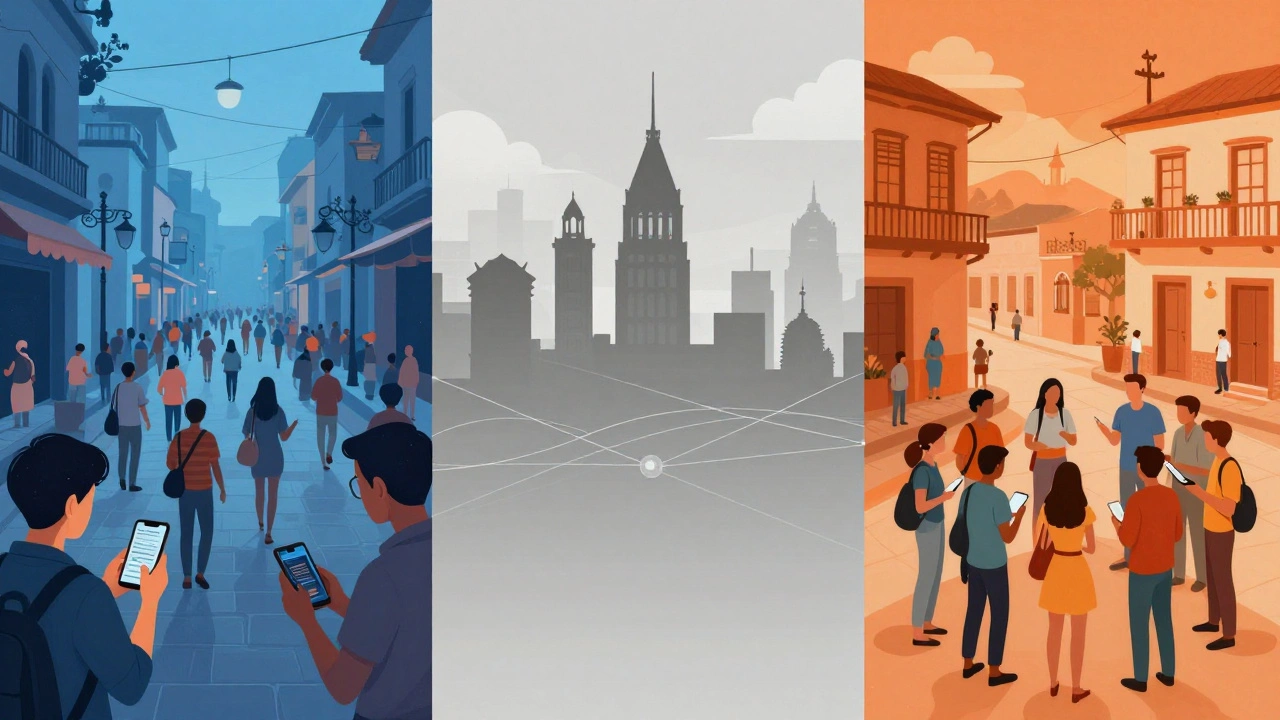
The growth numbers are staggering. From 35 million users in March 2014, the app hit 700 million by 2025. That is an increase of 2,757%. But growth looks different depending on where you live. In some places, it's a tool for bypassing censorship. In others, it's a community bulletin board. To understand the platform, you need to look at the three biggest regions: Asia, Europe, and Latin America. Each has its own rules, habits, and reasons for using the app.
Asia: The Volume Leader
Asia holds the largest slice of the Telegram pie, accounting for 38% of the user base. When you talk about news here, you are mostly talking about India. The country alone has between 100 and 104 million downloads. That represents roughly 23-24% of all global users. For Indian internet users, 45% are regular Telegram users. In the last month of Q3 2023, 58% of active social media users reported using the app.
How do people find news? It's not always direct. Research shows 78% of Indian users discover news channels through WhatsApp forwards. The process is simple: click a shared link, join the channel, and turn on notifications. It takes three steps. Indonesia follows India with 24.3 to 27.2 million downloads. The Asia-Pacific region recorded nearly 63 million downloads in Q3 2024 alone. This shows the momentum is still building.
The content style in Asia is distinct. Users primarily access news through topic-specific channels. You will see separate channels for politics, business, and entertainment. This segmentation helps users filter information quickly. During internet shutdowns, like those in Kashmir in 2023, these channels became the only way to get verified news. One user on Reddit noted that when the internet went down, Telegram channels were the lifeline. This utility drives adoption more than any marketing campaign.
Europe: The Political Hub
Europe makes up 27% of the user base, but the behavior is different. Here, the platform is often tied to political engagement and media restrictions. Russia leads the region with 34.4 to 38.4 million downloads. About 51% of Russian citizens use Telegram as a primary news source. This number grew from 11% in 2020 to 51% in 2025. The rise correlates directly with increased media restrictions in the country.
Ukraine shows particularly high engagement. There were 7 million installations as of August 2022. Users there rely on the app for real-time updates during conflict. In Western Europe, adoption is more varied. Italy has 32% penetration, and Spain sits at 25% overall, though 32% of millennials use it. The UK lags significantly at just 3%.
European users favor localized news channels with heavy political content. Unlike Asia, where users might join topic channels, Europeans often search directly using Telegram's internal search. Italian users average 4.2 news channels subscribed, compared to 2.7 for Spanish users. The interface adoption also varies. Cyrillic interface adoption takes Russian users 2-3 days, while non-Cyrillic users accessing Russian news take 5-7 days. This language barrier affects how fast information spreads.
Latin America: The Community Network
Latin America represents 21% of the users. The growth here is organic, driven by community utility rather than censorship. Brazil leads with 21.9 to 22.8 million downloads and a 29.4% penetration rate. Mexico follows closely with 34% penetration, making it one of Telegram's strongest markets globally.
The key difference in Latin America is the format. Users show the strongest engagement with community-driven news sharing in group formats. Instead of just reading a channel, people join neighborhood groups. A user from Sao Paulo reported that 20,000-member neighborhood groups share real-time safety updates that police ignore. This creates a hyper-local news network that traditional media cannot match.
Documentation quality affects this region too. There are excellent English and Russian resources, but limited Spanish and virtually no Portuguese documentation for Brazilian users. Despite this, the community stickiness remains high. The platform works well on budget models costing as little as $50. System requirements are minimal (Android 4.1+, iOS 9.0+), which explains the penetration in emerging markets where high-end smartphones are rare.
Technical Architecture and Speed
The app's ability to handle news depends on its technical setup. Telegram operates on the MTProto protocol. It offers end-to-end encryption for secret chats, though standard chats are encrypted client-server. Public channels support up to 200,000 subscribers, which increased from 5,000 in 2015. This capacity allows major media outlets to broadcast directly to audiences.
Speed is a major factor. Message delivery speeds are under 0.2 seconds globally. News consumption sessions are short, averaging 4.7 minutes per session. However, 68% of news consumers access Telegram multiple times daily. This pattern suggests users check for updates frequently rather than spending long hours reading. The free core service is supplemented by Telegram Premium at $4.99/month. This offers doubled limits for media uploads (4GB vs 2GB) and faster downloads. However, less than 5% of news consumers have adopted the premium tier.
| Region | Top Country | Penetration Rate | Primary Use Case |
|---|---|---|---|
| Asia | India | 45% | Topic-specific channels |
| Europe | Russia | 51% | Political news & censorship bypass |
| Latin America | Mexico | 34% | Community group sharing |

Risks and Regulation
The rapid growth brings challenges. Expert analysis identifies Telegram's news adoption patterns as directly correlated with media freedom. Dr. Elena Petrova from the Oxford Internet Institute noted a 0.78 correlation between adoption rates and the RSF's World Press Freedom Index. However, the lack of content moderation creates risks. The Stanford Internet Observatory found 37% higher misinformation rates in Telegram news channels compared to Twitter in crisis situations.
Regulatory pressures are mounting. The EU's Digital Services Act requires Telegram to implement content moderation for news channels serving over 45 million EU users. This became effective February 17, 2025. In India, the IT Rules 2021 prompted Telegram to establish a local grievance officer. The Electronic Frontier Foundation acknowledges the utility but criticizes the inconsistent encryption implementation that creates false security perceptions among news consumers.
Current developments aim to address these issues. A May 2025 update introduced AI-powered news verification tools in beta for Indian and Brazilian markets. The platform also partnered with AFP for fact-checking in European markets. User growth projections suggest Telegram will reach 1.3 billion users by 2027, with news consumption driving 65% of daily engagement. However, sustainability concerns remain. The platform's reliance on founder Pavel Durov's personal funding creates uncertainty, though it became profitable in 2024 through premium subscriptions and advertising on public channels.
Practical Implementation for Users
Using the app for news requires minimal technical skill but regional adaptation. The learning curve is shallow, under 15 minutes to basic proficiency. However, language-specific challenges exist. Indian users typically discover channels through WhatsApp forwards. European users search directly. Latin American users rely on group invites. Negative feedback centers on misinformation. European users on Trustpilot note too many fake news channels impersonating legitimate media. Asian users cite language barriers in international news channels.
For anyone looking to use this for news, the advice is simple. Verify the source. Check if the channel is verified. Be aware of the regional context. In Russia, state TV might lie, so Telegram channels provide raw footage. In Brazil, neighborhood groups share safety updates. In India, channels bypass shutdowns. The tool is the same, but the utility changes based on your location and needs.
Is Telegram safe for reading news?
It depends on the channel. While the app uses encryption, standard chats are client-server encrypted, not end-to-end. Misinformation rates are higher here than on some other platforms. Always verify sources and check for official verification badges.
Which region uses Telegram most for news?
Asia has the highest volume with 38% of the user base, led by India. However, Europe has higher penetration for primary news sourcing, with Russia at 51% usage as a main news source.
How do I find reliable news channels?
In Europe, search directly using the internal search. In Asia, users often find links via WhatsApp. Look for verified channels and cross-reference information with other trusted media outlets.
Does Telegram cost money?
The core service is free. Telegram Premium costs $4.99/month for faster downloads and larger file uploads, but less than 5% of news consumers pay for it.
What are the risks of using Telegram for news?
The main risk is misinformation. Studies show higher misinformation rates in Telegram channels compared to Twitter during crises. There are also regulatory risks as governments demand more content moderation.