Running a Telegram news channel with 100 subscribers is easy. Running one with 100,000? That’s where most people give up. They think they need a team of developers, a server farm, and a budget that rivals a startup. But the truth? You can scale a Telegram news operation with nothing more than a few cloud functions, a bot, and some smart automation. No fancy infrastructure. No hiring. Just smart tools working together.
How Telegram News Bots Actually Work
At its core, a Telegram news bot is just a program that listens for triggers-like a new article or a scheduled time-and sends a message to users. It doesn’t need to be complex. Most bots start by pulling data from RSS feeds. News sites like BBC, Reuters, or even niche blogs expose their content through RSS URLs. You point your bot at those URLs, it checks every hour, and if there’s a new post, it sends it out.
But here’s the problem: RSS feeds often dump 60+ articles at once. If your bot sends all of them, users unsubscribe. Fast. So you need filters. You don’t send every article. You send the top 3. Or the top 5. You pick them based on publication time, relevance, or even a quick AI summary. This isn’t magic. It’s logic.
Cloud Functions: The Secret Weapon
You don’t need a server. You don’t need to pay for a VPS. Cloud functions-like AWS Lambda, Google Cloud Functions, or even n8n’s built-in execution engine-are designed for exactly this: run code when something happens. They wake up when a timer hits. They pull news. They format it. They send it. Then they go back to sleep. You only pay for the milliseconds they’re active.
Imagine this: Every morning at 7 AM, a cloud function wakes up. It calls NewsAPI, grabs the top 5 headlines from the U.S. tech sector. It runs each headline through a lightweight AI model (like Ollama) to generate a 1-sentence summary. Then it sends each one as a separate message to your Telegram channel. Done in 2.3 seconds. No human touched it. No server running 24/7. Just clean, cheap, reliable automation.
Why RSS Isn’t Enough (And What to Do About It)
RSS feeds are great. But they’re messy. Some feeds don’t include full summaries. Others have broken links. A few even change their structure without warning. That’s why smart operators don’t rely on one source.
Instead, they combine three: an RSS feed, a news API (like NewsAPI or SerpApi), and sometimes even a scraped Google News feed. Each source has strengths. RSS gives you direct publisher content. APIs give you clean, structured data. Scraping gives you real-time trending. You merge them. You deduplicate. You rank. You pick the best.
For example: If three sources all report the same breaking story, you send it once. If only one source has it, you still send it-but tag it as "Exclusive". This builds trust. Users start expecting your bot to catch what others miss.
Personalization: The Game-Changer
One-size-fits-all news is dead. Users don’t want politics, sports, and tech all mixed together. They want control. And Telegram lets you give it to them.
Here’s how it works: When a user joins your channel, they get a private message: "What topics interest you? Reply: tech, finance, health, or all." You store that choice in a simple database. Next time your cloud function runs, it checks each user’s preference before sending. Tech-only users get tech. Finance users get market updates. No noise. No spam.
Some bots even let users say: "Send me the top 3 stories about AI this week." That’s not just automation-it’s conversation. And it keeps users coming back.
Building the Workflow (No Code Required)
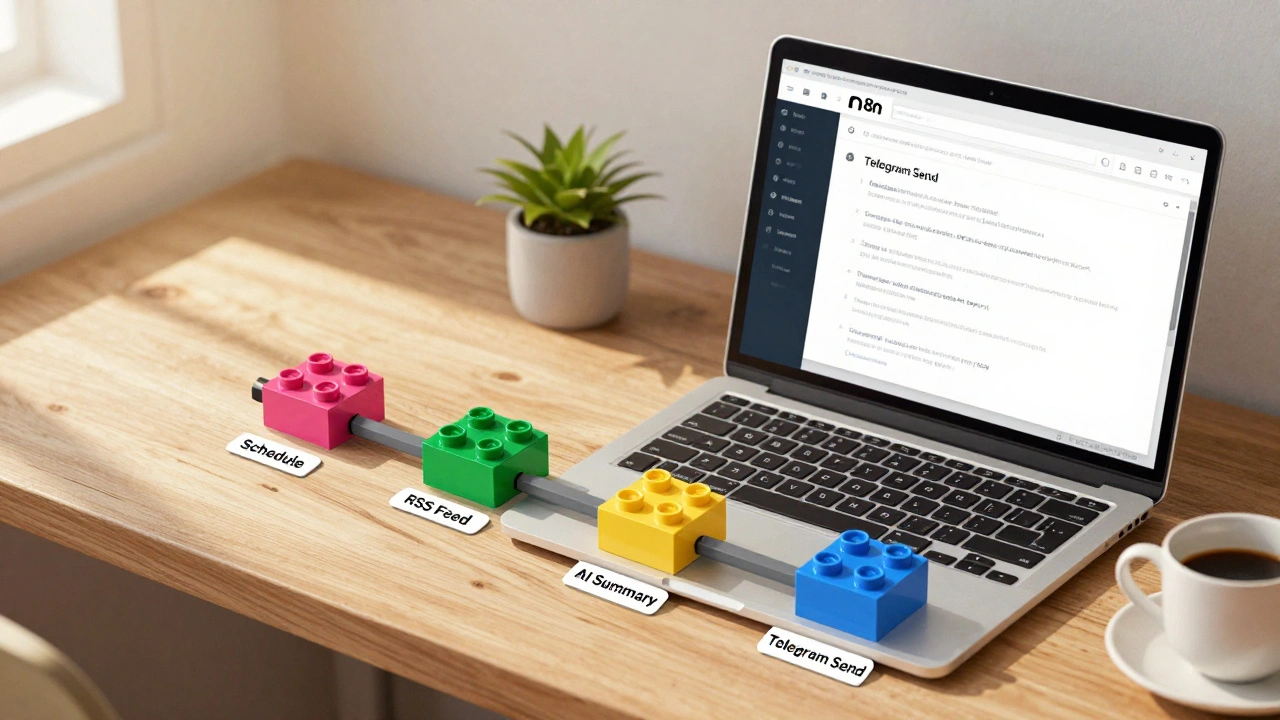
You don’t need to write Python. You don’t need to learn Docker. Tools like n8n make this visual. Think of it like Lego blocks.
- Start with a Schedule Trigger-set it for 8 AM, 12 PM, and 6 PM.
- Add an RSS Node-paste in your favorite news feed URL.
- Use an Iterator-this splits the 50 articles into individual items.
- Throw in a Code Node-use JavaScript to filter out duplicates or flag breaking news.
- Add an AI Node-connect to a local LLM and say: "Summarize this article in one sentence, keep it under 100 characters."
- Finish with a Telegram Node-map the title, link, and summary into a clean message.
That’s it. You’ve built a news engine that runs 24/7. No maintenance. No crashes. Just updates.
Scaling Beyond One Channel
Once your single channel works, why stop? You can clone this system for different audiences. A tech channel. A crypto channel. A local news channel for your city. Each one uses the same workflow. Just change the RSS feeds. Change the filters. Change the schedule.
One cloud function can handle ten different bots. You just give each one a unique Telegram token and a unique database table. You can even use the same AI model across all of them. The cost? Almost nothing. The reach? Massive.
What Happens When It Breaks?
Automation fails. RSS feeds go down. APIs hit rate limits. Telegram blocks messages. You need to plan for it.
Set up error alerts. If your cloud function fails three times in a row, send yourself a Telegram message. Don’t wait for users to complain.
Use fallbacks. If NewsAPI is down, switch to RSS. If RSS is down, use a cached version of yesterday’s top stories. Users won’t notice a 24-hour delay. They’ll notice if your bot goes silent for a week.

Costs at Scale
Let’s say you’re sending 500 messages an hour. That’s 12,000 a day. 360,000 a month.
Cloud functions? $0.0000001 per execution. You’re paying pennies.
Telegram Bot API? Free. Unlimited.
NewsAPI? $10/month for 1,000 requests/day. You’re using 120. You’re under budget.
AI summarization? Ollama runs on a $5/month VPS. You’re not even using 10% of its power.
This isn’t a startup. This is a side project that makes money.
Real Examples, Not Theory
There’s a Telegram channel called "Daily Tech Brief" with 87,000 subscribers. It sends three updates a day. No humans. Just n8n, NewsAPI, and Ollama. It’s been running for 14 months. It’s profitable from affiliate links. No ads. No sponsors. Just smart automation.
Another one, "Crypto Pulse", uses Google News scraping to track trending coins. It sends a digest every morning. It’s run by a college student in Poland. He doesn’t even know how to code. He used a YouTube tutorial and n8n. Now he makes $3,000 a month.
You don’t need to be an expert. You just need to start.
Where to Start Today
Here’s your 1-hour plan:
- Go to n8n.io and sign up for free.
- Create a Telegram bot using BotFather. Copy your bot token.
- Pick one news source-like BBC’s RSS feed:
https://feeds.bbci.co.uk/news/technology/rss.xml - Build the workflow: Schedule → RSS → Filter (top 3) → AI Summary → Telegram.
- Test it. Send a message to yourself.
- Wait 24 hours. See if it worked.
If it did, you just scaled a news operation. No team. No budget. Just a bot and a cloud function.
Can I scale a Telegram news bot without coding?
Yes. Tools like n8n, Make, and IFTTT let you build fully functional Telegram news bots with drag-and-drop workflows. You don’t need to write a single line of code. Just connect your RSS feeds, set a schedule, and send messages. Many users build their first working bot in under an hour.
How many users can a Telegram bot handle?
Telegram doesn’t limit bot messages per user count. A single bot can send millions of messages daily. The real limit is your infrastructure. Cloud functions like AWS Lambda or Google Cloud Functions can handle thousands of simultaneous executions. With proper error handling and rate limiting, there’s no hard cap-just cost and efficiency.
Is using RSS feeds legal for news bots?
Yes, as long as you follow basic rules. Most news sites allow RSS feeds for personal or non-commercial use. You must not republish full articles-only headlines and links. Never scrape behind paywalls. Always credit the source. Many publishers actually encourage this because it drives traffic back to their site.
What’s the biggest mistake people make when scaling?
Sending too much. New operators think more messages = more engagement. But users unsubscribe fast if they get 10+ updates a day. The key is quality over quantity. Send 3-5 well-filtered, well-summarized updates daily. That’s enough to stay top-of-mind without being annoying.
Can I make money from a Telegram news bot?
Absolutely. The most common ways are affiliate links (like Amazon or crypto exchanges), sponsored digests (paid by companies to feature their news), and premium subscriptions (offering exclusive content or faster updates). Some bots with 50K+ users earn $2K-$10K/month passively. It’s not get-rich-quick-but it’s real.
Do I need AI to make this work?
No. You can use plain article summaries from RSS or APIs. But AI changes the game. It turns a 300-word article into a 15-word hook. It removes fluff. It makes your bot feel smarter. Even a free local LLM like Ollama can boost engagement by 40% or more. It’s not required-but it’s the difference between good and great.
What’s Next?
You’ve got the tools. You’ve seen the examples. Now it’s time to build. Start small. Test one feed. One schedule. One audience. Then expand. The next big Telegram news channel isn’t being built by a media company. It’s being built by someone just like you-someone who clicked "start" instead of waiting for perfect.