By 2026, if you want to know what’s happening in the world-really happening-you don’t open a news app. You don’t scroll through Twitter or check your local TV station. You open Telegram. For over 781 million users, Telegram isn’t just a messaging app anymore. It’s the front page of the global newsroom.
Why Telegram Took Over News Distribution
Telegram wasn’t built to be a news platform. When Pavel Durov launched it in 2013, the goal was simple: secure, private messaging without ads or surveillance. But users had other ideas. In countries like Iran, Russia, and Belarus, where governments shut down websites and block social media, people turned to Telegram channels to share breaking news, protest updates, and eyewitness videos. The platform’s technical design made it perfect for this.Unlike WhatsApp, which caps group sizes at 1,024, Telegram channels can have unlimited subscribers. A single channel like Ukraine War reached 14.2 million followers by early 2025. That’s more than the entire population of Sweden. And unlike Facebook or Twitter, Telegram doesn’t hide posts behind an algorithm. If you subscribe, you see everything-no filtering, no shadowbanning, no engagement bait.
It’s not just scale. Telegram handles massive files-up to 4GB for Premium users-so journalists can send raw footage, maps, and documents without compression. During the 2024 U.S. election, verified reports from polling stations were shared as video clips and PDFs directly through channels, bypassing traditional media delays. The platform’s MTProto proxy system keeps channels online even during nationwide internet shutdowns, with 99.98% uptime in conflict zones.
Who’s Running the News Channels?
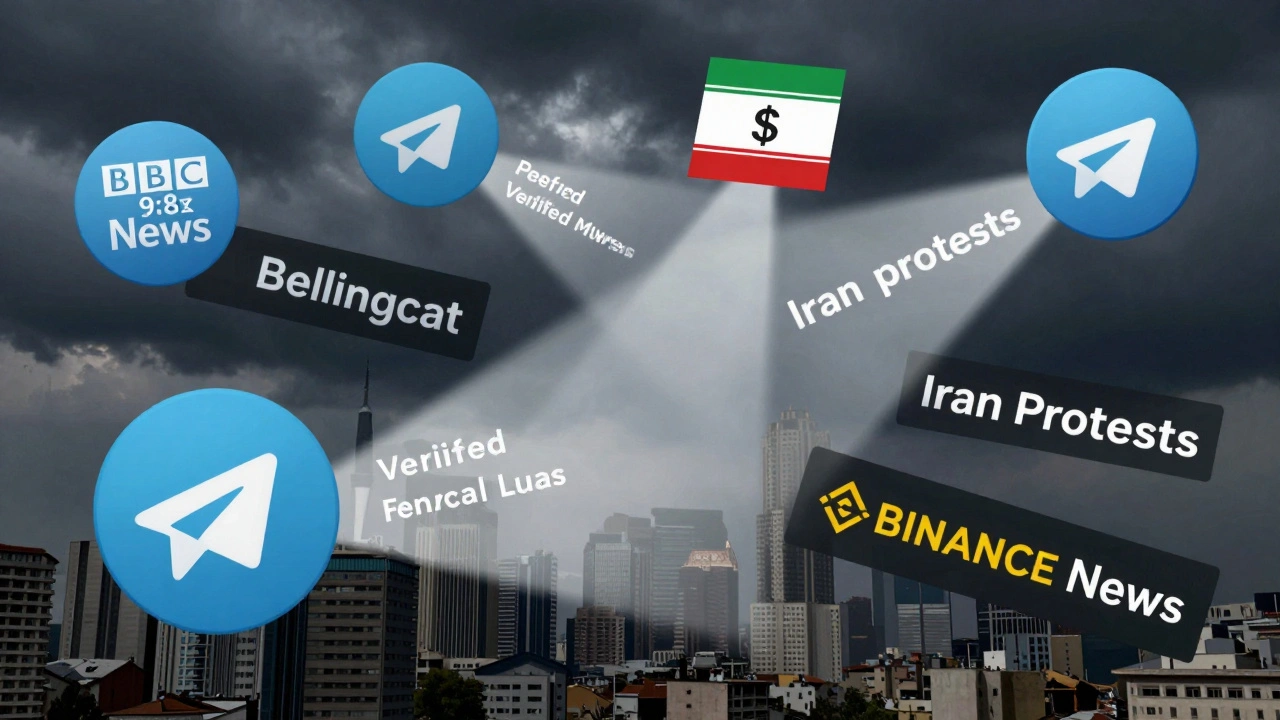
Telegram’s news ecosystem isn’t monolithic. It’s a patchwork of sources:- Official outlets: BBC News, Reuters, and AP run verified channels with 2-5 posts daily, mixing short videos, infographics, and fact-checked text. BBC’s channel reports 87% satisfaction among its 2.3 million subscribers.
- Independent journalists: Groups like Bellingcat, with 1.8 million subscribers, use Telegram to publish investigative reports on war crimes, corruption, and disinformation campaigns.
- Citizen reporters: Channels like Iran Protests (3.2 million followers) are run by ordinary people using smartphones to document events in real time.
- Specialized niches: Crypto news channels grew 187% year-over-year in 2025. Binance News now has 5.55 million subscribers.
This mix creates a powerful but messy system. On one hand, you get speed and diversity. On the other, misinformation spreads just as fast. During the 2023 mpox outbreak, unverified health claims reached 41 million users before any official response. Stanford Internet Observatory found that 63% of viral election conspiracy theories in 2024 started on Telegram.
How People Use Telegram for News
Most users don’t just read-they interact. The average Telegram news consumer spends 15.7 minutes per session, more than Twitter users and nearly as much as YouTube viewers. Why? Because Telegram feels personal. You’re not being sold to. You’re not being fed content based on your past clicks. You chose the channels. You control the flow.According to a 2025 Whop survey, 78% of users prefer Telegram over Facebook or Twitter because it lacks algorithmic manipulation. That’s the biggest draw. But it’s also the biggest risk. Without filters, false claims ride alongside verified reports. Users report that verifying sources is their top challenge. One user in Poland told me: “I follow 67 news channels. Half of them are reliable. The other half? I don’t know who runs them. I cross-check everything.”
The most successful channels adapt to this. BBC News doesn’t just blast text. They post 3-5 times a day with clear headlines, embedded video clips, and simple graphics. Their retention rate is 28% higher than channels that post long paragraphs. In India, where Telegram has over 104 million downloads, users favor political updates. In Latin America, entertainment news leads. In Europe, business and finance dominate.
The Money Behind the Messages
Telegram’s news channels aren’t charities. They’re businesses. In 2026, Telegram’s advertising platform generated an estimated $10 billion in revenue. Channel owners keep 50% of that. For popular channels, that’s millions of dollars a year.How? Ads appear as sponsored posts, labeled clearly. Some channels sell subscriptions through Telegram’s built-in payment system. Others partner with crypto projects or affiliate marketers. Binance News doesn’t just report on Bitcoin-it promotes trading tools. Independent journalists use Patreon-style subscriptions to fund investigations.
Telegram Premium, at $4.99/month, brings in $1.2 billion annually from 10 million subscribers. That’s more than the entire annual revenue of many legacy news outlets. And unlike traditional media, Telegram doesn’t rely on ad blockers or paywalls. The platform makes money from ads and subscriptions, while publishers keep the lion’s share.
The Dark Side: Misinformation and Lack of Accountability
Telegram’s strength is also its weakness. No centralized moderation. No fact-checking team. No transparency. If a channel posts false information, you can report it-but Telegram doesn’t remove it unless it violates specific laws in the country where the channel is registered.That’s why 73% of misinformation on Telegram spreads through forwarded messages. Once something is shared, it’s nearly impossible to trace or delete. A false claim about a political candidate can be forwarded thousands of times before anyone notices. In 2025, the Oxford Internet Institute found that over 60% of Telegram’s most-shared news items couldn’t be verified by any independent source.
Telegram’s response? A half-measure. In May 2025, they partnered with Reuters Fact Check. Channels that use the service saw misinformation drop by 42%. In January 2026, they started requiring news channels with over 1 million subscribers to disclose ownership. That helped expose some state-backed operations-but also scared off independent journalists in authoritarian countries who fear retaliation.
Dr. Emily Chen from MIT Media Lab put it bluntly: “Telegram doesn’t moderate content. It moderates nothing. Verified reporting and conspiracy theories spread with equal velocity. That’s not freedom. That’s chaos.”
What’s Next for Telegram News?
Telegram is trying to fix its reputation. The 2026 app update includes a dedicated News tab, grouping verified channels and highlighting fact-checked content. They’re also testing a News Verification API that will let third-party fact-checkers flag false claims directly in the app.But here’s the catch: Telegram won’t force anyone to use it. Users still choose what to follow. The platform’s philosophy is simple: “Users deserve to choose their information sources without corporate or government intermediaries.”
That’s why it works. And that’s why it’s dangerous.
For now, Telegram remains the most powerful news distribution tool on earth. It’s faster than CNN, more private than WhatsApp, and more open than Facebook. But it’s not a news organization. It’s a pipe. And what flows through it? Whatever someone decides to send.
If you’re using Telegram for news, you’re not just consuming information. You’re acting as your own editor, your own fact-checker, your own gatekeeper. The newsstand is open. But you’re the one holding the keys.
Can Telegram channels be trusted as a primary news source?
Some can, but not all. Official outlets like BBC and Reuters maintain high credibility on Telegram, with 87% of their subscribers reporting satisfaction. However, 63% of viral conspiracy theories in 2024 started on Telegram, and 41 million users saw unverified health claims during the 2023 mpox outbreak. Trust depends on the channel. Always cross-check with known sources.
Why is Telegram better than Twitter or Facebook for news?
Telegram has no algorithmic feed, no ad-driven engagement hooks, and no content suppression. Posts appear in order, and you see everything you subscribe to. It supports large files (up to 4GB), works during internet shutdowns, and allows unlimited subscribers. Twitter and Facebook prioritize viral content-Telegram prioritizes access.
How do Telegram news channels make money?
Telegram shares 50% of its advertising revenue with channel owners. Popular channels also sell subscriptions, promote crypto tools, or partner with sponsors. Binance News, with over 5.5 million subscribers, earns millions annually through affiliate links and sponsored posts. Independent journalists use Patreon-style funding via Telegram’s payment system.
Is Telegram banned in any countries?
Yes. China, Iran, and Russia have banned or restricted Telegram at times. But users still access it through proxy servers and VPNs. In fact, Telegram’s growth surged in these regions precisely because it’s hard to shut down. Its MTProto protocol maintains 99.98% uptime during government-imposed internet blackouts.
Should I subscribe to more than one news channel on Telegram?
Yes. The most informed users subscribe to 10-50 channels. Relying on one source-even a reputable one-leaves you vulnerable to bias or gaps. Combine official outlets (BBC, Reuters), independent investigators (Bellingcat), and local citizen channels. Cross-reference stories. That’s how you avoid misinformation.
What’s the difference between a Telegram channel and a group?
A channel is one-way broadcast: admins post, subscribers read. A group is interactive: anyone can message, reply, and share. News channels use the broadcast model to reach millions. Groups are for discussion. Most breaking news spreads through channels; debates happen in groups.
Can I trust Telegram’s new “Verified News Sources” badge?
It’s a step forward, but not foolproof. The badge means the channel owner disclosed their identity to Telegram. It doesn’t mean the content is accurate. Some state-backed outlets have received the badge. Always verify the source behind the badge-check their history, past reporting, and whether they’re cited by independent media.
How does Telegram compare to WhatsApp for news?
Telegram is far superior. WhatsApp limits groups to 1,024 people and doesn’t allow public channels. News on WhatsApp spreads through private groups, making it impossible to track or verify. Telegram’s public channels, unlimited subscribers, and file-sharing make it the only viable platform for mass news distribution.
What You Should Do Today
If you’re using Telegram for news, here’s what to do right now:- Find 3 trusted channels: BBC News, Reuters, and one local independent outlet.
- Unsubscribe from any channel that posts without sources or uses emotional headlines.
- Enable notifications only for breaking news-don’t get overwhelmed.
- Use the Quote Reply feature to preserve context when forwarding.
- Check if your favorite channel is part of the Reuters Fact Check program.
Telegram isn’t replacing journalism. It’s redistributing it. And that means the responsibility for truth now rests with you.