When a source sends a 90-second voice note on Telegram with critical information about a breaking story, you don’t have time to write it all down by hand. That’s where voice and video transcription for Telegram news production becomes essential. What used to take 5-10 minutes of manual typing now happens in under 30 seconds-with the right tools. But not all transcription services are created equal. For journalists, accuracy, speed, and integration matter more than ever.
Why Telegram Voice Notes Are a Game-Changer for Newsrooms
Telegram has become a go-to platform for journalists because it’s encrypted, supports large file transfers, and lets sources stay anonymous. But the real advantage? The flood of voice messages. Field reporters, whistleblowers, and eyewitnesses prefer speaking over typing. A 2024 Reuters Institute report found that 82% of newsrooms saw a spike in voice messages from sources since 2022. That’s a lot of audio to process. Manual transcription eats up hours. One journalist at The Guardian told me they spent 22 minutes per voice note just typing. Multiply that by five notes a day, and you’re losing nearly two hours daily. That’s two hours you could be verifying facts, interviewing sources, or filing stories. Enter automated transcription. The goal isn’t to replace humans-it’s to remove the grunt work. Get the text fast, then focus on what matters: context, tone, and truth.Telegram’s Native Transcription: Easy, But Not Enough for Pros
Telegram rolled out built-in transcription in 2022. It’s free. It works inside the app. You tap a voice note, and it turns into text. No setup. No login. No credit card. But here’s the catch: accuracy drops when it matters most. For clear, studio-quality audio, Telegram hits around 90% accuracy. For field recordings-noisy streets, shaky phone mics, overlapping voices-it plummets to 72%. A MediaTech Institute study of 1,200 news-related voice notes found Telegram missed proper nouns 41% of the time. Names of people, places, organizations? Gone. Or wrong. It also has a 2-minute audio limit. If your source goes on for 3 minutes, you’re stuck with two chunks. And it doesn’t distinguish speakers. One voice note with two people talking? You get one blob of text. No “Interviewer:” or “Source:” labels. For quick, casual use-like confirming a time or place-it’s fine. For quoting a politician or verifying a whistleblower’s claim? Not close.Third-Party Tools That Actually Work for Journalism
Professional newsrooms don’t rely on Telegram’s native tool. They use specialized services built for media workflows. Three stand out:- ElevenLabs Scribe v3: Processes audio in under 6 seconds per minute. Accuracy? 96.8% on political interviews, 94.2% on recordings from conflict zones. Its “journalist mode” reduces name errors by 31%. Used by Reuters, AP, and Al Jazeera. Costs $22/month for 10 hours.
- Google Cloud Speech-to-Text: Enterprise-grade. SOC 2 and HIPAA compliant. Handles 120+ languages. Accuracy: 89.7% on journalistic content. Integrates with CMS platforms like WordPress and Drupal. Costs $0.024 per minute. Best for large teams with budget.
- OpenAI Whisper (self-hosted): Free and open-source. Runs on your own server. Accuracy: 92.7% on clean audio. But it’s complex. A 2024 Nieman Lab survey found 68% of newsrooms that tried it gave up within six months because of maintenance headaches.
Real-World Performance: Speed, Cost, and Accuracy Compared
| Tool | Accuracy (Clear Audio) | Speed (per minute) | Cost | Best For |
|---|---|---|---|---|
| Telegram Native | 89-90% | 15-22 seconds | Free | Quick checks, low-risk info |
| ElevenLabs Scribe v3 | 96.8% | 4-6 seconds | $22/month (10 hrs) | Breaking news, direct quotes |
| Google Cloud Speech | 89.7% | 8-10 seconds | $0.024/min (min $50/month) | Large teams, compliance needs |
| Whisper (self-hosted) | 92.7% | 8-12 seconds | Free (but tech-heavy) | Teams with IT support |
The Hybrid Approach: Let AI Do the Heavy Lifting, Humans Do the Verifying
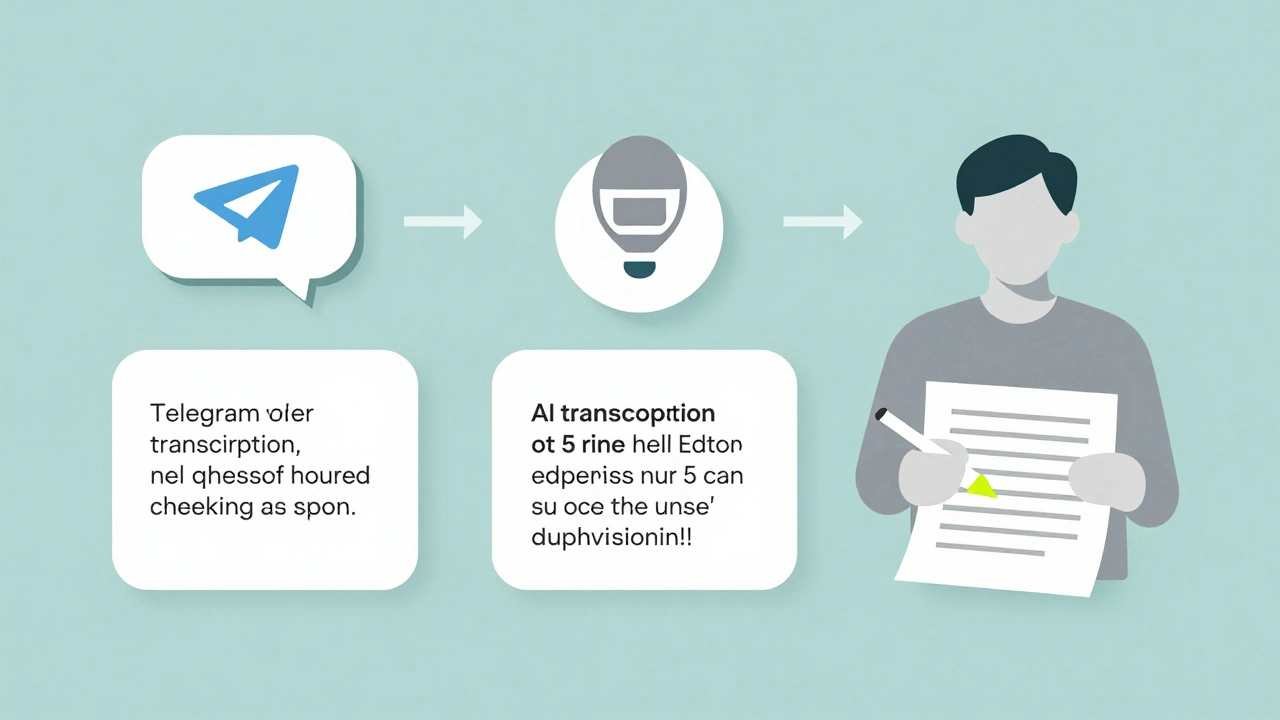
Even the best AI makes mistakes. A 2025 Gartner report linked 12 published misquotations since 2023 to unchecked transcription errors. One outlet misquoted a protest leader’s name, triggering a legal threat. Another mistook “federal agent” for “federal agent’s dog.” The fix? A two-step system:- Use AI to generate the first draft-cutting 90% of typing time.
- Have a human verify every direct quote before publishing.
How to Set It Up (Without Being a Developer)
You don’t need to code to use these tools. Here’s how most newsrooms do it:- Choose your tool: ElevenLabs for speed and accuracy. Google Cloud for compliance. Telegram’s built-in for quick, low-stakes notes.
- Connect it to Telegram: Use a bot or API. ElevenLabs offers a Telegram bot you can add in minutes.
- Test with real audio: Send a 30-second voice note from your phone. Does it catch the name? The number? The location?
- Train your team: Show them how to spot errors. Highlight common pitfalls: names, numbers, accents.
- Build a workflow: Auto-send transcripts to your CMS or Notion doc. Flag quotes for review.
What’s Coming in 2025 and Beyond
Telegram announced an upgraded transcription API in January 2025, promising 94% accuracy and better noise handling. It rolls out in Q2. That could close the gap with third-party tools. Meanwhile, ElevenLabs is adding speaker diarization-automatically labeling who’s talking. That’s huge for interviews. Google is integrating transcription directly into its newsroom CMS tools. The trend is clear: voice-to-text isn’t a luxury anymore. It’s part of the news cycle. The question isn’t whether to use it-it’s how to use it right.Common Pitfalls and How to Avoid Them
- Wrong names: Always double-check proper nouns. AI confuses “Biden” with “Biden’s” or “Biden’s team.”
- Multiple speakers: If two people talk over each other, most tools fail. Ask sources to speak one at a time.
- Background noise: Wind, traffic, crowds? Use noise-reduction apps like Krisp before sending.
- Cost spikes: During breaking news, you might hit 50 voice notes in an hour. Set usage alerts with Google or ElevenLabs.
- Legal risk: The EU now requires disclosure if a quote comes from AI transcription. Add a footnote: “Transcribed via AI and verified by reporter.”
Final Thought: It’s Not About Replacing Journalists
Automation isn’t here to take your job. It’s here to give you back time. Time to dig deeper. Time to ask harder questions. Time to verify the truth. The best journalists aren’t the ones who type fastest. They’re the ones who listen best. And now, with the right transcription tools, they can listen to more voices-faster, safer, and with greater accuracy than ever before.Can I use Telegram’s built-in transcription for professional journalism?
Telegram’s native transcription works for quick, low-stakes tasks like confirming dates or locations. But for direct quotes, breaking news, or sensitive sources, it’s not reliable enough. Accuracy drops below 75% on noisy or multi-speaker audio, and it frequently misidentifies names and organizations. Professional newsrooms use third-party tools like ElevenLabs or Google Cloud for accuracy above 95%.
What’s the cheapest way to transcribe Telegram voice notes?
The cheapest option is Telegram’s built-in tool-it’s free. But if you need higher accuracy, OpenAI’s Whisper is free to self-host. However, it requires technical skills to set up and maintain. Most small newsrooms find ElevenLabs’ $22/month plan more practical, since it includes support, updates, and higher accuracy without needing a developer.
How fast can transcription tools process voice notes?
Telegram’s native tool takes 15-22 seconds per minute of audio. ElevenLabs processes it in 4-6 seconds. Google Cloud takes 8-10 seconds. Whisper on a standard laptop runs at 8-12 seconds. For breaking news, speed matters. If you need text in under 30 seconds, avoid Telegram’s native option.
Do I need to pay for transcription services?
You don’t have to, but you’ll pay in time and risk. Free tools like Telegram or self-hosted Whisper save money but cost you hours in manual correction and risk publishing errors. Paid services like ElevenLabs or Google Cloud reduce verification time by 70% and cut error rates by over 80%. For newsrooms publishing daily, the ROI is clear.
Can AI transcription be trusted for direct quotes?
Never trust an AI transcript for a direct quote without human verification. Even the best tools make mistakes with names, numbers, and context. The International Journalists’ Network found that combining AI transcription with mandatory human review reduces misquotation errors by 83%. Always cross-check with the source before publishing.