When you open your phone to check the news, where do you go? For most people in the U.S., it’s Facebook, YouTube, or TikTok. But if you’re in Kyiv, Moscow, or Tashkent, chances are you’re opening Telegram. The same breaking story - a missile strike, a political resignation, a protest - plays out differently depending on which platform you’re on. That’s not because of the story itself. It’s because the people consuming it are completely different.
Who Uses Telegram for News? It’s Not Who You Think
Telegram isn’t just another social app. It doesn’t have an algorithmic feed. It doesn’t push trending posts. You don’t scroll. You subscribe. And that simple difference changes everything about who ends up using it for news. In Russia and neighboring countries, Telegram isn’t optional - it’s essential. Over 40 million people in Russia alone use it regularly. Independent media outlets like Meduza and Vedomosti moved there years ago because government censorship made their websites unreachable. Journalists and citizen reporters use Telegram to share photos from battlefields, documents from courtrooms, and live updates from protests. These aren’t random channels. These are verified newsrooms with editors, fact-checkers, and sourcing standards - but they’re operating outside the reach of state-controlled media. In the U.S., that’s not the case. Telegram has no measurable share of the mainstream news audience. Pew Research and Reuters Institute don’t even list it among top news platforms. Why? Because most Americans don’t use it for news at all. When Telegram did gain attention here, it was during the 2017 crypto boom. Crypto groups, coin launches, and token presales flooded Telegram with channels. Today, many of those channels are dead. Filled with bots, spam, and pump-and-dump schemes. If you’re looking for reliable financial news on Telegram, you’re digging through noise.Legacy Platforms Have Broader, But Less Trustworthy, Audiences
Compare that to Facebook. In the U.S., 26% to 33% of adults get news from it. YouTube? 21% to 32%. Instagram? Nearly 20%. Even TikTok, with its short-form videos, hits 10% to 20% of Americans for news. These platforms reach older adults, younger people, rural communities, and urban centers - all at once. But here’s the catch: these platforms prioritize engagement over accuracy. A sensational headline about a politician’s scandal gets more views than a detailed policy breakdown. Algorithms reward outrage, not depth. That’s why misinformation spreads faster on Facebook and YouTube than on most news websites. The platforms have moderation teams, but they’re overwhelmed. A false video of a bombing can go viral before fact-checkers even see it. Telegram doesn’t have that problem - because it doesn’t try to solve it. There’s no algorithm. No trending tab. No forced feed. If a channel is full of bots, you leave it. If a channel is run by a journalist with a track record, you stay. The responsibility falls on the user. That’s why Telegram’s audience in the West is small, but highly selective. It’s not for casual news readers. It’s for people who already know what they’re looking for.Age and Geography Shape the Divide
Younger audiences - ages 18 to 24 - are the most likely to get news from social media. Globally, 44% of them rely on platforms like TikTok, YouTube, and Reddit. In the U.S., TikTok and YouTube dominate this group. Reddit is the top choice for news among Gen Z and Millennials. But where’s Telegram? Almost nowhere in the data. Why? Because young people in Western countries don’t see Telegram as a news tool. They use it for private chats, memes, or group coordination. They don’t follow news channels. They don’t need to. The news comes to them - through TikTok trends, YouTube Shorts, or Instagram Stories. In contrast, in Ukraine, Belarus, or Kazakhstan, a 19-year-old might follow 15 Telegram channels: one for military updates, one for local city council meetings, one for independent radio broadcasts, and another for international news in English. They don’t just consume news. They curate their own media ecosystem. That’s not a trend. It’s survival.
How Institutions Are Starting to Use Telegram
Some major news organizations have noticed. The New York Times launched a Telegram channel during the Ukraine war. It got 43,000 subscribers. That’s tiny compared to its 10 million website visitors. But for people stuck behind Russia’s firewall, it was a lifeline. The channel didn’t break new stories. It simply mirrored the Times’ live blog - clean, clear, and unblocked. Bloomberg made a similar move in 2020. They shifted their "dark social" distribution from WhatsApp to Telegram after WhatsApp started blocking bulk messages. Now, Bloomberg editors send daily updates directly to subscribers - no algorithms, no ads, no filters. It’s a newsletter you can’t unsubscribe from unless you leave the channel. But these are exceptions. Most legacy media still focus on Facebook, YouTube, and their own apps. Why? Because those platforms have scale. Telegram doesn’t. It’s not built for mass reach. It’s built for trust.Content Style: Raw vs Polished
The kind of news you get on Telegram feels different. On legacy platforms, news is edited, branded, and formatted. A YouTube news video has intro music, on-screen graphics, and a host. A Facebook post has a headline, a thumbnail, and a comment section. On Telegram, it’s often raw. A photo of a damaged building. A voice note from a soldier. A PDF of a leaked document. No captions. No context. Just facts. That’s powerful. It’s also dangerous. Without context, a photo can be misinterpreted. A voice note can be faked. A document can be doctored. That’s why Telegram’s most trusted channels are run by journalists, not anonymous admins. Meduza doesn’t just post updates - they verify sources. They label uncertainty. They correct mistakes. That’s the difference between a channel and a platform.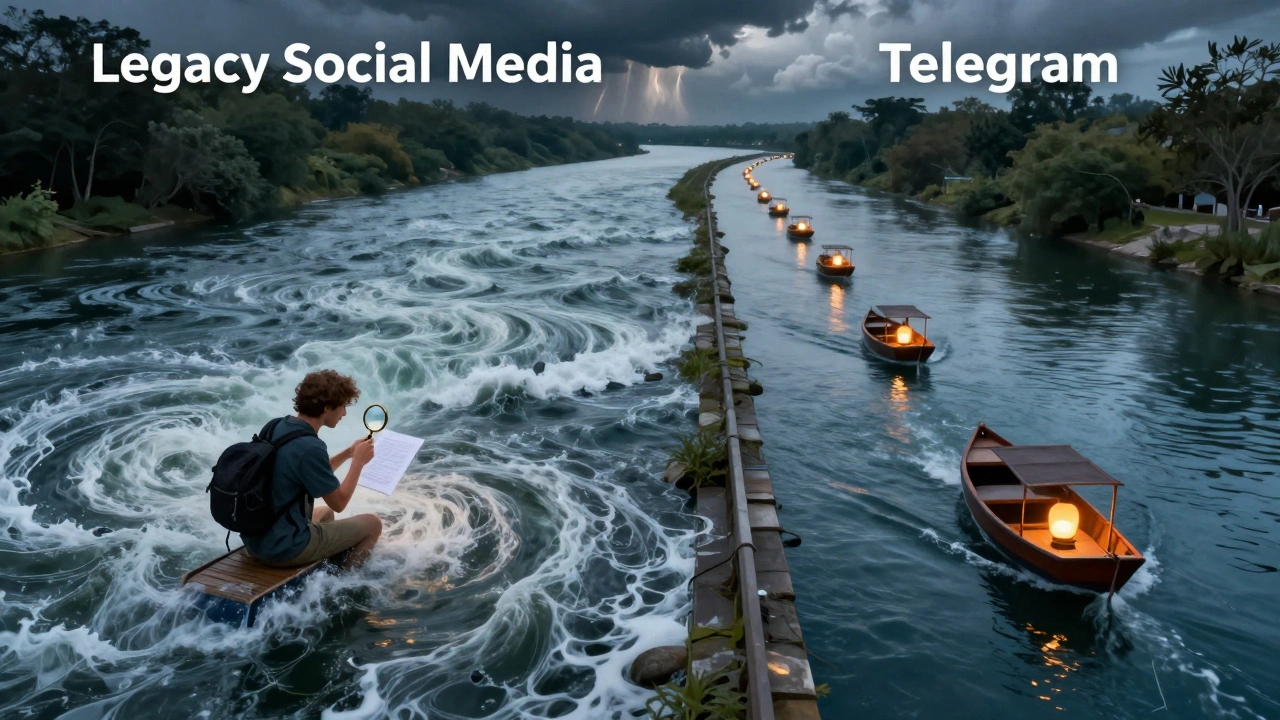
Why Telegram Won’t Replace Facebook - But Won’t Disappear Either
Telegram isn’t going to overtake Facebook. It doesn’t have the tools. It doesn’t have the audience. It doesn’t want to. Its strength isn’t in popularity. It’s in resilience. In places where governments shut down websites, Telegram stays up. In communities where people distrust mainstream media, Telegram offers direct access. In crypto circles, where trust is scarce, Telegram becomes the only place where founders talk directly to users. The future of news isn’t one platform. It’s many. Facebook for the masses. YouTube for video. TikTok for trends. Reddit for deep dives. And Telegram? For those who need to see what others can’t - or won’t - show them.Why doesn’t Telegram show up in U.S. news usage stats?
Telegram doesn’t appear in major U.S. news usage surveys because it’s not used as a mainstream news source there. While platforms like Facebook, YouTube, and TikTok have millions of American users who regularly get news through them, Telegram’s U.S. audience is small and fragmented - mostly limited to crypto communities, privacy advocates, and niche interest groups. Most Americans don’t follow news channels on Telegram at all, so it doesn’t register in national data.
Is Telegram more trustworthy than Facebook for news?
It depends on the channel. Telegram has no built-in fact-checking or moderation, so many channels spread misinformation. But some - like Meduza or independent journalists - are highly credible and operate like traditional newsrooms. Facebook, on the other hand, has content policies and teams that remove false posts, but its algorithm still pushes viral lies for engagement. So while Telegram can be more trustworthy if you follow the right sources, it’s not inherently more reliable.
Do younger people use Telegram for news?
In the U.S. and Western Europe, very few people under 25 use Telegram for news. They prefer TikTok, YouTube, and Instagram. But in countries like Ukraine, Russia, or Kazakhstan, younger users are among Telegram’s most active news consumers - often following multiple channels for real-time updates on war, politics, and protests. The difference comes down to access and censorship, not preference.
Why do media outlets like Bloomberg use Telegram?
Bloomberg and other outlets use Telegram because it lets them bypass algorithms and send direct, unfiltered updates to people who want them. Unlike Facebook or YouTube, Telegram doesn’t decide what you see. Editors can send daily briefs, documents, or breaking updates without being buried under ads or trending posts. It’s not about reach - it’s about control and reliability for a small, targeted audience.
Can Telegram be used to spread misinformation?
Absolutely. Because Telegram doesn’t moderate content, it’s become a haven for misinformation, conspiracy theories, and spam channels - especially in crypto, politics, and conspiracy circles. Many channels are run by bots or scammers. Unlike Facebook or YouTube, there’s no way to report false content at scale. Users have to judge credibility themselves, which makes Telegram risky for casual news readers.
Is Telegram better for breaking news than Twitter (X)?
In some cases, yes - especially in regions with restricted internet. Telegram channels can host longer updates, photos, videos, and documents that X’s 280-character limit can’t handle. During the Ukraine war, many frontline updates came through Telegram because it allowed real-time sharing of evidence without censorship. But X still has stronger global reach and verification tools. Telegram wins in access; X wins in speed and visibility.