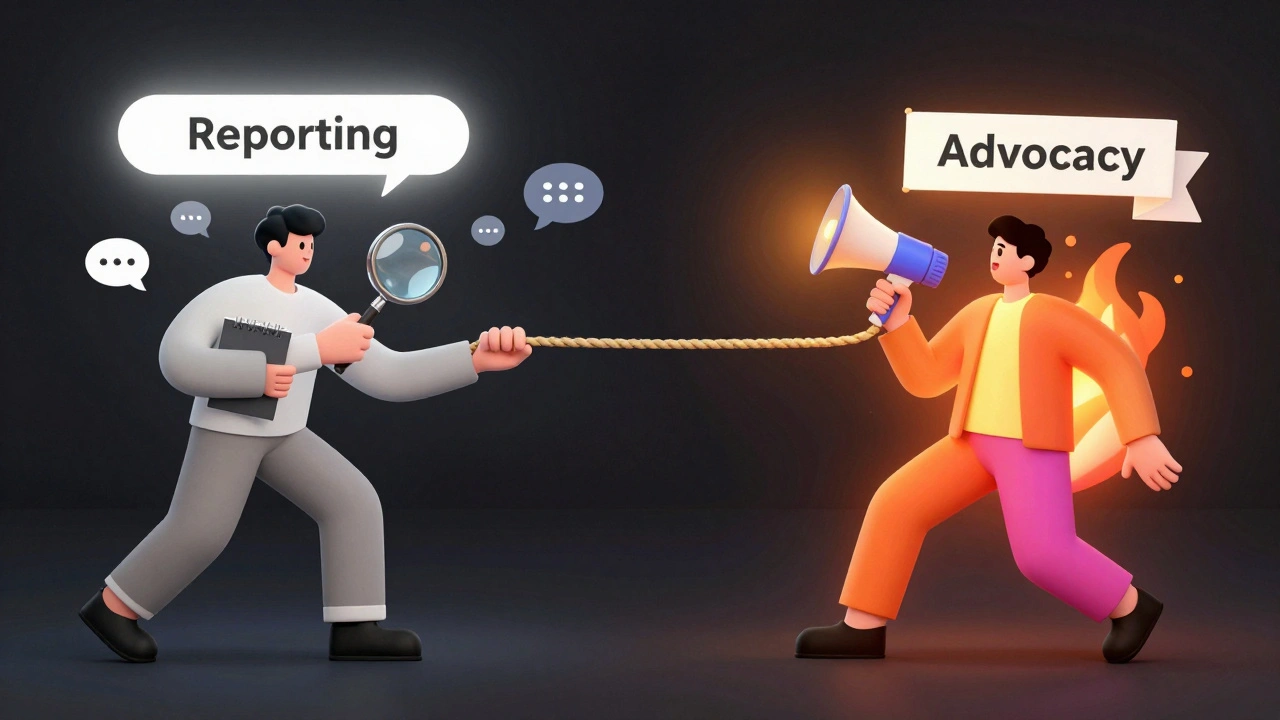
For many, Telegram is more than just a messaging app; it's a global news wire. Unlike traditional newsrooms with layers of editors, Telegram puts the power of publication directly into the hands of the individual. While this democratizes information, it also creates a dangerous tug-of-war between the desire to drive social change (advocacy) and the duty to provide an objective account of events (reporting). If you lean too far toward advocacy, you become a propaganda outlet. If you stay too neutral during a crisis, you might feel like you're ignoring the human cost.
The Tug-of-War: Reporting vs. Advocacy
To get this balance right, we first need to define what we're actually dealing with. Reporting is about the "what, where, and when." It's the act of gathering evidence and presenting it without trying to steer the reader toward a specific emotional or political conclusion. Advocacy, on the other hand, is purposeful. It's reporting with a goal-trying to change a law, stop an injustice, or rally support for a movement.
On Telegram News Channels, these two often merge. Because the platform allows for anonymity and rapid-fire posting, it's easy for a journalist to start by reporting a fact and end by calling for action. The danger here is "mission creep." When your goal shifts from informing the public to winning an argument, the factual accuracy of your reports often starts to slide. You might start ignoring details that contradict your narrative or amplifying unverified claims because they support your cause.
Why Telegram Changes the Ethical Game
Traditional journalism relies on a hierarchy. A reporter finds a lead, a fact-checker verifies it, and an editor approves it. Telegram kills that hierarchy. The technical features of the platform-encryption, massive group capacities, and a lack of centralized moderation-mean the individual operator is the reporter, the fact-checker, and the editor all at once.
A 2025 study on news channels during the Israel-Hamas conflict highlighted a sharp duality. Some channels used Telegram's speed to provide life-saving real-time updates, while others used that same speed to spread misinformation. The very features that make Telegram a sanctuary for journalists in oppressive regimes-like its end-to-end encryption-also make it a haven for those who want to bypass the truth. When there is no one to tell you "no," the temptation to prioritize speed over accuracy is overwhelming.
| Feature | Pure Reporting | Pure Advocacy | The Balanced Approach |
|---|---|---|---|
| Primary Goal | Accuracy & Objectivity | Social or Political Change | Informing to Enable Action |
| Verification | Rigorous/Delayed | Selective/Rapid | Transparent Process |
| Tone | Neutral/Descriptive | Emotional/Urgent | Factual but Empathetic |
| Source Handling | Diverse perspectives | Aligned perspectives | Attributed & Varied |
Practical Strategies for Maintaining Balance
How do you actually do this without losing your mind or your credibility? It starts with a personal code of ethics. Even if you aren't employed by a major network, you can adopt standards similar to the Israeli Code of Ethics, which emphasizes the need to rigorously verify information before it ever hits the "send" button. Here are a few ways to implement that in a fast-paced Telegram environment:
- The "Verification Delay": Just because you can post in two seconds doesn't mean you should. Establish a rule: any claim that could cause panic or impact a reputation requires two independent sources before publication.
- Transparent Labeling: Be honest with your audience. If you are posting an opinion piece or a call to action, label it as "Opinion" or "Advocacy." When you are reporting a sequence of events, label it as "Reporting." This prevents the reader from confusing your personal goals with factual data.
- The Correction Habit: In the race to be first, mistakes happen. The mark of a professional citizen journalist isn't a perfect record-it's a visible correction record. If you get something wrong, don't just delete the post. Post a correction. This builds more trust than perfection ever could.
- Sourcing Diversity: If you only follow and cite people who agree with you, you're not reporting; you're echoing. Actively seek out perspectives that challenge your narrative. If you're advocating for a cause, the most powerful tool you have is a factual report that acknowledges the opposing side's strongest argument.
The Risk of the "Echo Chamber" Effect
Telegram's structure naturally creates echo chambers. Because people choose which channels to join, they often curate a feed that only confirms their existing biases. As a creator, it's easy to fall into the trap of "audience pleasing." You might find that your most sensational, advocacy-heavy posts get the most shares, while your dry, factual reports are ignored. This creates a perverse incentive to abandon reporting in favor of activism.
To fight this, focus on Media Literacy. Not just for your readers, but for yourself. Understand how algorithms and human psychology drive engagement. When you feel the urge to use an inflammatory headline to get more views, ask yourself if you're serving the truth or just your ego. A channel that is known for being "boringly accurate" is far more valuable in the long run than one that is "excitingly wrong."

Navigating the Regulatory Gray Zone
Right now, Telegram exists in a bit of a legal wilderness. Governments are struggling to figure out how to handle it. Some see it as a tool for freedom, while others, like French authorities, have flagged it as a tool for illegal activity and extremism. This means that as a citizen journalist, you are often your own legal counsel.
When you balance advocacy and reporting, you are also balancing risk. Pure reporting usually offers more protection under the guise of "public interest," but advocacy can sometimes cross into areas that regulators view as incitement. The best defense is a paper trail. Keep records of your sources and your verification process. If you can prove that you acted in good faith to verify a story, you are in a much stronger position regardless of the political climate.
Moving Forward: The Future of Decentralized News
We are seeing a shift toward "verified' labeling and certification systems. Imagine a world where Telegram channels that adhere to a specific set of ethical standards-like those used by The Telegram News publication, which maintains high factual ratings through neutral sourcing-get a special badge of credibility. This would allow users to instantly distinguish between a passionate activist and a disciplined reporter.
Until those systems are standard, the responsibility lies with you. You have to decide if you want to be a voice for the voiceless or a mirror for the facts. The most effective journalists on the platform are those who can do both: use the facts to build an undeniable case for the change they want to see. That is the heart of balanced journalism-letting the truth do the advocating.
Is it possible to be 100% objective on Telegram?
True objectivity is nearly impossible because every human has a perspective. However, you can achieve "procedural objectivity" by following a strict set of rules: verifying every fact with multiple sources, attributing all quotes, and presenting opposing viewpoints fairly. The goal isn't to have no opinion, but to ensure your opinion doesn't distort the facts.
How do I handle a source who wants to remain anonymous?
Anonymity is a core feature of Telegram, but it's a double-edged sword. If a source insists on being anonymous, you must explain to your audience why they are anonymous (e.g., "fear of retaliation") and describe the source's credibility without giving away their identity. Never post a high-stakes claim based solely on one anonymous source without attempting to find corroborating evidence.
What should I do if I accidentally post misinformation?
The worst thing you can do is quietly delete the post. This makes it look like you're hiding the truth. Instead, post a clear correction: "Correction: In a previous post, we stated X. We have since learned Y. We apologize for the error." This transparency actually increases your long-term credibility with your audience.
How can I tell if another Telegram channel is reliable?
Look for three things: attribution, corrections, and tone. Does the channel link to original sources? Do they admit when they are wrong? Is the tone neutral, or is it designed to make you feel angry or scared? Reliable channels usually prioritize evidence over emotion and are transparent about where their information comes from.
Does advocacy journalism automatically mean bias?
Not necessarily. Advocacy journalism is about having a goal, but that goal can be supported by unbiased facts. Bias occurs when you intentionally omit or distort information to make your goal seem more attainable. You can be a fierce advocate for a cause while still being a fair and honest reporter of the facts surrounding that cause.
Latest Posts