Managing multiple Telegram channels manually is a nightmare. You write a post, copy it to five channels, tweak the tone for each one, schedule it at the right time, check if images uploaded correctly, and pray Telegram doesn’t throttle you. Now imagine doing that for 20 channels. Or 50. That’s not efficiency-that’s burnout.
Centralized editorial queues solve this by letting you create, review, and publish content across dozens of Telegram channels from one dashboard. No more copy-pasting. No more timezone confusion. No more hitting Telegram’s 30-messages-per-second limit because you clicked "Send All" too fast.
These systems aren’t just fancy schedulers. They’re smart content engines that adapt your message for each channel’s audience. A crypto news post for a technical audience gets detailed charts and jargon. The same post for a casual investor gets simple language and emojis. All from one draft.
How Centralized Editorial Queues Actually Work
At its core, a centralized editorial queue is a cloud-based system connected to your Telegram channels via bot tokens. You log in, write a post, pick which channels it goes to, set the publish time, and hit "Queue." Behind the scenes, the system handles everything else.
Here’s what happens when you hit "Publish":
- The system checks your channel’s tone profile-learned from 5-7 past posts you provided during setup.
- It uses AI (usually GPT-4 Turbo) to rewrite the message in that channel’s voice, keeping facts intact but changing style, length, and tone.
- Media files (images, videos) are automatically compressed to under 20MB and formatted for Telegram’s specs.
- The system queues the message with millisecond precision, accounting for each channel’s local time zone.
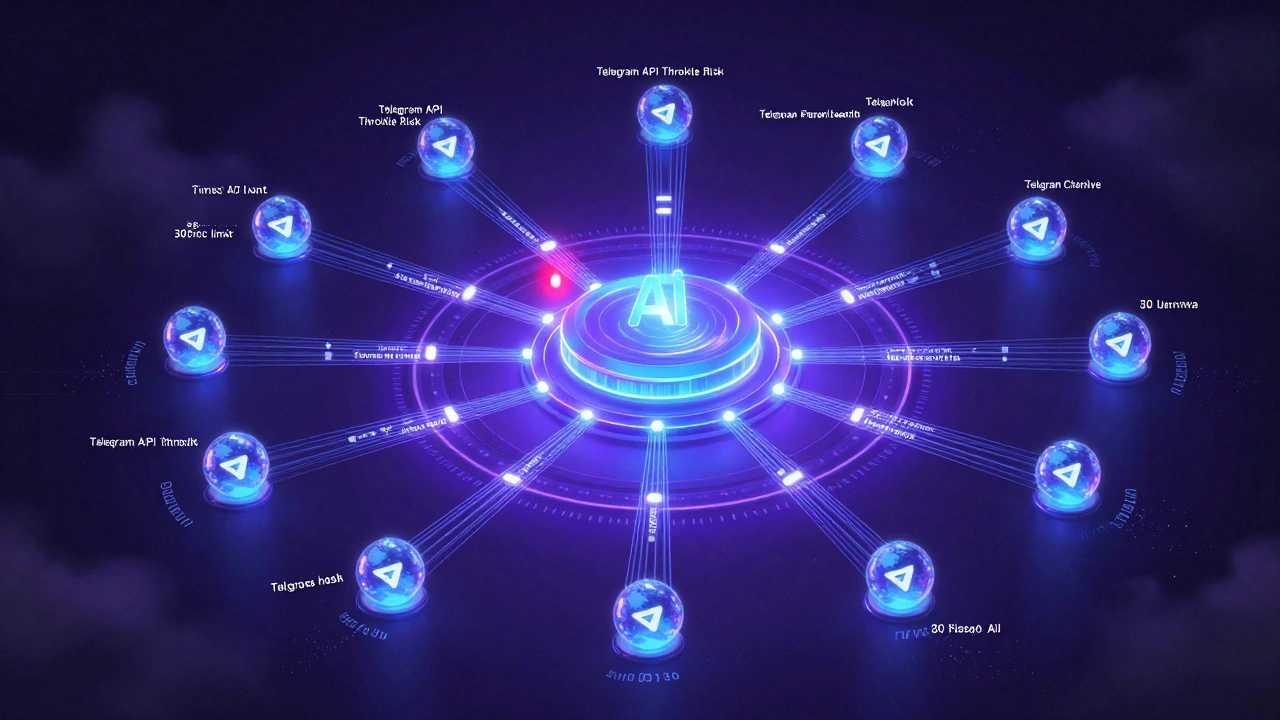
- It sends messages in batches, staying under Telegram’s 30 messages/second limit to avoid FLOOD_WAIT errors.
One media startup using LI Solutions’ platform published 36,719 posts in three months. Manual work? Reduced by 94%. That’s not a nice-to-have-it’s a business multiplier.
Key Features You Can’t Afford to Ignore
Not all tools are built the same. Here’s what separates good systems from the rest:
- AI Tone Adaptation: Platforms like LI Solutions track how each channel writes-do they use emojis? Short sentences? Formal tone? The AI learns from your history and mimics it. Accuracy hits 89% in real tests.
- Timezone-Aware Scheduling: Postly supports 214 timezones. You can schedule a post for 8 AM in Tokyo, 1 PM in Berlin, and 7 AM in New York-all from one calendar.
- Media Auto-Formatting: Telegram accepts JPG, PNG, MP4, and GIFs under 20MB. Most systems auto-resize and convert files so you don’t have to.
- Queue Prioritization: Urgent breaking news? Push it to the front. Evergreen content? Let it sit. Advanced users assign priority levels so high-value posts aren’t buried.
- Engagement Analytics: Postly tracks reactions per view and link click-through rates. You see which posts drive traffic, which get ignored, and why.
These aren’t marketing buzzwords. They’re features that cut hours off your workflow every single day.
Top Platforms Compared (2025)
There are seven major tools in this space. Here’s how the leaders stack up:
| Platform | Best For | Channels Supported | AI Tone Adaptation | Starting Price | Key Limitation |
|---|---|---|---|---|---|
| Postly | Analytics & ease of use | Up to 50 | Yes (GPT-4 Turbo) | $29/month | 37% more expensive than competitors for same tier |
| Botize | Small teams, no bot setup | Up to 25 | No | $49/month | Requires paid plan for multi-channel use |
| LI Solutions | Enterprise, tone accuracy | 20+ | Yes (89% accuracy) | $1,200/month | No built-in analytics |
| ChatMaxima | Multi-platform sync | Up to 30 | Yes | $69/month | Weak documentation |
Postly leads in market share (38%) because it’s the easiest to start with. Botize’s "no bot registration" feature is a game-changer for teams scared of API keys. LI Solutions wins for tone consistency-but only if you have a team that can handle complex setup.

What Happens When Telegram Changes the Rules?
Here’s the scary part: you’re building on someone else’s platform. Telegram doesn’t guarantee API stability. Their official docs say bots can send 30 messages per second. But in practice, they throttle users unpredictably.
According to Stack Overflow’s 2024 survey, 68% of developers using these tools ran into inconsistent webhook responses. One minute your posts go through fine. The next, you get a 429 error for 10 minutes. No warning. No explanation.
Telegram’s Head of Platform Development, Mikhail Ivanov, said it bluntly in December 2024: "Third-party queue systems operate at Telegram’s mercy." That means your entire workflow could break overnight if Telegram updates their API.
Security is another risk. In Q3 2024, 17 API key leaks were traced back to misconfigured queue tools. That’s 22% of all Telegram security incidents that quarter. If your bot token gets stolen, someone can post fake news from your channels.
Who Should Use This? Who Should Avoid It?
These tools aren’t for everyone.
Use it if:
- You manage 5+ Telegram channels with different audiences
- You’re spending more than 10 hours a week on manual posting
- You need consistent tone across regions or languages
- You’re scaling content and can’t hire a full-time editor per channel
Avoid it if:
- You only have 1-2 channels (manual posting is faster)
- You need real-time crisis response (there’s a 23-second delay between scheduling and publishing)
- Your content is longer than 4,096 characters (Telegram’s limit-tools can’t bypass it)
- You’re on a tight budget and can’t afford $29+/month
For example, a crypto news site with 47 channels used LI Solutions to scale without hiring 47 editors. Audience retention stayed at 92%. That’s the kind of ROI that justifies the cost.
Getting Started: What You Need to Know
Setting up a centralized queue takes 14-28 hours for most teams. Here’s how to do it right:
- Get your bot token: Talk to your Telegram admin. You need a bot with "Post Messages" and "Edit Messages" permissions. Don’t use your personal account.
- Train the AI: For each channel, upload 5-7 past posts. This teaches the system how that channel talks. Skip this, and your AI will sound robotic.
- Set up time zones: Match each channel to its audience’s location. Don’t assume everyone’s in UTC.
- Test with a small batch: Send 3-5 posts to 2-3 channels first. Check formatting, tone, timing. Fix errors before going live.
- Monitor for throttling: If posts start failing, reduce batch size. Telegram’s limits aren’t always consistent.
Most failures come from ignoring Telegram’s Markdown rules. If you use **bold** or _italics_ wrong, the message breaks. 89% of implementation errors are formatting issues.
The Future: AI, Monetization, and Consolidation
This market is exploding. It was worth $18.7 million in 2023. By 2024, it hit $84.3 million. That’s 241% growth in one year.
Why? Because Telegram has 1.2 billion active users-and 47% of Fortune 500 companies now have at least one channel. Web3 companies are driving premium adoption. Crypto projects need to reach global audiences fast.
What’s next?
- AI tone cloning: Postly’s beta feature lets you clone a human editor’s voice-not just channel style, but personality.
- Telegram Stars integration: 63% of queue tools plan to let you monetize channels directly through in-app purchases by mid-2025.
- Fact-checking AI: LI Solutions is building a system that flags false claims before publishing.
But Forrester predicts only 3-4 platforms will survive by 2026. The market is consolidating. If you’re investing now, pick a leader with strong funding and clear roadmap-not the cheapest option.
Final Thoughts
Centralized editorial queues aren’t magic. They won’t write your content. They won’t fix bad strategy. But they’ll remove the grunt work that’s holding you back.
If you’re juggling multiple Telegram channels and still posting manually, you’re not just inefficient-you’re losing reach. Every hour spent copying text is an hour not spent creating better content, analyzing engagement, or growing your audience.
Start small. Pick one tool. Train it on two channels. See how much time you save. Then scale.
The future of multi-channel publishing isn’t about doing more. It’s about doing less-and doing it smarter.
Do I need a bot to use a centralized editorial queue?
Yes, most systems require a Telegram bot with API access to post messages. The bot acts as the bridge between your dashboard and your channels. Botize is the exception-it uses a different method that doesn’t require bot registration, but it’s limited to fewer channels and lacks AI features.
Can I schedule posts for different time zones at once?
Absolutely. Tools like Postly and LI Solutions let you assign each channel a specific time zone. You can schedule one post to go out at 8 AM in Tokyo, 3 PM in London, and 9 AM in New York-all from the same queue. The system handles the conversion automatically.
What happens if Telegram changes its API?
That’s the biggest risk. Telegram doesn’t guarantee API stability. If they change how bots send messages, your queue system could stop working overnight. Most tools have fallbacks and update quickly, but there’s no guarantee. Always have a manual backup plan for urgent posts.
Are these tools secure?
Security depends on how you set them up. API keys can be leaked if stored in plain text or shared improperly. In Q3 2024, 22% of Telegram security incidents came from misconfigured queue tools. Always use environment variables, never hardcode tokens. Enable two-factor authentication on your dashboard if available.
Can I use these tools for personal channels?
You can, but it’s usually overkill. If you manage 1-3 channels and post a few times a week, manual scheduling is faster and cheaper. These tools are designed for teams scaling to 5+ channels with consistent publishing needs.
How long does it take to set up a centralized queue?
Most teams need 14-28 hours for a full setup. The biggest time sink is training the AI-uploading sample posts for each channel. Configuring bot permissions takes about 6 hours per team member. Once it’s running, daily use takes under 15 minutes.
Do these tools support images and videos?
Yes. All major platforms handle images, videos, and GIFs automatically. They compress files to under 20MB (Telegram’s limit), resize them for optimal display, and attach them correctly. You just upload the file-you don’t need to worry about formats or sizes.
Can I edit or cancel a scheduled post?
Yes. All systems let you edit, delay, or delete scheduled posts before they’re sent. Some even let you edit live posts after publishing-though that’s rare and requires special permissions. Always double-check before hitting "Schedule."