Trying to build an internal tipline using Telegram for employee reporting or verification? You’re not alone. Many teams think Telegram’s encryption and speed make it a perfect fit for confidential channels. But here’s the truth: Telegram is not designed for internal verification systems, and using it this way can put your organization at risk.
Telegram is great for personal chats, news updates, or even customer support bots. But when you start asking it to handle sensitive internal reports-like harassment claims, policy violations, or compliance logs-you hit hard walls. Telegram’s architecture doesn’t support the basic requirements of enterprise security. And no, turning on two-step verification won’t fix it.
What Telegram Actually Offers for Verification
Telegram does have verification tools, but they’re built for public-facing use, not internal reporting. There are three main features:
- Two-step verification (2FA): This adds a password to your account, so even if someone gets your SMS code, they still can’t log in. It’s useful for personal accounts but does nothing for team-wide reporting systems.
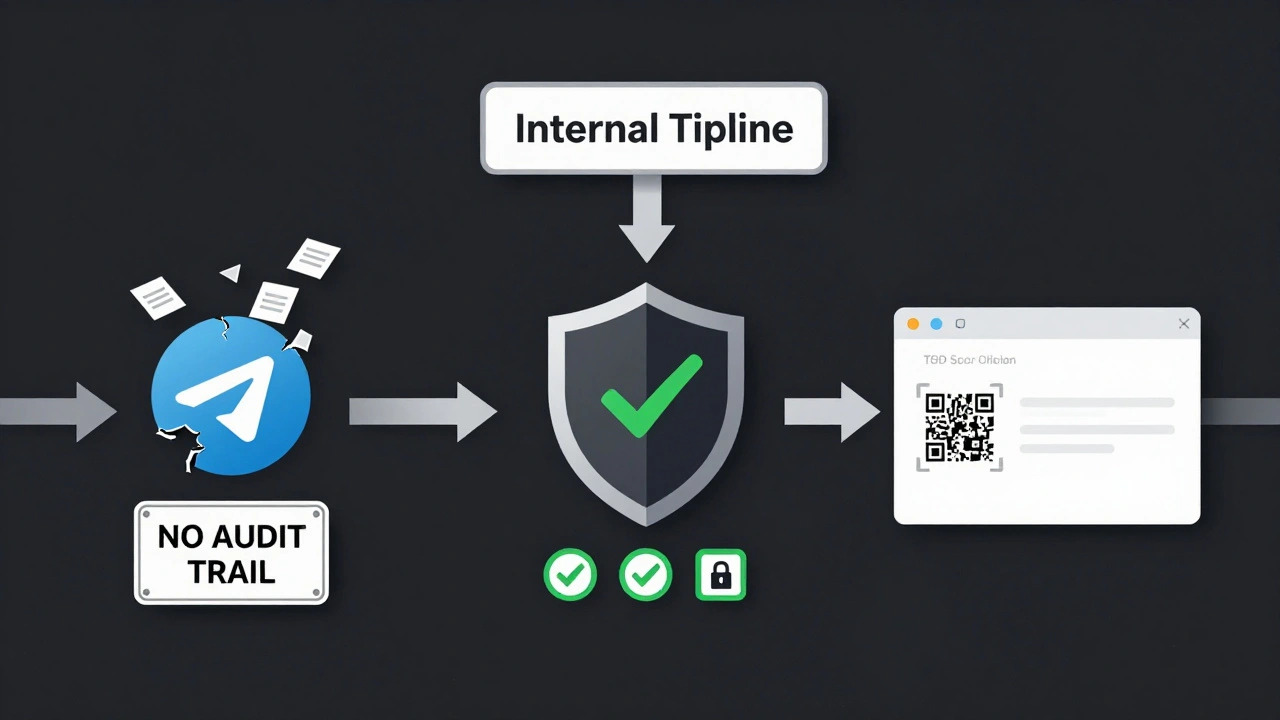
- Telegram Gateway API: This lets developers send verification codes via Telegram. It’s used by apps to confirm phone numbers-like when you sign up for a service and get a code through Telegram instead of SMS. It’s reliable (97% delivery rate in some tests), but it’s one-way. No audit trail. No user tracking. No way to know who sent what.
- Official page verification: This is for brands, media outlets, or public figures. It shows a green checkmark next to a public channel. It has nothing to do with internal staff or confidential reporting.
None of these are meant to be stitched together into a secure internal reporting system. And if you try, you’ll run into problems fast.
Why Telegram Fails as an Internal Tipline
Let’s say you set up a private Telegram group for employees to report issues. You think it’s secure because Telegram says “end-to-end encryption.” But here’s what most people don’t realize: end-to-end encryption only works in Secret Chats. Regular group chats, even private ones, are stored on Telegram’s servers. That means:
- Messages can be accessed by Telegram if legally compelled.
- There’s no way to enforce message retention or deletion policies.
- Employees can screenshot, forward, or delete messages without a trace.
And that’s just the start. Here are the real issues:
- No audit logs: Telegram doesn’t record who sent a message, when it was deleted, or who viewed it. If someone reports misconduct and then deletes the message, there’s no way to prove it ever happened.
- No role permissions: Telegram only offers three user roles (admin, member, restricted). Enterprise systems need granular controls-like who can view reports, who can assign cases, who can export data. Telegram gives you none of that.
- No compliance features: GDPR, HIPAA, SOX-all require detailed logs of data access and retention. Telegram has zero built-in support for any of these. A 2024 Deloitte survey found 78% of financial firms abandoned Telegram-based reporting within six months because they couldn’t pass audits.
- No integration: You can’t connect Telegram to HR systems, ticketing tools, or identity providers like Okta or Microsoft Entra. That means manual work. Manual work means mistakes.
- API limits and abuse: The Gateway API has no rate limits. That means bad actors can flood your system with fake verification requests, clogging your channels and triggering SMS bombing attacks.
One sysadmin from a tech company told me their team tried building a Telegram tipline for reporting data leaks. Within three weeks, they had 12 false reports, 3 deleted messages that couldn’t be recovered, and a compliance officer who threatened to shut them down. They switched to a dedicated platform in two days.

What Works Instead
If you need a real internal tipline for verification or reporting, you don’t need Telegram. You need tools built for this exact purpose.
Here are three proven alternatives:
- Whistleblower platforms: Tools like EthicsPoint, Navex, or SpeakPipe are designed for secure, anonymous reporting. They include encrypted submissions, case tracking, audit logs, and compliance reporting. Many integrate with HR systems and offer multilingual support.
- Enterprise messaging with compliance: Microsoft Teams and Slack both offer enterprise-grade compliance features. You can set retention policies, enable eDiscovery, restrict forwarding, and integrate with SSO. They’re not perfect, but they’re built for regulated environments.
- Custom-built solutions: If you have the budget, build a simple web form with end-to-end encryption, anonymous submission, and automatic ticket creation. Use tools like Supabase or Firebase with encryption libraries. Add a QR code for employees to scan from their phones. It’s cheaper than you think.
One healthcare nonprofit in North Carolina replaced their Telegram tipline with a custom form built on WordPress + encrypted storage. They cut response time by 40%, eliminated false reports, and passed their HIPAA audit with zero findings.
The Hidden Cost of Using Telegram
People think using Telegram is free. It’s not.
The UN Refugee Agency tried using Telegram for staff verification in 2023. They spent 11 weeks and $28,500 building middleware just to add basic logging and message retention. That’s not a savings. That’s a workaround for a tool that wasn’t meant for this.
And the risk? Higher than you think. A 2025 SANS Institute survey of 1,247 security pros found 87.6% said Telegram is “unsuitable for internal tiplines” because of its lack of audit capabilities. That’s not a minority opinion. That’s industry consensus.
Even Telegram’s own FAQ says: “Enable 2-Step Verification and set up a strong passcode to lock your app.” Notice it doesn’t say, “Use Telegram to report misconduct.”
What’s Coming? Maybe, But Not Yet
Telegram’s January 2026 roadmap mentions “enterprise-focused API extensions” coming in Q3 2026. That’s promising. But even if they add audit logs and role controls, it’ll take months for companies to adopt it. And it still won’t solve the core problem: Telegram’s default behavior is consumer-first. It’s built for speed, not security.
By 2028, Gartner predicts Telegram will hold just 8.3% of the enterprise verification market-compared to 34.7% for dedicated tools like Auth0 and OneLogin. That’s not a fluke. That’s a market rejecting it.
Final Answer: Don’t Use Telegram for Internal Verification
If you’re looking to create a secure, reliable, compliant internal tipline, stop trying to force Telegram into a role it wasn’t built for. It’s like using a bicycle to haul a truck. You might get it moving, but you’ll break it-and maybe hurt someone in the process.
Use the right tool. Invest in a platform built for reporting, not just messaging. Your team, your compliance officers, and your legal team will thank you.
Can I use Telegram’s two-step verification for my team’s internal reporting?
No. Two-step verification (2FA) only protects individual Telegram accounts from unauthorized access. It does not secure messages, track who sent them, or store them for audits. It’s a login security feature, not a reporting tool.
Is Telegram’s encryption enough for confidential reports?
Only if you use Secret Chats-and even then, it’s not enough. Secret Chats don’t support groups, can’t be backed up, and can’t be accessed from multiple devices. Most teams need a shared, searchable, trackable system. Telegram’s encryption doesn’t help with compliance, retention, or accountability.
Can I build a bot to automate verification on Telegram?
You can build a bot to send codes via the Telegram Gateway API, but it won’t create a reporting system. Bots can’t store reports, assign cases, or prevent message deletion. They’re useful for confirming phone numbers, not for handling sensitive internal disclosures.
What are the biggest risks of using Telegram for internal reporting?
The biggest risks are: no audit trails (so reports disappear), no compliance with GDPR or HIPAA, no way to prove a report was made, and vulnerability to SMS bombing attacks. Organizations using Telegram this way have been fined, sued, or forced to shut down their reporting channels.
Are there any companies successfully using Telegram for internal verification?
A few have used Telegram’s API for low-risk tasks like confirming staff IDs via code delivery. But no reputable organization uses it for confidential reporting. Even those who tried it later switched to dedicated platforms due to compliance failures and lack of accountability.
What should I look for in a real internal tipline system?
Look for: encrypted submissions, anonymous reporting, case tracking, audit logs, retention policies, SSO integration, role-based access, and compliance certifications (like ISO 27001 or SOC 2). Avoid anything that requires you to manually copy-paste reports or store data in plain text.