When people in Lagos, Jakarta, or Mexico City open Telegram to check the latest news, they’re not just tapping an app-they’re making a budget decision. In emerging economies, where a single gigabyte of data can cost half a day’s wages, every scroll, video, or voice note has a price tag. And that price is shaping who gets news, what kind of news they see, and how much they trust it.
Telegram isn’t popular in these regions because it’s flashy or trendy. It’s popular because it’s cheap. Compared to WhatsApp or Facebook, Telegram uses up to 40% less data per message, thanks to its optimized compression and cloud-based storage. That matters when your monthly data plan costs $3 and your phone is the only window to the world. In Nigeria, where 52% of online adults use Telegram regularly, many say they switched from WhatsApp because their data ran out before the end of the week. One user in Abuja told a local reporter, "I used to wait until I had Wi-Fi to check news. Now I get updates on my way to work with 200MB left on my plan."
Why Telegram Wins Where Data Is Scarce
Most messaging apps are built for high-speed, unlimited connections. They auto-play videos, load high-res images, and sync massive chat histories. In places with slow networks or tight budgets, that’s a liability. Telegram doesn’t do that. It lets you turn off auto-download. It lets you choose between low, medium, or high-quality media. It stores files in the cloud so you can access them without re-downloading. And it doesn’t force you into group chats that eat up bandwidth with constant pings.
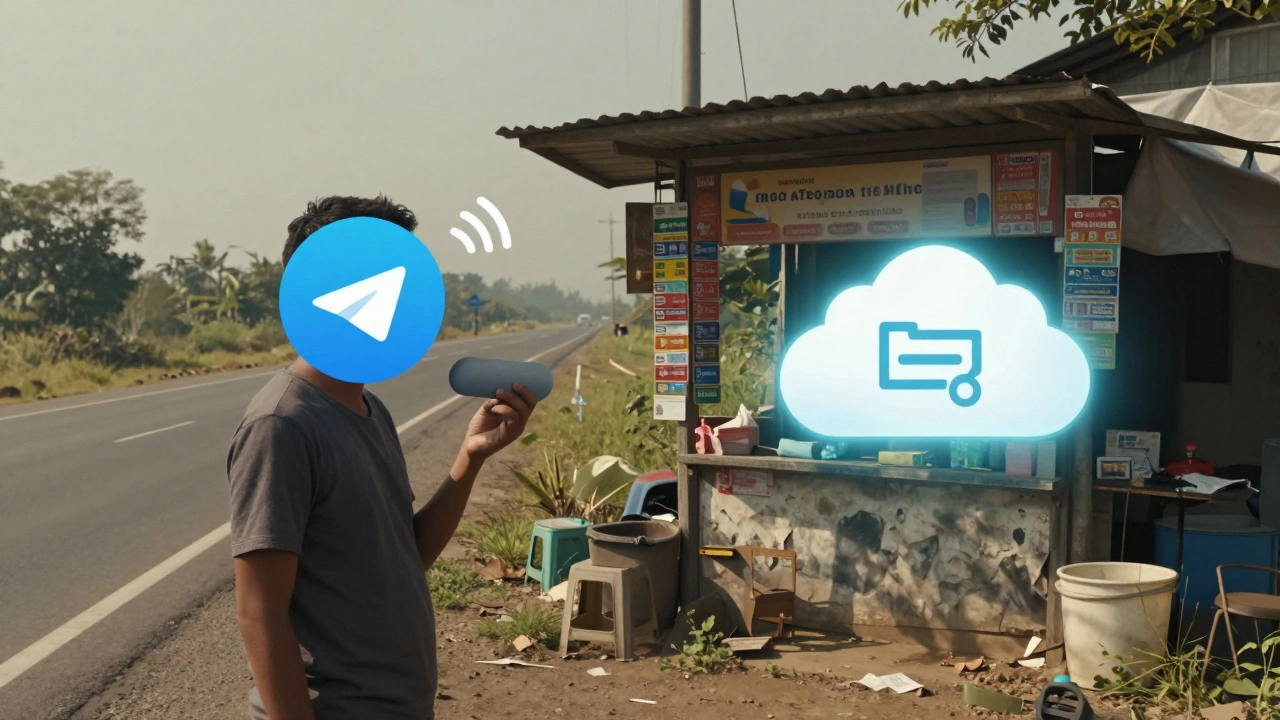
This efficiency isn’t accidental. Telegram’s engineers designed it with users in mind who live where mobile data is expensive and unreliable. The result? A platform that thrives in places where others struggle. In Indonesia, where 48% of the population uses Telegram for news, users report getting updates from channels on rural highways where 4G barely works. In Brazil, 39% of users say they rely on Telegram because it’s the only app that loads news during power outages or network congestion.
The Cost of Ignoring Telecom Realities
Many global news organizations still assume people in emerging economies consume news the same way they do in the U.S. or Europe-through websites, newsletters, or YouTube. But that ignores the real barrier: cost. A 5-minute video report on YouTube can use 150MB. On Telegram, the same story might be delivered as a 2-minute voice note (under 10MB) and a 5-image carousel (under 30MB total). That’s a 5x difference in data use.
When telecom providers charge per megabyte, users become highly selective. They don’t open links from strangers. They avoid platforms that auto-play content. They stick to channels they know are trustworthy and efficient. That’s why Telegram’s channel-based model works so well. You subscribe once. You get updates without constant data drains. You don’t have to scroll through ads, reels, or trending posts that don’t matter to you.
In India, where 45% of online users use Telegram regularly, a 2024 survey found that 68% of respondents preferred Telegram for news because "it doesn’t waste my data." That’s not a preference-it’s survival.
Who Gets Left Behind?
But here’s the catch: not everyone can use Telegram effectively. People without smartphones, or those on basic feature phones, can’t access it at all. In rural Kenya, where 30% of adults still use non-smartphones, Telegram adoption is below 12%. Even among smartphone users, those on the cheapest plans-often under $2/month-may not have enough data to even open the app daily.
This creates a two-tier news system. Those who can afford Telegram get real-time updates, investigative reports, and community-driven fact-checks. Those who can’t? They rely on word-of-mouth, radio, or state-controlled media. In Pakistan, a 2023 study found that households spending more than 15% of their income on mobile data were 3.5 times more likely to get news from Telegram than those spending less than 5%.
The gap isn’t just about technology. It’s about power. The people who control telecom pricing-governments, monopolies, international carriers-don’t always prioritize affordability. In some countries, data is priced as a luxury. In others, it’s treated as public infrastructure. The difference shows up in how news flows.
Telegram as a Lifeline, Not Just a Tool
In Iran, where the government has blocked international news sites for years, Telegram became the primary channel for independent reporting. By 2018, over 50 million Iranians were using it daily. More than 380,000 Persian-language channels were publishing over 2 million posts every day. Many of those channels were run by citizen journalists using minimal data-text updates, short audio clips, low-res photos. They didn’t need fancy tools. They needed efficiency.
That’s the pattern repeating everywhere. In Nigeria, Telegram channels report on local elections with photos taken on cheap phones and sent via compressed files. In Brazil, community groups use Telegram to share weather alerts, water shortages, and protest schedules-all with data usage under 5MB per update. These aren’t just news sources. They’re survival networks.
And when telecom companies raise prices or cut data allowances, these networks break. In 2023, when Egypt increased mobile data rates by 22%, Telegram usage dropped by 17% in rural areas within three months. People didn’t stop caring about news. They just couldn’t afford to keep checking.
What This Means for the Future
If telecom costs stay high, Telegram will remain the go-to for news in emerging economies-not because it’s perfect, but because it’s the least bad option. Platforms that demand more data, more bandwidth, more engagement will keep losing ground. The next wave of news innovation won’t come from flashy apps. It’ll come from lightweight, data-savvy tools that respect how little people can spend.
Investors, journalists, and policymakers need to stop assuming that high engagement equals high reach. In Lagos, a viral TikTok video might get 500,000 views. But if each view costs 30MB, and the average user has only 200MB left this month, that video reaches maybe 6,000 people. A 500KB Telegram text update? It reaches 400,000.
The real story of Telegram’s rise isn’t about encryption or privacy. It’s about economics. It’s about how a simple, efficient app became the most trusted news source for millions because it asked for less-and gave more.
Why is Telegram more popular than WhatsApp in emerging economies?
Telegram uses significantly less data than WhatsApp, especially for media and group chats. It lets users control auto-downloads, stores files in the cloud, and doesn’t force constant syncing. In places where data is expensive, these features make Telegram the only practical choice for daily news checks.
Do telecom companies intentionally make data expensive in emerging markets?
Many do-not always out of malice, but because of infrastructure gaps and profit models. In countries where fiber networks are underdeveloped, mobile carriers rely on expensive spectrum licenses and limited capacity. They price data to recoup costs, not to serve users. This creates a cycle where only wealthier users can afford reliable news access, while others are left behind.
Can Telegram be used without internet access?
No. Telegram requires an internet connection. But it’s designed to work with very little data. Users can download content once and access it offline. Many people in low-connectivity areas save news channels, audio updates, and documents to their phones when they have Wi-Fi, then read them later without using mobile data.
Is Telegram the only platform that works well with low data?
No, but it’s one of the few designed for it from the start. Apps like Signal and Threema also use less data than Facebook or WhatsApp, but they lack Telegram’s channel system and file-sharing tools. For news consumption, Telegram’s combination of efficiency, scalability, and organization makes it unmatched.
How do people in emerging economies afford Telegram data?
Many rely on cheap prepaid plans, shared Wi-Fi, or data bundles offered by local providers. In some countries, telecom companies offer special "news bundles"-small, low-cost data packages that work only with apps like Telegram or WhatsApp. Others trade data with neighbors or use public libraries and internet cafes. Affordability is a daily negotiation, not a fixed cost.