Telegram isn’t just another messaging app. For news publishers, it’s the most direct line to an audience that actually reads. But sending the same update to 50,000 subscribers? That’s not personalization. That’s noise. And in a world where people get 12 news alerts before breakfast, Telegram news personas are the only way to stand out - and stay relevant.
Why Personas Work Better Than Broadcasts on Telegram
Most Telegram news channels treat their audience like a single block. They blast headlines. They hope for clicks. They wonder why open rates drop after a month. The problem isn’t the content. It’s the delivery.
Telegram channels can have unlimited subscribers, but they don’t have built-in segmentation. You can’t group users by interest or schedule. That’s why top channels now use Telegram news personas - detailed profiles of who their subscribers are, what they care about, and how they want to consume news.
Channels using this method see 47% higher engagement, according to Graphy’s 2025 case studies. Why? Because people don’t want more news. They want the right news, at the right time, without the clutter.
Think of it like a radio station. You wouldn’t play heavy metal to a group of retirees expecting morning market updates. Same logic applies here. A 34-year-old investment analyst in London doesn’t want crypto memes. A retiree in Manila doesn’t need deep dives on Fed policy. Personas let you match content to context.
Who Are Your Telegram News Subscribers? The 3 Core Personas
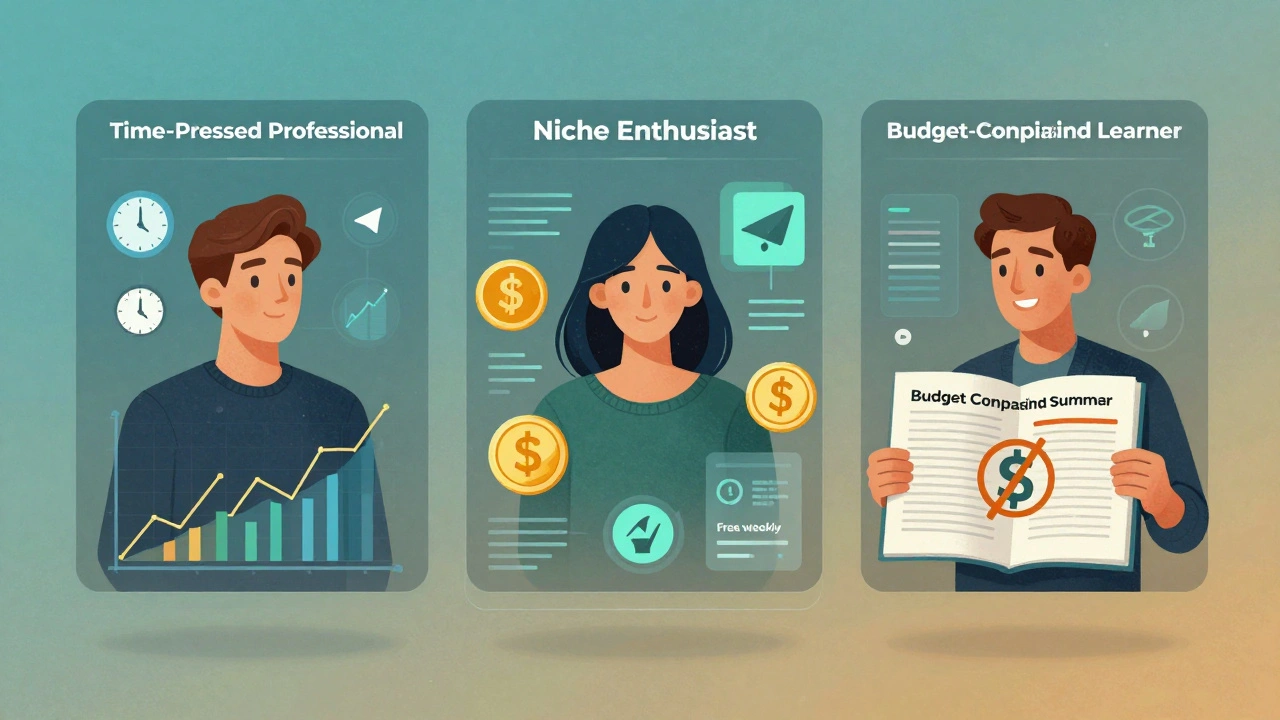
Based on analysis of over 1,200 subscriber comments from Reddit and subscription behavior from Graphy’s 2026 report, three clear personas dominate Telegram news audiences:
- The Time-Pressed Professional (42% of paid users): Usually 30-45, works in finance, law, or tech. They’re busy. They want clarity, not noise. They pay for scheduled digests - 7:00 AM for markets, 6:30 PM for global wrap-up. They don’t read every message. They wait for the ones that arrive on time, with clean summaries. One user, u/FinancePro92, says: “I pay $12/month specifically for the 7 AM market digest that fits my commute.”
- The Niche Enthusiast (31% of subscribers): This could be a crypto trader, a geopolitical hobbyist, or a climate data nerd. They follow obscure sources. They want aggregation. One subscriber, u/CryptoDeepDive, said: “Having all DeFi sources in one personalized feed saves me 2 hours daily.” These users tolerate paywalls if the content is unique. They’re the ones who forward your updates to their Slack groups.
- The Budget-Conscious Learner (27% of free users): Students, early-career professionals, retirees on fixed income. They want quality but won’t pay. They complain about locked content. App Store reviews show 68% of negative feedback mentions “too much locked behind subscriptions.” They’ll stick around if you offer free daily summaries, weekly deep dives, and occasional free Q&As.
These aren’t guesses. They’re patterns from real behavior. Build your personas around these types - not age or location alone, but behavior, willingness to pay, and content expectations.
How to Build a Subscriber Persona (Step by Step)
Creating personas isn’t about writing fiction. It’s about collecting facts.
- Start with data, not assumptions. Don’t say “our audience is 25-35.” Use Telegram bot menus to ask: “What topics do you want daily?” Options: Markets, Tech, Politics, Climate, Crypto, Local News. Let users pick 1-4. Track responses.
- Ask for delivery preferences. Use a simple bot: “When should we send your digest? 7 AM, 12 PM, 6 PM, or none (weekly summary)?” 65% of successful channels use this. The most popular times: 7:00 AM and 6:30 PM.
- Identify source preferences. “Which sources do you trust?” Offer 5-8 options: Bloomberg, Reuters, Financial Times, CoinDesk, The Guardian, AP, local outlet, independent blogger. Users will pick 2-4. This tells you what to aggregate.
- Test willingness to pay. Run a 48-hour survey: “Would you pay $5/month for ad-free, scheduled updates with analysis?” Use a link to a simple payment page (Graphy or Stripe). Track conversion. You’ll learn what price point feels fair.
- Build a profile template. Each persona should include: Name (e.g., “Maria, 34, Investment Analyst”), Preferred Topics, Delivery Time, Sources, Payment Tier, and a quote from real feedback. Save this in a spreadsheet or database.
Example persona: “Maria, 34, Investment Analyst. Needs: 7:00 AM global market digest. Sources: Bloomberg, FT, Wall Street Journal. Willing to pay: $15/month. Quote: ‘I don’t have time to hunt for updates. You give me the signal, not the noise.’”
How to Structure Content for Each Persona Tier
Once you have personas, structure your content in tiers. This isn’t optional. It’s what keeps people subscribed.
Based on Graphy’s 2026 framework, the standard model is:
- Basic (Free): One daily digest (2-4 headlines), 300 words max, no analysis. Delivered at 7:00 AM. Sources: Public, high-reliability outlets. No paywall.
- Pro ($9.99/month): Two digests (AM + PM), 1-2 deep dives per week, source comparisons (“Bloomberg says X, FT says Y”), curated links. Includes access to weekly archive. This tier captures 58% of paying subscribers - people choose it because it feels premium but not overwhelming.
- VIP ($19.99/month): All Pro features + live Q&A every Friday, early access to reports, exclusive interviews, and direct bot replies to questions. Only 12-15% of users upgrade here, but they’re your most loyal advocates.
Channels using this structure see 63% higher 90-day retention than single-tier channels. The middle tier is the sweet spot. People don’t want to pay too much. They don’t want to feel cheap. Pro is the Goldilocks zone.
Technical Setup: What You Actually Need
You don’t need a team of developers. But you do need three tools:
- Telegram Bot: Use BotFather to create one. It handles preference collection. 83% of top channels use interactive menus (buttons, not text replies).
- Backend Database: Store preferences in PostgreSQL or Firebase. Each user profile needs 12-15 data points: topics, time, sources, tier, last update, feedback score. Newsmate’s system handles 4,700 updates daily for 50,000 users.
- Aggregation Engine: Pull from 3-12 sources per user. Use RSS feeds or APIs. Tools like Zapier or Make.com can automate this. Average: 7.2 sources per profile.
Telegram doesn’t let you segment users inside a channel. So you need a separate system. That’s okay. Most successful channels use FastAPI or Node.js backends. Monthly cost: $3,200. Compare that to a native app: $24,500.
And yes, you need analytics. InviteMember ($49/month) tracks 17 metrics: open rate, click rate, churn, preference changes. Without it, you’re flying blind.
What Not to Do (And Why People Leave)
People don’t leave because the news is bad. They leave because you broke a promise.
Here’s what kills retention:
- Ignoring preferences: 41% of churn happens because users set a topic or time, then get irrelevant content. If someone picks “Crypto” and you send them politics? They’ll leave.
- Not updating personas: People’s interests change. A crypto trader might shift to AI stocks. Automated re-engagement messages (“Still interested in crypto? Update your settings”) fix 73% of outdated profiles.
- Over-personalizing: Too many filters create echo chambers. A 2025 Wired study found Telegram users consume 37% less diverse news than those on algorithmic platforms. Balance personalization with occasional broad headlines.
- Too many paywalls: Free users want value. Offer a free weekly summary. Let them sample. Don’t lock everything.
One channel lost 2,000 subscribers in a month because they changed the delivery time from 7 AM to 8 AM without asking. No one complained. They just unsubscribed.

Monetization and Growth: Real Numbers
Only 17% of Telegram news channels make money. But the top 10% earn $12,000-$85,000 monthly. Here’s how:
- Pro tier at $9.99/month: 58% of payers choose this.
- VIP tier at $19.99: 12-15% of payers.
- Free users: 73% of total audience, but only 3-5% convert to paid - if you nurture them.
Channels with persona-based onboarding see 53% higher 30-day retention (68% vs. 45% industry average). Referral rates jump 2.3x. People tell friends: “This channel actually gets me.”
Enterprise adoption is rising. 43 Fortune 100 companies now run official Telegram news channels. Not for marketing. For internal comms and stakeholder updates. They use the same persona model.
The Future: AI That Adapts Automatically
By 2027, Gartner predicts 75% of Telegram news channels will use AI to auto-adjust personas. No more manual surveys. The system learns from what you read, what you skip, what you forward.
Right now, tools like Newsmate analyze 27 behavioral signals: time opened, length read, links clicked, replies sent. Then they tweak your profile. If you start reading more about AI and less about crypto? Your feed shifts - without you lifting a finger.
But here’s the catch: the EU’s Digital Services Act now requires transparency. You must explain how your persona system works. No black boxes. So document your logic. Even if it’s simple: “We group you by topics you selected and delivery time you chose.”
Final Thought: It’s Not About Tech. It’s About Trust.
Telegram’s power isn’t its features. It’s the direct, no-algorithm relationship between you and your subscriber. When you build personas, you’re not just organizing content. You’re saying: “I see you. I know what you need. I won’t waste your time.”
That’s why people pay. That’s why they stay. That’s why they refer others.
Start small. Build one persona. Test it. Fix what breaks. Then scale. The rest? That’s just delivery.
Latest Posts