Why Telegram Is Now the First Place to See Breaking News
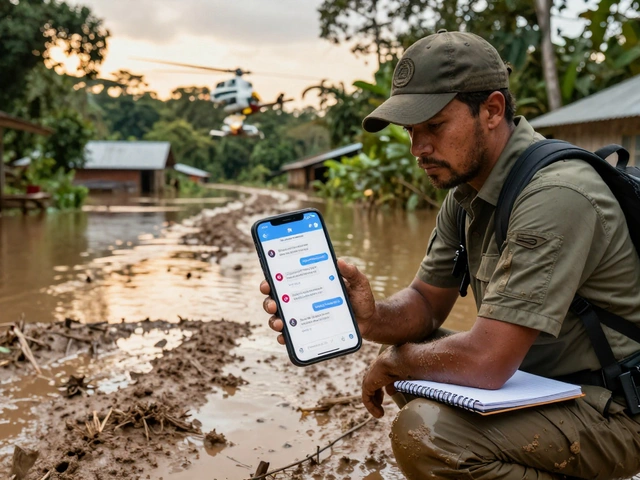
When a major event happens-like a natural disaster, political upheaval, or military strike-people don’t wait for TV news to air. They go to Telegram. In 2025, over 950 million people use Telegram, and nearly 1.2 million public channels are dedicated to news. Unlike Twitter or Facebook, Telegram doesn’t push content based on algorithms. Posts show up in order, so you see what happened first, not what got the most likes. That’s why journalists, investigators, and everyday users now turn to Telegram before any other platform for real-time updates.
But here’s the catch: just because something is posted on Telegram doesn’t mean it’s true. A study from January 2025 found that over 400,000 active Telegram channels spread misinformation. Some of these channels look exactly like real news outlets. One fake channel named @BBC_News_Official789 fooled thousands before it was taken down. The real @BBCNews has a blue checkmark. The fake one doesn’t. And if you don’t know how to tell the difference, you’ll believe false stories-like a video of a missile strike in Ukraine that was actually from a 2022 game trailer.
The Four Tools You Need to Verify Telegram News
Verifying news on Telegram isn’t about guessing. It’s about using four simple tools that anyone can learn in under an hour.
- Public channels: These are one-way feeds like @Reuters, @AFP, or @BBCBreaking. They’re run by real news organizations. Look for the blue checkmark next to the name. If it’s not there, treat it like a blog post-not a report.
- Group chats: Some groups have over 100,000 members and are used by fact-checkers to crowdsource verification. Channels like @CrossRefNews (launched in late 2024) let users submit suspicious posts for review. These groups are where real-time debunking happens.
- Verification bots: Tools like TGStat and Combot Statistics show how often a channel is mentioned by others. A channel with a high citation index (meaning lots of other channels link to it) is more likely to be trustworthy. TGStat Pro costs $49/month, but the free version works fine for most users.
- Forwarded from metadata: Every message on Telegram shows where it came from. If you see a video with “Forwarded from @UkraineWarUpdates,” go to that channel and check if they posted it first. If they didn’t, it’s likely been edited or taken out of context.
How to Cross-Reference Like a Pro (Step by Step)
Here’s how professional fact-checkers verify a breaking news post on Telegram. Follow these steps every time:
- Find the original source. Look at the “Forwarded from” line. If it says “Forwarded from @UnknownUser,” stop. This isn’t a source-it’s a rumor.
- Search for the same content. Use Telegram’s search function: type
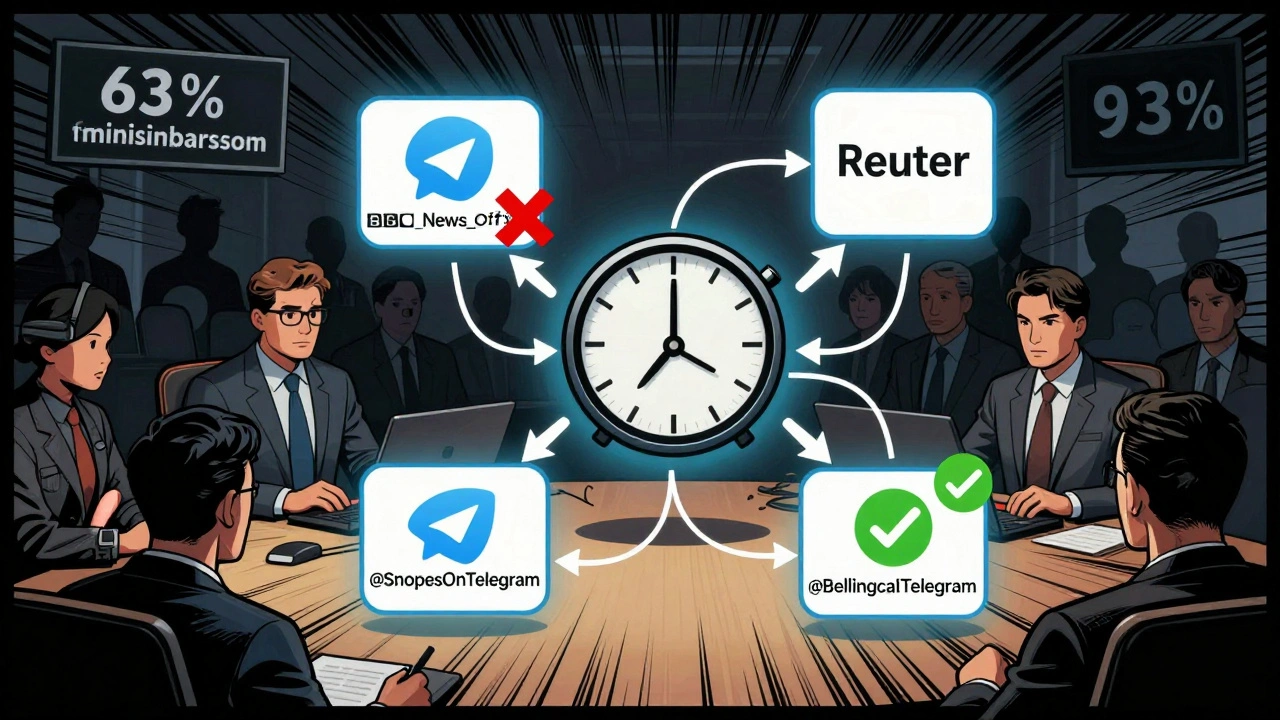
t.me/s/channelname?before=messageIDinto your browser. Replacechannelnamewith the channel’s username andmessageIDwith the ID of the post. This lets you see if other channels have posted the same thing. - Check at least three independent channels. Don’t rely on just one. Find one official wire service (like @Reuters), one major news outlet (like @CNNbrk), and one fact-checking channel (like @SnopesOnTelegram). If all three confirm it, it’s likely true.
- Look for geolocation clues. If a post claims a bombing happened in Kyiv, check the shadows in the video. Use tools like SunCalc.org to see where the sun was at that time. If the lighting doesn’t match, it’s fake. Bellingcat’s team used this method to verify Russian troop movements in 2023.
- Check the timeline. Did the post appear 10 minutes after the event? Or did it appear 3 hours later? Real news spreads fast. If it took hours to appear, it’s probably staged or recycled.
One journalist in Ukraine verified a missile strike in Kharkiv in under 8 minutes using this method. She cross-referenced three Ukrainian channels, one Russian channel, and @Reuters. All three sources matched on time, location, and equipment type. That’s how you know it’s real.
What You’ll See on Telegram (And Why It’s Misleading)
Telegram is full of tricks designed to make false stories look real. Here are the most common ones:
- Image-text mismatch. A photo of a fire in Syria is paired with text claiming it happened in Poland. This trick works because 68% of viral health and war misinformation uses emotional image-text combos to trigger outrage. Always reverse-image search the photo using Google Lens or TinEye.
- Same channel, different name. @BBCNews is real. @BBC_News_Official789 is fake. The difference is tiny. Always double-check the exact username. Even one letter off means it’s not official.
- Staged footage. Videos of explosions often use stock footage from movies or video games. Look for unnatural lighting, repeating backgrounds, or impossible physics. A real explosion doesn’t pause mid-air.
- Private group leaks. Most misinformation starts in private groups that can’t be searched. That’s why 72% of false claims on Telegram can’t be verified-they never leave the group. If you only check public channels, you’re missing half the story.
Who’s Getting It Right (And Who’s Not)
Some newsrooms have mastered Telegram verification. Reuters, AFP, and The Wall Street Journal now have teams dedicated to monitoring Telegram. Their average response time to breaking news is 17 minutes. Independent fact-checkers take 42 minutes.
Why the difference? Professional teams use TGStat to track citation indexes. They know which channels are cited by others. They don’t just look at the post-they look at who’s talking about it. If @BellingcatTelegram shares a post, and then @Reuters and @AFP also reference it, that’s a green flag.
On the flip side, amateur users often make the same mistakes:
- They trust one source because it “feels right.”
- They don’t check the original channel-just the forwarded version.
- They ignore non-English channels. 42% of active news channels on Telegram are in languages like Ukrainian, Arabic, or Russian. If you only check English ones, you’re blind to half the truth.
One Reddit user, u/TruthSeeker99, spent three hours trying to verify a fake missile strike during the Iran-Israel conflict. He used only two sources-both were run by the same person. He didn’t check @SnopesOnTelegram or @Reuters. He believed a lie.

The Future of Telegram News Verification
Telegram is changing. In Q2 2025, CEO Pavel Durov plans to roll out official verification badges for news organizations. That will help users spot real channels. But it won’t fix the core problem: private groups.
Right now, 63% of misinformation starts in private chats that can’t be searched. Even if Telegram adds badges, those groups will still spread false claims. The only solution is better public awareness.
Meanwhile, the EU’s Digital Services Act will force Telegram to improve its verification tools by mid-2025. That could mean AI detection for deepfakes or mandatory labeling of unverified content. But until then, the burden is on you.
Fact-checking on Telegram isn’t optional anymore. It’s a survival skill. The same way you check a bank statement before transferring money, you need to verify a Telegram post before sharing it.
Quick Checklist for Telegram News Verification
- ✅ Look for the blue checkmark on official channels
- ✅ Always check “Forwarded from” before trusting a post
- ✅ Search for the same content on at least three independent channels
- ✅ Use TGStat or Combot to check citation indexes
- ✅ Reverse-image search visuals with Google Lens
- ✅ Check the timing-real news spreads in minutes, not hours
- ✅ Never trust a post from a private group without public proof
- ✅ Use fact-checking channels: @SnopesOnTelegram, @PolitiFactTelegram, @FullFactTelegram
Can You Trust Telegram for Breaking News?
Yes-but only if you know how to use it. Telegram is the fastest, most open platform for breaking news. But it’s also the most dangerous if you don’t verify. The difference between truth and lies comes down to one habit: cross-referencing.
Every time you see a shocking video or claim, pause. Don’t share it. Don’t react to it. Go find the original source. Find two others. Check the time. Check the location. Check the language. If all three lines up, it’s probably real. If not, it’s noise.
Journalists don’t get paid to be fast. They get paid to be right. You don’t need a press pass to do the same.