Stop guessing when your audience is awake. Most publishers stick to a "standard" posting schedule-maybe 9 AM and 6 PM-because that's what some generic blog told them to do. But on Telegram is a cloud-based instant messaging service that delivers content chronologically and instantly to subscribers, a generic schedule is a waste of reach. Unlike Facebook or Instagram, where an algorithm decides if your post is seen three hours after you hit publish, Telegram puts your news right at the top of the user's chat list the second it drops. If you post a breaking story at 3 AM when your readers are asleep, you aren't just losing views; you're risking Telegram A/B testing failures and, worse, notification fatigue that leads to users muting your channel forever.
Why Timing is Different on Telegram
The technical architecture of Telegram changes the rules of engagement. On other platforms, the algorithm acts as a buffer. On Telegram, the notification is the trigger. This creates a high-stakes environment: you have a direct line to the user's pocket. If you hit that line at the wrong time, you're an annoyance. If you hit it during a "micro-moment"-those small gaps in a user's day where they check their phone-you win the click.
Because the feed is strictly chronological, the window of peak visibility is much narrower. Your content doesn't "linger" in a discovery feed for days. This means the difference between posting at 12:00 PM and 12:30 PM can actually impact your total view count. To stop the guesswork, you need a systematic way to test these windows using actual data from your own subscribers.
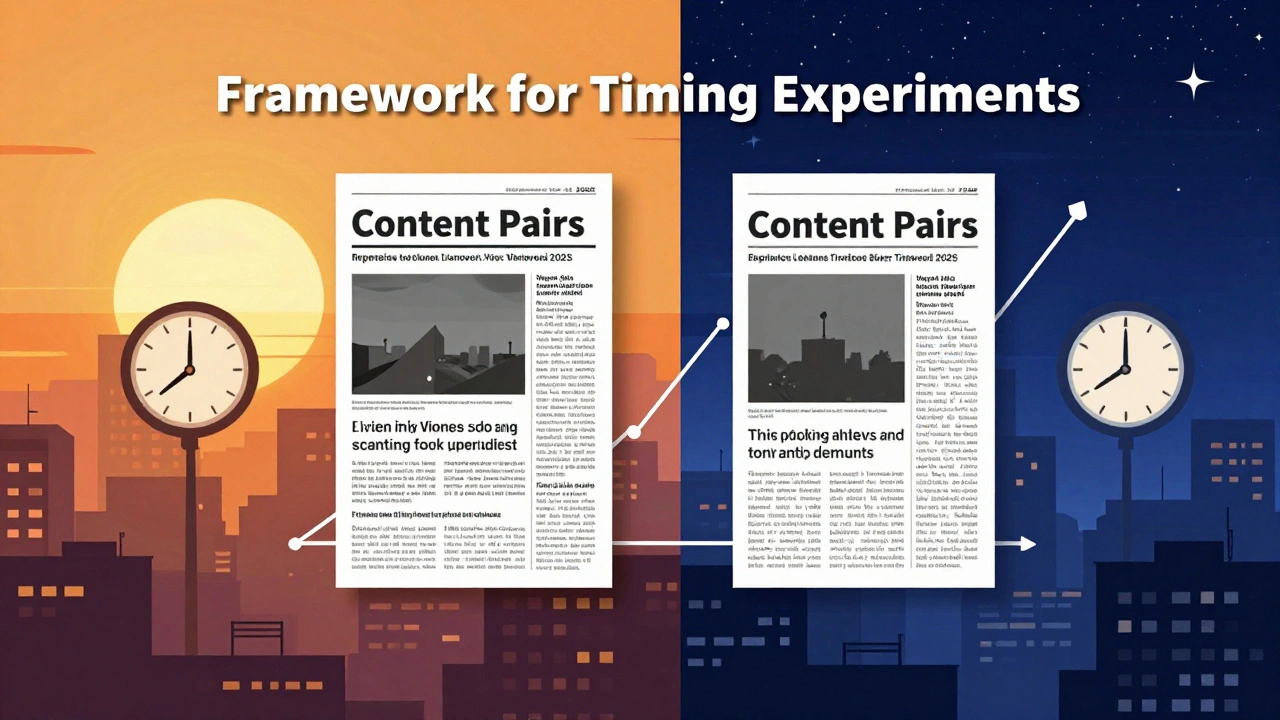
The Framework for Timing Experiments
You can't just post randomly and call it a test. To get a clean result, you have to isolate timing as the only variable. If you post a boring story on Monday morning and a viral bombshell on Tuesday evening, the evening post will win-not because the time was better, but because the content was better. That's a failed experiment.
To run a proper test, follow this structure:
- Define Time Blocks: Divide your day into logical segments: Morning (7 AM - 10 AM), Midday (12 PM - 2 PM), Afternoon (3 PM - 6 PM), and Evening (8 PM - 11 PM).
- Create Content Pairs: Find two pieces of content that are similar in format and appeal (e.g., two brief news summaries about the same topic).
- Split the Delivery: Post Version A in the Morning block and Version B in the Evening block.
- Control for Duration: Run this cycle for at least two to three weeks to account for day-of-the-week anomalies (Tuesdays often behave differently than Saturdays).
- Measure the Delta: Compare the view counts and shares specifically for those two posts.
Matching Content Types to the Clock
Not all news is created equal. A breaking news flash needs to be instant, but an analysis piece requires a different strategy. Based on behavioral patterns, different formats hit different "cognitive loads" throughout the day.
| Content Type | Suggested Window | User Mindset |
|---|---|---|
| Breaking News/Alerts | Immediate / 7 AM - 9 AM | Information seeking, "What happened?" |
| Long-form Analysis | 8 PM - 11 PM / Weekend Mornings | Focused attention, leisure reading |
| Polls & Interactive Posts | 12 PM - 2 PM / 7 PM - 10 PM | Active participation, boredom breaking |
| Community Announcements | 7 PM - 9 PM | High simultaneous activity, social connection |
For example, if you run a political news channel, a 2,000-word deep dive into policy will likely tank if posted at 11 AM when people are in meetings. However, that same post might see a 30% higher read-through rate if published at 9 PM when users are winding down and have the mental space to actually read it.
Using Native Analytics to Validate Results
You don't need expensive third-party software to start. Telegram Analytics is the built-in statistics tool provided by Telegram for channel administrators to track views, reach, and growth provides the raw data you need. Look specifically at the view-to-subscriber ratio. If 50% of your subscribers see a post in the first two hours at 8 AM, but only 20% see it in the first two hours at 2 PM, you've found a clear winner.
Beyond views, track the Click-Through Rate (CTR). Use a URL shortener or a tracking link to see if people are more likely to click your external articles during their lunch break or late at night. Often, a post might get many views at 9 AM (passive scrolling), but the actual clicks happen at 1 PM (active interest). Your goal isn't just views; it's action.

Avoiding the "Mute" Trap
The biggest risk in experimenting with timing is notification fatigue. Every time a user's phone buzzes, they make a split-second decision: "Is this valuable or is this noise?" If you start testing a 6 AM posting window and your audience finds it intrusive, they won't just ignore the post-they'll mute the channel. Once a channel is muted, you've lost the primary advantage of the platform.
To mitigate this, avoid "clustering" your tests. Don't push five different timing experiments in one week. Gradually shift your window by 15 to 30 minutes every few days rather than jumping from 9 AM to 9 PM overnight. This allows your audience to adjust to a new rhythm without feeling bombarded.
Scaling the Strategy for Global Audiences
If your news channel serves a global audience, a single "best time" doesn't exist. A post that hits the sweet spot for New York (EST) is hitting the middle of the night for Tokyo (JST). This is where you move from simple A/B testing to segmentation.
Try creating regional mirrors of your channel or using a scheduling tool that allows you to stagger posts. If you have a heavy concentration of readers in Europe and the US, you might find that a "double peak" strategy works best-one burst of content at 8 AM UTC and another at 3 PM UTC. Use heat maps of your user activity to identify these clusters and treat each peak as its own separate A/B testing environment.
How long should a timing A/B test run before I trust the data?
You should run your tests for at least 14 to 21 days. A single week isn't enough because user behavior varies wildly between weekdays and weekends. By testing over three weeks, you can see if a "Tuesday at 10 AM" win is a consistent pattern or just a fluke caused by a specific news event that happened that day.
Does the content format actually change the best time to post?
Yes, absolutely. Short-form updates and breaking news are best consumed during "micro-moments" like commutes or lunch breaks. Conversely, long-form analysis requires high cognitive load, which most people only have during late evening hours or weekend mornings. Testing the same content type at different times is the only way to find this balance.
Can I use results from other platforms like X (Twitter) or Facebook?
No. Telegram's chronological delivery and notification-heavy nature make it fundamentally different. Other platforms use algorithms that might show a post hours or days later, meaning the exact time of posting is less critical. On Telegram, the timing is the delivery mechanism itself.
What is the risk of posting too frequently during tests?
The primary risk is notification fatigue. When users feel a channel is spamming them, they are likely to mute the channel or unsubscribe entirely. To avoid this, ensure your tests don't increase the total volume of posts per day; instead, simply move existing posts to different time slots.
Should I use automation tools for these tests?
Automation tools are helpful for maintaining a consistent schedule, especially when testing across multiple time zones. However, don't automate everything. Keep a human element for breaking news, as those posts should always bypass the "scheduled" timing to maximize the value of being first.
Latest Posts