When something big happens in a region-like an election, a protest, or a war-Telegram doesn’t just react. It explodes. Thousands of new users join. Channels flood with updates. Misinformation spreads faster than facts. And in a matter of hours, a local event becomes a global information war. This isn’t theory. It’s what’s been happening for years, and it’s getting worse.
How Elections Turn Telegram Into a Propaganda Machine
In Romania’s 2024 presidential election, a single Telegram channel called “Propagator” pushed a little-known candidate, Calin Georgescu, into the spotlight. It didn’t do this by accident. It coordinated 41 county-specific groups, each pumping out tailored content-videos, memes, fake polls-to match local concerns. Together, these groups generated over 1.4 billion views across TikTok and Telegram. The goal? Make it look like a grassroots movement. The reality? A tightly controlled disinformation network.
Similar tactics played out in Moldova. Authorities shut down more than 95 Telegram chatbots tied to pro-Kremlin figure Ilan Shor during their October 2024 vote. Why? Because those bots were flooding local channels with fake claims of election fraud, confusing voters and eroding trust in the process. Telegram didn’t create these campaigns-but its architecture made them possible. Channels can broadcast to millions without moderation. Groups can organize in secret. And bots can auto-post at scale.
These aren’t isolated cases. In Ukraine, during the 2022 invasion, Telegram became the primary source of real-time updates. People shared live maps of Russian troop movements. Emergency contacts. Medical aid locations. But the same platform also spread Russian disinformation-false claims of Ukrainian attacks, doctored videos of civilian casualties. The same channel that saved lives in Kyiv was also used to scare people in Odessa.
Conflict Triggers Instant, Massive Spikes
War changes how people use Telegram. When Russia invaded Ukraine on February 22, 2022, activity on Russian diplomatic Telegram channels jumped 300% in just 48 hours. In Kazakhstan, Russian-language channels saw over 10,000 comments in three years. In Djibouti? Just three. That’s not random. It’s targeted. Russia’s diplomatic Telegram strategy focuses on post-Soviet states-83% of their content goes there. Asia-Pacific gets 12%. Africa? Just 5%.
Telegram’s structure makes this easy. One message can be forwarded across dozens of channels in seconds. Unlike Twitter or Facebook, there’s no algorithm pushing content. Instead, users follow channels they trust. And when fear spreads, so does misinformation. MIT found that Telegram-based disinformation spreads 3.2 times faster than on Twitter during crises. Russian-language content, in particular, migrates across platforms at a 67% rate-meaning a lie told on Telegram ends up on YouTube, WhatsApp, or even mainstream news sites.
Even smaller conflicts trigger spikes. The Crocus Hall attack in March 2024 sent Telegram channels into overdrive. Within hours, deepfake audio clips of Ukrainian officials admitting responsibility were circulating. AI-generated voices made it sound real. By December 2024, researchers found that 22% of all viral misinformation during regional events was AI-generated. That number is expected to hit 65% by 2026.
Censorship Makes People Run to Telegram
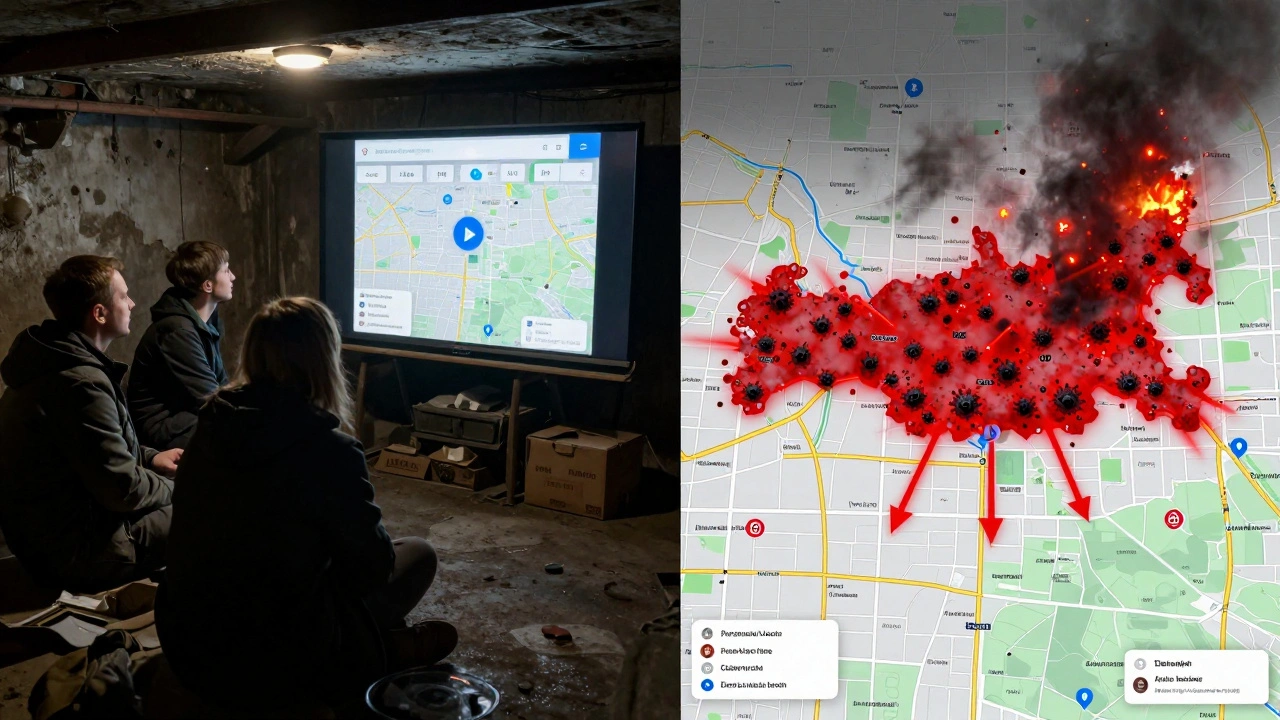
When governments try to shut down information, Telegram becomes the escape hatch. In South Korea, after lawmakers proposed new press restrictions in January 2025, Telegram installations jumped 27% in one week. People didn’t just download the app-they created new accounts using virtual numbers to bypass local restrictions. On Naver Blog, 78% of users reported using secondary accounts to access international news channels.
The same thing happened in Hong Kong. During the 2019 anti-extradition protests, Telegram was the backbone of coordination. Protesters shared real-time police locations, medical aid spots, and legal advice. Channels were organized by neighborhood. Messages were encrypted. But after China imposed the National Security Law in July 2020, activity collapsed. By 2021, usage dropped 63%. The platform didn’t disappear-it was suppressed. And when governments can control the network, Telegram’s power vanishes.
When Telegram’s CEO Gets Arrested, Everyone Pays Attention
On April 12, 2024, Pavel Durov was arrested in France over allegations of failing to combat illegal content. The reaction wasn’t just political-it was technical. Within 72 hours, new user registrations surged 220% across Eastern Europe. Why? Because people saw it as a sign that Telegram was finally being held accountable. But it also signaled something else: the platform was vulnerable.
At the same time, U.S. law enforcement saw a 65% spike in data requests. Telegram, under pressure, changed its policies. By late 2024, it began fulfilling 185% more requests from U.S. authorities than in 2023. That’s a major shift for a platform built on privacy. Users who joined for secrecy now had to wonder: Is this still safe?
Who’s Monitoring This? And How?
News organizations are scrambling to keep up. BBC Monitoring found that 63% of major outlets increased Telegram monitoring during crisis events-up from just 22% in normal times. But most don’t have the tools. Telegram doesn’t offer analytics beyond subscriber counts. So researchers rely on third-party services like TGSTAT, which themselves are 18-22% inaccurate during high-traffic spikes.
Tracking real influence requires more than just watching channels. You need to map the network. The arXiv study showed that identifying the key “bridge nodes”-channels that connect disinformation networks-requires at least 21 days of data. Without that, false positives are high. Teams using Python tools like Telethon API need 40-60 hours just to set up basic monitoring. Most newsrooms can’t afford that.
And even when they do, verification is hard. In Romania, 32% of users shared misinformation believing it was legitimate protest coordination. The solution? Cross-check with at least three independent sources. In Hong Kong, users who did this avoided 82% of coordinated disinformation. Simple. But rarely practiced.
The Bigger Picture: Telegram as Critical Infrastructure
Telegram now has 950 million monthly users. Ukraine’s user base grew 320% after the invasion. Hong Kong’s spiked during protests. Even now, 72 of the Fortune 100 companies have official Telegram channels for crisis communication-up from 19 in 2021.
This isn’t just a messaging app anymore. It’s critical infrastructure. Governments use it to control narratives. Activists use it to organize. Journalists use it to report. And criminals use it to deceive.
But here’s the problem: Telegram doesn’t care who wins. It doesn’t moderate. It doesn’t fact-check. It just delivers. That’s why Goldman Sachs predicts it’ll hit 1.2 billion users by 2027. And why the Center for European Policy Analysis warns it could lose 40% of institutional users by 2028-if it keeps letting disinformation run wild.
Regional events will keep triggering spikes. Elections. Wars. Protests. Arrests. And every time, Telegram will be the stage. The question isn’t whether it will happen again. It’s whether anyone will be ready to separate truth from noise when it does.
Why does Telegram see spikes during regional events?
Telegram sees spikes during regional events because its structure allows for rapid, unmoderated information sharing. Channels can broadcast to millions instantly, groups can organize privately, and bots can automate content. During elections, conflicts, or crackdowns, people turn to Telegram for real-time updates-whether it’s protest coordinates, military movements, or emergency alerts. But the same features make it ideal for spreading disinformation, which often spreads faster than verified news.
Which types of events cause the biggest Telegram spikes?
Political elections cause the most sustained spikes, like Romania’s 2024 campaign that lasted six months. Conflict-related events, like Russia’s invasion of Ukraine, cause the sharpest surges-up to 400% in days. Censorship threats, such as South Korea’s 2025 press law proposal, trigger sudden download spikes. Arrests of key figures, like Pavel Durov in 2024, cause dual spikes: more users join, while authorities increase data requests.
How do disinformation networks use Telegram during elections?
Disinformation networks use Telegram by creating a hierarchy of channels: a central hub (like Romania’s “Propagator”) that coordinates dozens of localized groups. Each group tailors content to regional concerns-fake polls, doctored videos, or fabricated protest footage. They use bots to auto-post, and forward content across platforms like TikTok and YouTube. The goal is to mimic organic grassroots support while maintaining centralized control. In Romania, this network generated over 1.4 billion views across platforms.
Can Telegram be trusted during a crisis?
Telegram can be vital during a crisis-it saved lives in Ukraine with real-time evacuation maps. But it can’t be trusted as a source. It has no content moderation, no fact-checking, and no transparency. Studies show that 63% of misinformation spreads faster on Telegram than on Twitter. The only reliable way to use it is to cross-check every claim with at least three independent sources. Otherwise, you risk believing and sharing false information.
Why do governments try to block Telegram during protests?
Governments block Telegram during protests because it’s nearly impossible to control. Unlike social media platforms, Telegram doesn’t hand over user data easily, and its encrypted groups allow protesters to coordinate without fear of surveillance. During Hong Kong’s 2019 protests, Telegram was the main tool for sharing police movements and medical aid. After China imposed the National Security Law, Telegram usage dropped 63%-not because people stopped using it, but because the government cracked down hard on access.
What’s the future of Telegram in regional crises?
Telegram’s role will grow, but so will its risks. By 2026, AI-generated content is expected to drive 65% of all spikes. Deepfakes, automated bots, and hyper-targeted disinformation will become the norm. Governments may try to regulate it, but Telegram’s decentralized structure makes that difficult. Companies and journalists will need better tools to monitor it. Without major changes, Telegram risks becoming less a communication tool and more a weapon for misinformation.