Telegram isn’t just another messaging app. With over 800 million active users, it’s a global communication backbone for journalists, activists, traders, and everyday people who value privacy. But that same privacy is what’s putting it in the crosshairs of governments worldwide. As of December 2025, Telegram is caught in a tightening web of regulatory pressure - not because it’s breaking laws everywhere, but because it refuses to play by every country’s rules.
Why Governments Are Targeting Telegram
Telegram’s architecture is built for secrecy. Secret Chats use end-to-end encryption. Cloud chats? Not so much. Messages are encrypted between your device and Telegram’s servers, but Telegram holds the keys. That’s a dealbreaker for regulators who want access to content during investigations. In countries like Russia, China, and Vietnam, authorities demand full visibility into user communications. Telegram’s refusal to hand over encryption keys or install backdoors led to outright bans. Russia banned Telegram in 2018, then lifted it in 2020 after the company agreed to store Russian user data locally. Vietnam blocked it in June 2025 after cryptocurrency traders used Telegram channels to coordinate pump-and-dump schemes. The ban lasted six weeks and wiped out nearly half the members in major trading groups, according to ChainCatcher. China never lifted its ban - Telegram is still completely inaccessible there. The pattern is clear: if a country wants to monitor or control speech, Telegram is a threat. If it doesn’t, like in Dubai, Telegram operates without interference. That’s why the company moved its headquarters from Singapore to Dubai in 2021 - it’s the only major city that lets them run the platform on their own terms.How Telegram’s Design Creates Compliance Nightmares
Telegram’s technical setup makes compliance nearly impossible to standardize. Unlike WhatsApp, which is owned by Meta and has deep ties to law enforcement agencies, Telegram is decentralized. It doesn’t have a single point of control. Even its CEO, Pavel Durov, can’t force the platform to change how data is stored or accessed in every country. The biggest problem? Telegram doesn’t automatically delete data when required. In the EU, GDPR demands that user data be erased on request. In the U.S., law enforcement can request data with a warrant. But Telegram’s distributed servers - spread across Sweden, Singapore, and the Netherlands - mean there’s no single database to pull from. The company’s Q3 2025 transparency report shows they complied with only 38% of data requests from non-democratic nations. In democratic countries, compliance jumped to 71%. This selective approach works for users in free societies but raises red flags for financial regulators. The SEC fined financial firms $1.2 billion in 2024 for using Telegram to communicate about trades. Why? Because those messages couldn’t be archived or audited. Banks and hedge funds are now forced to spend up to $285,000 and 120 hours per year just to monitor Telegram activity through third-party tools like Global Relay or Sprinto.Telegram vs. Signal vs. WhatsApp: Who Plays by the Rules?
Comparing Telegram to its rivals shows how it sits in a dangerous middle ground. Signal is the gold standard for privacy. Every message, group chat, and call is end-to-end encrypted. No keys stored on servers. No cloud backups. Signal has only 50 million users, but it’s trusted by the U.S. military and journalists in authoritarian regimes. The downside? It’s slow to add features. No large groups. No bots. No public channels. It’s built for security, not scale. WhatsApp has 2.7 billion users. It uses Signal’s encryption protocol but shares metadata with Meta. That’s why it’s compliant everywhere. If the FBI asks for a user’s contact list or last seen time, WhatsApp hands it over. Governments love that. But users hate it. Privacy advocates call it a surveillance tool with a pretty interface. Telegram? It’s the middle child. It offers big groups, bots, channels, and cloud storage - all with some encryption. But that “some” is the problem. Regulators can’t trust it. Users can’t fully rely on it. It’s the app you use when you want convenience and secrecy - but not when you need either one for sure.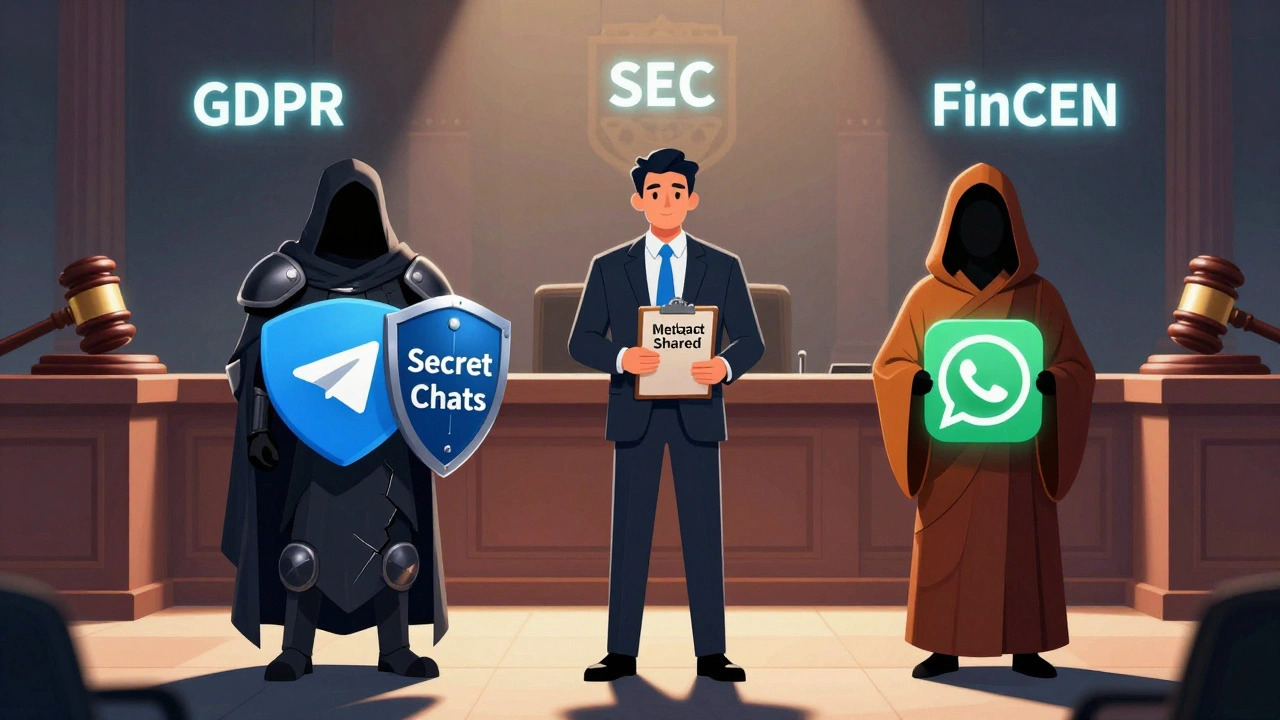
The Cocoon AI Experiment: Can Privacy and Compliance Coexist?
In Q2 2025, Telegram launched Cocoon AI - a new AI moderation system powered by data centers in Sweden. The goal? To detect illegal content without breaking encryption. The system scans public channels for known illegal material: child abuse imagery, terrorist propaganda, drug marketplaces. It doesn’t read private messages. It only flags content that’s already public. It’s a smart workaround. And it’s working - barely. After FinCEN pressured Telegram in September 2025 to shut down crypto scam channels like Huione Guarantee, Cocoon AI removed them within 48 hours. That’s faster than most platforms. But it’s still reactive. And it only works in public spaces. The real test comes when governments demand access to private chats. Cocoon AI can’t help there. And Telegram still won’t build a backdoor. That’s why the European Data Protection Board gave Telegram a “moderate improvement” rating on GDPR compliance - but still flagged it as high-risk.Who’s Getting Hurt? Users, Not Just Regulators
The fallout isn’t just legal. Real people are losing access to vital tools. In Ukraine, activists rely on Telegram to coordinate aid and share battlefield updates. One verified Trustpilot review from November 2025 says: “The only platform where activists can communicate safely.” In Brazil, political organizers used Telegram to mobilize voters during the 2024 elections. In Thailand, journalists used it to report on protests. When Telegram gets blocked, these communities go dark. Even in places where it’s legal, users face sudden bans. In India, during the 2025 election season, dozens of news channels were removed without warning. No explanation. No appeal process. Reddit users in r/Telegram reported 37 cases of political content being deleted during global elections - all without transparency. The lack of due process is a silent crisis. Telegram doesn’t have a public appeals system. No human review. Just an algorithm. And if you’re flagged, you’re gone.
The Future: Survival or Collapse?
Telegram’s growth has slowed. In 2025, it grew by just 8.3% - far behind WhatsApp’s 12.7% and Signal’s 22.1%. Why? Because the world is getting more regulated, not less. Financial institutions are dropping it. Governments are tightening controls. Even its core users - crypto traders - are moving to alternatives like Matrix and Briar, which offer better compliance options. The arrest of Pavel Durov in France in August 2025 was a turning point. It forced Telegram to release jurisdiction-specific transparency reports - but only for “democracies with strong rule of law.” That’s code for: we’ll cooperate with you if you’re nice. We won’t with the rest. Gartner predicts Telegram will lose 15-20% of its market share in regulated countries by 2027. But in Southeast Asia and Latin America, where governments are weak or corrupt, Telegram will keep growing. It’s not a global platform anymore. It’s two platforms: one for the free world, one for the rest.What This Means for You
If you’re a regular user: understand that Telegram isn’t private everywhere. If you’re in a country that bans it, your messages might be blocked. If you’re in a country that allows it, your data might still be shared with authorities - especially if you’re in a public channel. If you’re a business or financial professional: avoid using Telegram for official communications. The fines are real. The audits are coming. And your compliance team won’t thank you for it. If you’re a journalist or activist: Telegram is still your best bet - but only if you use Secret Chats. Never post sensitive info in public channels. And always have a backup plan. When Telegram goes down, so do your connections. The truth is simple: Telegram won’t disappear. But its role is changing. It’s no longer the champion of digital freedom. It’s a tool - powerful, useful, dangerous - that survives only where it’s tolerated. And tolerance is shrinking.Is Telegram completely encrypted?
No. Only "Secret Chats" are end-to-end encrypted. All other messages - including group chats and cloud-based messages - are encrypted between your device and Telegram’s servers, but Telegram holds the decryption keys. That means they can technically access your messages if required by law.
Why was Telegram banned in some countries?
Telegram was banned in countries like Russia, China, and Vietnam because it refused to give governments access to user messages or install backdoors for surveillance. Authorities saw its encryption and lack of content moderation as a threat to state control, especially during protests, elections, or financial crackdowns.
Can law enforcement access Telegram messages?
Only if they’re not encrypted end-to-end. For cloud chats, Telegram can provide metadata (who you talked to, when) and sometimes message content if they have a legal order. Secret Chats are truly private - even Telegram can’t read them. But most users don’t use Secret Chats by default.
Is Telegram safe for business use?
No. Financial regulators like the SEC and FCA warn against using Telegram for business communications because messages can’t be archived, monitored, or audited. Firms using it for trading or client communication face fines up to $1.2 billion. Use approved platforms like Microsoft Teams or Slack instead.
What’s the difference between Telegram and Signal?
Signal encrypts every message end-to-end by default and doesn’t store any metadata. Telegram only encrypts Secret Chats and stores cloud messages on its servers. Signal has fewer features but stronger privacy. Telegram has channels, bots, and large groups - but weaker security for most users.
Will Telegram survive global regulation?
It will survive in places with weak or friendly regulations - like Dubai, parts of Latin America, and Southeast Asia. But in Europe, North America, and China, its role is shrinking. Without major changes to its compliance model, it risks becoming a niche tool for unregulated communities, not a global messenger.
Does Telegram share data with governments?
Telegram shares metadata - like IP addresses and phone numbers - with governments in countries it deems "democracies with strong rule of law." It refuses to share content from private chats. But public channels and cloud messages can be handed over if legally requested. Its transparency reports show a 71% compliance rate in democratic nations.
How does Telegram handle illegal content?
Telegram uses its Cocoon AI system to scan public channels for illegal content like terrorist material, child abuse, and drug marketplaces. It removes content after being notified by authorities, like FinCEN or Europol. It doesn’t scan private messages. Critics say this reactive approach is too slow and inconsistent.