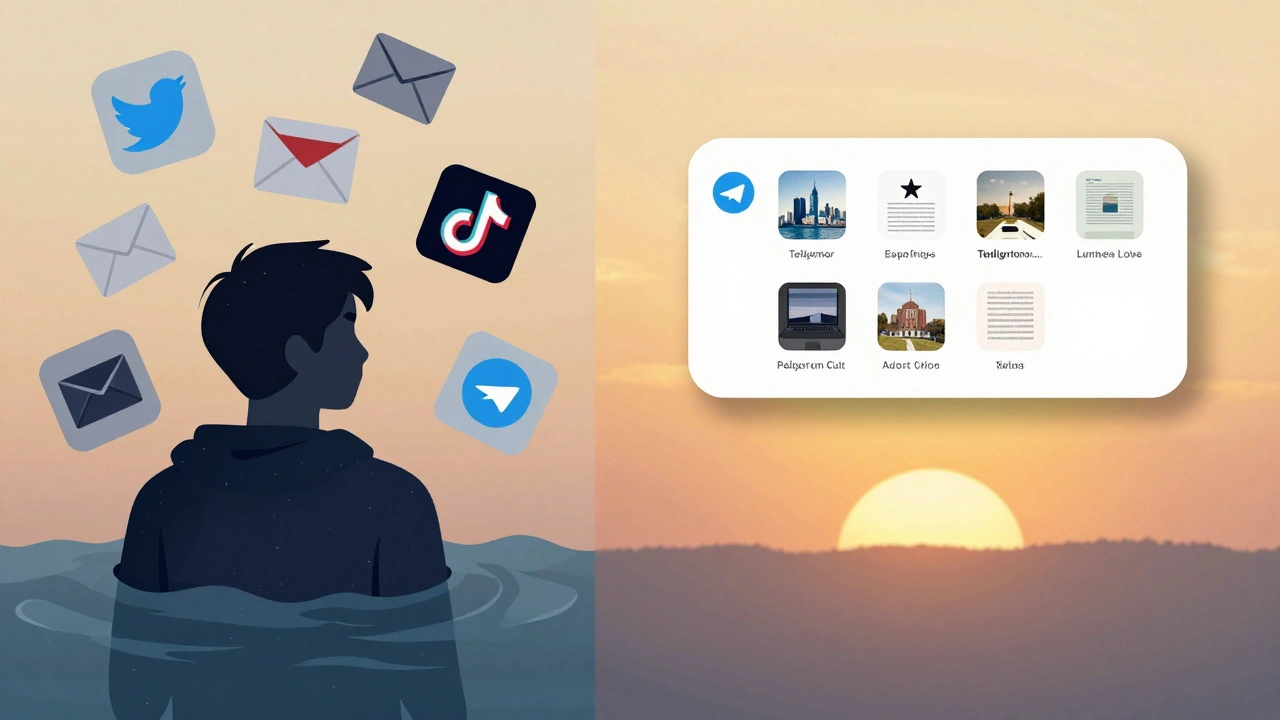
Most people check their phones too much. By the time evening rolls around, they’ve scrolled through five news apps, five Twitter threads, and three email newsletters-only to feel more overwhelmed than informed. That’s where end-of-day news digests on Telegram come in. They don’t just deliver news. They cut the noise. They give subscribers one clean, focused update at the end of the day, so they can close their apps and actually relax.
Why Telegram Works Better Than Email for News Digests
Email is cluttered. Slack is for work. WhatsApp is for family. Telegram? It’s the only platform where people willingly subscribe to news channels and actually open them. With 950 million active users as of December 2025, Telegram has become the go-to for people who want control over what they read-without ads, without algorithms, without the endless scroll.
Unlike email, Telegram doesn’t bury your digest in a flood of promotions. Unlike Twitter, it doesn’t force you to chase context. And unlike newsletters that land at 8 a.m., a Telegram digest arrives at 7 p.m.-right when people are winding down. According to Telegram’s own data, digests sent between 6 p.m. and 9 p.m. local time get 29% higher open rates than those sent earlier. That’s not luck. That’s timing.
The Core Structure of a High-Performing Digest
A great digest isn’t just a list of headlines. It’s a curated experience. Think of it like a bartender who knows your taste: you don’t want every drink on the menu. You want the three that actually matter.
Top-performing channels stick to 5-7 articles per day. Why? Because research from MIT’s Media Lab shows that digests with exactly five precisely selected articles generate 43% more engagement than those with 15 or more. More isn’t better. Better is better.
Each article needs:
- A clear, underlined title (not just a headline copy-pasted)
- A one-sentence summary that answers: Why should I care?
- A direct link (no URL shorteners)
- Optional: a single relevant detail-a quote, a stat, or a source tag like “Source: Bloomberg”
Formatting matters. Telegram supports basic HTML. Use <b> for bold, <a href=""> for links, and <i> for subtle emphasis. Avoid full paragraphs. Use line breaks. Make it skimmable on a phone screen.
How to Build a Telegram News Digest (Without Coding)
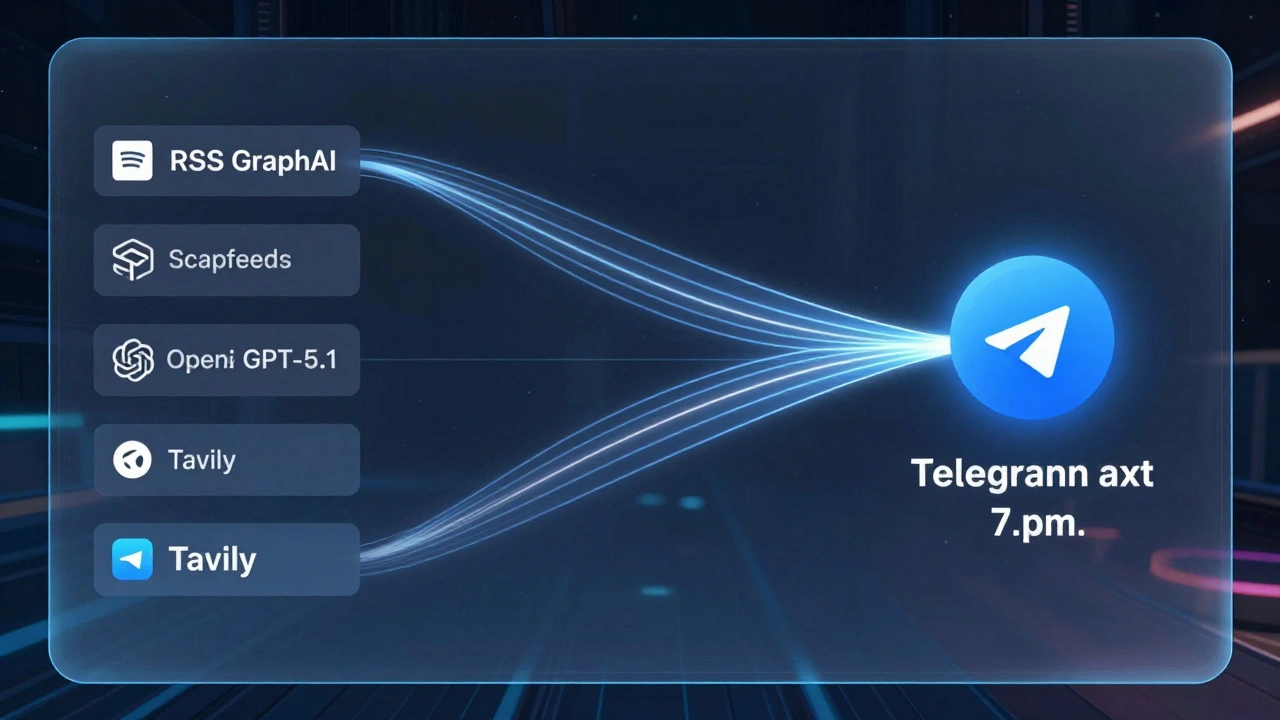
You don’t need to be a developer. The easiest way to start is with n8n, a no-code automation tool that connects apps like RSS feeds, AI summarizers, and Telegram.
Here’s how it works in practice:
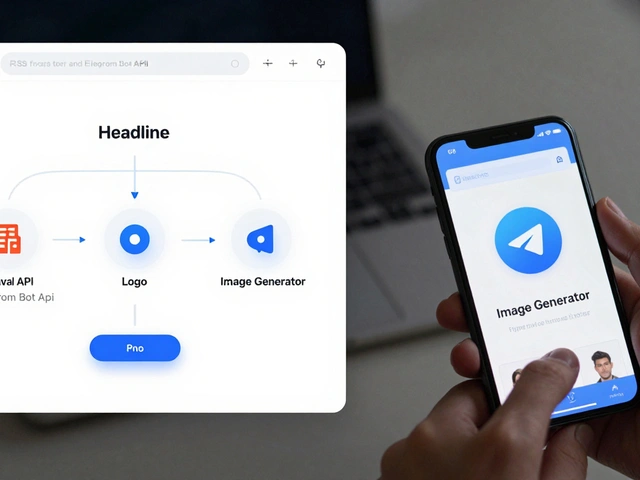
- Use the ScrapeGraphAI node to pull articles from RSS feeds (CNN, Reuters, TechCrunch, etc.)
- Filter for articles published in the last 24 hours
- Send them to OpenAI’s GPT-5.1 to pick the 5 most relevant, non-repeating stories
- Use Tavily to enrich each article with a short, human-like summary
- Send the final digest via Telegram Bot API at 7 p.m. daily
This setup takes under 3 hours to configure. You’ll need API keys for ScrapeGraphAI, OpenAI, and Telegram-but no code. The monthly cost? Around $20 for cloud hosting. You can even start with a free n8n plan to test it.
One creator using this method, @TechDailyDigest, grew to over 52,000 subscribers in 8 months. Their secret? Strict deduplication. They use the article’s GUID and publication date to block repeats. Result? 92% fewer duplicate articles. Subscriber retention jumped 37%.
When You Need to Code Your Own Bot
If you want deeper control-like letting users pick their own topics, saving preferences, or adding a feedback button-you’ll need a custom bot. The most common setup uses Python with FastAPI, PostgreSQL, Celery for scheduling, and OpenAI or Gemini for summarization.
This approach takes 80-120 hours to build from scratch. But once it’s done, you own everything. You can add features like:
- “Skip this topic” buttons in replies
- Weekly summaries for subscribers who want deeper dives
- Multi-language output (e.g., Spanish and English for bilingual audiences)
One open-source bot called Newsmate, detailed in a May 2025 YouTube video, added collaborative filtering in version 2.3.1. That means if you like AI news, and others with similar tastes also liked a story about quantum computing, the bot will recommend it-even if you never typed “quantum” as a topic. That’s the future: personalized, not just pre-set.
What to Avoid (The 3 Deadly Mistakes)
Most digests fail-not because they’re poorly written, but because they ignore basic rules.
Mistake 1: Sending too much
More than 7 articles? You’re not helping. You’re exhausting. The average subscriber opens 1-2 articles per digest. If you give them 12, they’ll stop opening any.
Mistake 2: Ignoring time zones
If your subscribers are in New York, London, and Tokyo, sending a digest at 7 p.m. UTC means someone in Tokyo gets it at 4 a.m. Normalize all timestamps to UTC before scheduling. Let users pick their time zone in a setup message.
Mistake 3: Not handling RSS chaos
78% of news sites use broken or inconsistent RSS feeds. One feed might list dates in MM/DD/YYYY. Another in ISO format. One has no author. Another has 3 authors. Use feedparser 6.0.10 in Python to normalize this. Or use ScrapeGraphAI-it handles the mess for you.
Privacy and Compliance Are Non-Negotiable
Telegram doesn’t require you to collect user data. But if you let users choose topics, save preferences, or reply to digests, you’re storing personal information. That means GDPR applies if you have EU subscribers.
Dr. Marcus Chen of the Electronic Frontier Foundation found that 3 out of 12 popular digest services stored user preferences in plain text. That’s not just sloppy-it’s illegal in Europe. Always encrypt user data. Use environment variables for API keys. Never log raw user inputs. If you’re unsure, don’t store anything. Let users re-select topics daily.
Why This Isn’t Just a Trend-It’s a Strategy
News digest channels on Telegram grow 3.2 times faster than general content channels. The average monthly growth rate? 14.7%. Compare that to 4.6% for regular channels. That’s not a fluke. People crave control. They want to consume news on their terms.
Even Fortune 500 companies are using them-for internal comms. One tech firm sends a daily digest to 12,000 employees: top 5 tech news, 2 product updates, 1 industry insight. No emails. No meetings. Just clarity.
This isn’t about replacing journalism. It’s about restoring trust. When people know they’ll get five good stories at the end of the day-no spam, no hype, no distractions-they start to rely on you. That’s loyalty. That’s value.
What’s Next? The Future of Personalized Digests
Right now, most digests work on fixed topics: “AI,” “Crypto,” “Politics.” But the next leap is individualized weighting. Imagine a user who clicks on a story about battery tech three times in a week. The bot learns: this person cares more about energy than AI. Next time, it pushes more battery stories-even if they didn’t ask for them.
MIT’s Media Lab is already testing this. By 2027, Forrester predicts 75% of successful digests will use dynamic personalization like this. Audio summaries are coming too-expected in Q2 2026. Imagine listening to your daily news while walking the dog.
But the foundation hasn’t changed. Still, the best digest is the one that makes someone say: “I didn’t have to think today. I just got what mattered.”