You post a breaking story on Facebook. You tweet the headline on X. You email it to your list. And then? Silence. Or worse, you get a fraction of the views you deserve because an algorithm decided your content wasn't 'engaging' enough for today's feed. This is the reality for most publishers in 2026. But there is a platform where that doesn't happen. Where every single subscriber sees every single post. That platform is Telegram, and its broadcast-style news channels offer a direct, unfiltered line to audiences without algorithmic interference.
While social media giants fight over attention spans with opaque ranking systems, Telegram has quietly become the backbone of serious news distribution. It’s not just a messaging app anymore; it’s a publishing infrastructure. For journalists, editors, and independent creators, understanding why Telegram works-and how to use it strategically-is no longer optional. It’s essential.
The Architecture of Direct Reach
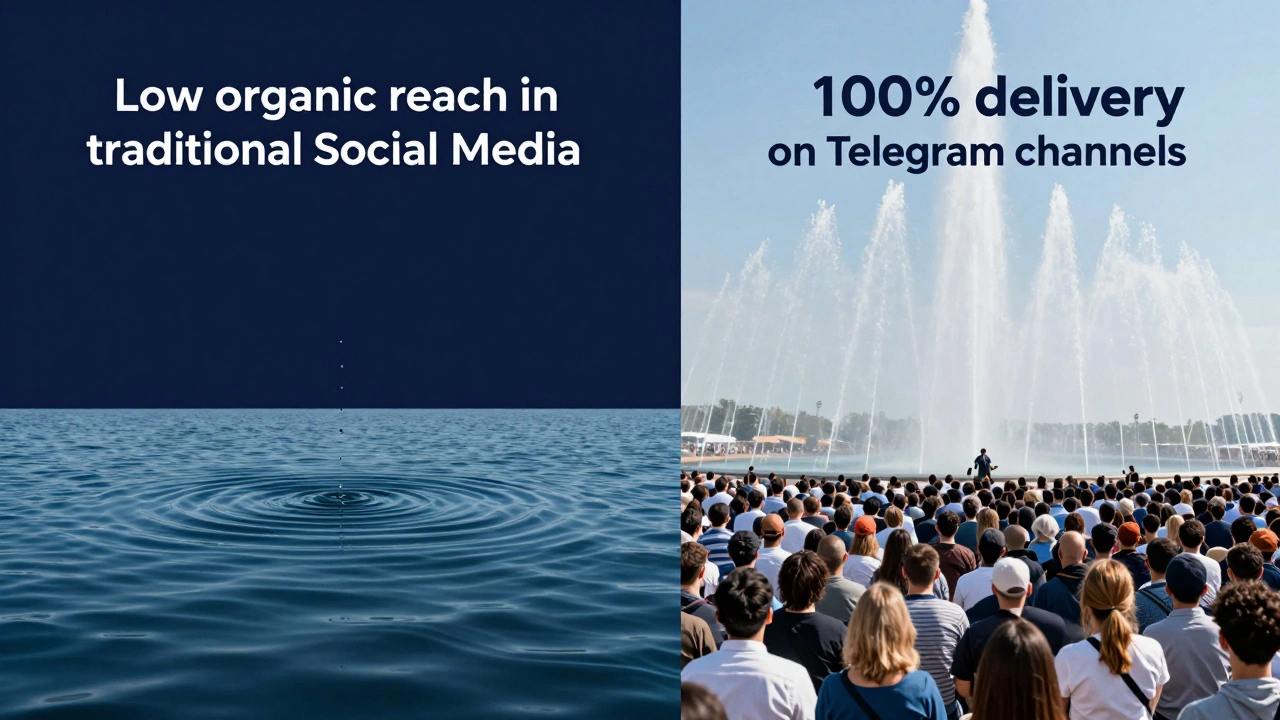
Let’s look at the mechanics. When you follow a brand on Instagram or a news outlet on Twitter, you are at the mercy of their code. Facebook Pages see organic reach rates between 2% and 6%. That means if you have 100,000 followers, only 2,000 to 6,000 people will actually see your post unless you pay for ads. It’s a broken model for news organizations that rely on public trust, not ad spend.
Telegram channels operate differently. They are built on a pure subscription model. If you subscribe, you get the message. Period. There is no algorithm hiding your content behind a ‘relevance’ score. According to Telegram’s own infrastructure reports from 2022, messages are delivered to all subscribers simultaneously with a median latency of just 0.2 seconds. That is near-instantaneous global delivery.
This architectural difference creates what experts call a ‘monologue’ flow. Unlike Telegram groups, which allow up to 200,000 members to chat interactively (a ‘dialogue’ format), channels are strictly one-way broadcasts. Only administrators can post. This gives publishers total control over the narrative. You decide when to post, what to say, and how to present it. No user comments cluttering the main feed, no viral but irrelevant memes pushing down your critical analysis. Just your voice, directly to your audience.
| Feature | Telegram Channels | Facebook Pages | X (Twitter) |
|---|---|---|---|
| Organic Reach Rate | 100% (All subscribers) | 2-6% | Variable (Algorithm dependent) |
| Content Control | Full (Admins only) | Shared (Comments visible) | Shared (Quotes/Replies) |
| Subscriber Limit | Unlimited | Unlimited | Unlimited |
| File Size Limit | 2 GB per file | Varies (usually smaller) | 15 MB (images), 5 MB (GIFs) |
Performance Metrics That Matter
Numbers don’t lie. The strategic advantage of Telegram isn't just theoretical; it’s measurable. In environments where internet access is restricted or censored, Telegram shines. During government-imposed internet shutdowns in Russia in 2022, Radio Free Europe/Radio Liberty (RFE/RL) documented an 89% audience retention rate on their Telegram channels. Compare that to 22% on Facebook and 37% on Twitter during the same period. Why? Because Telegram’s MTProto protocol is optimized for speed and efficiency, delivering data 30-50% faster than standard HTTPS protocols, according to Speedtest.net benchmarks from late 2023.
For everyday news consumption, the engagement metrics are equally striking. A moderator on Reddit’s r/Telegram community, analyzing 2,300 channels in early 2024, found that news channels consistently achieve open rates of 65-80% for breaking alerts. Email newsletters, by contrast, struggle to break 25%. The Moscow Times reported that their Telegram channel drives 12.3 times more traffic to their website during breaking news events than their X account. Furthermore, 47% of new Telegram subscribers convert into registered users on their site-a conversion rate that would make any marketing director jealous.
These numbers highlight a key insight: Telegram users are not passive scrollers. They are active seekers. When they subscribe to a channel, they want the information. They opt-in for value. This intent-driven audience behavior makes Telegram uniquely powerful for high-stakes communication.
Bridging the Monetization Gap
If Telegram is so effective, why isn’t everyone using it? The answer lies in the wallet. Here is the hard truth: Telegram lacks native monetization features. Unlike YouTube’s Partner Program or Substack’s paid subscriptions, there is no built-in way to charge readers directly within the app. As of mid-2026, this remains the platform’s biggest weakness for professional newsrooms.
News organizations have to get creative. Many use third-party tools to manage donations or link out to paid subscription pages on their websites. The Belarusian outlet NEXTA, which grew to 2 million subscribers, spent $18,500 monthly on third-party moderation services to combat disinformation, highlighting the operational costs involved. Without a sustainable revenue model inside the app, many channels operate at a loss, relying on the traffic they drive to their primary web properties to justify the effort.
However, change is coming. Pavel Durov announced plans for integrated paid subscription features in early 2024. While full implementation details were still rolling out in 2026, this shift signals Telegram’s recognition that creators need to earn. Until then, treat your Telegram channel as a top-of-funnel acquisition tool. Its job is to capture attention and drive users to where the money is made-your website, your newsletter, or your membership portal.
Navigating the Trust Deficit
Freedom comes with responsibility. The same lack of algorithmic filtering that benefits journalists also attracts bad actors. Maria Ressa, Nobel Peace Prize laureate and founder of Rappler, warned in 2024 that Telegram’s weak content moderation infrastructure makes it vulnerable to disinformation. Fact-checkers identified 68% more false narratives originating on Telegram channels compared to verified accounts on X during the 2023 global election cycle.
This is a real risk. If your channel becomes known for spreading rumors, you lose credibility fast. To mitigate this, successful news outlets implement strict internal protocols. Use bots like Combot or Shieldy to filter spam and block malicious links. Designate trusted admins who verify sources before posting. Transparency is your best defense. Clearly state your editorial standards in your channel bio. Link to original sources whenever possible. By building a reputation for accuracy, you turn the ‘wild west’ nature of Telegram into a competitive advantage against platforms that feel increasingly sanitized and controlled.
How to Launch Your Channel Strategically
Setting up a channel is easy; growing it requires strategy. Don’t just create a channel and hope for the best. Follow these steps to build a professional presence:
- Create with Intent: Go to the ‘New Channel’ menu. Choose a unique name that includes relevant keywords. Data from LaunchPass shows channels with brand names in their URLs see 27% higher subscription rates.
- Optimize Your Profile: Upload a high-resolution logo and write a concise bio. Channels with complete profiles achieve 42% higher conversion rates. Tell users exactly what they’ll get and why they should care.
- Choose Visibility Wisely: Decide between public (discoverable via search) and private (invitation-only). For news, public is usually better for growth, but private can create exclusivity for premium content.
- Integrate Your Workflow: Use the Telegram Bot API (version 6.9+) to automate posting from your CMS. If you use WordPress, plugins exist to push posts directly to Telegram. Save time and ensure consistency.
- Promote Cross-Platform: Telegram has poor discovery mechanisms. You must bring your audience from elsewhere. Add a link to your LinkedIn profile, your email signature, and your website footer. Share exclusive teasers on X to drive clicks to your Telegram channel.
The learning curve is minimal. Most marketers achieve operational proficiency within three hours. The real work is in the promotion and the consistent delivery of high-value content. Provide ‘exclusive value’-early access to stories, raw video footage, or expert commentary that isn’t available anywhere else. Give them a reason to stay subscribed.
The Future of Broadcast Journalism
As we move through 2026, Telegram’s role in the media landscape is solidifying. With 800 million monthly active users, it’s no longer a niche app. In Russia, it’s the primary news source for 42% of internet users. Globally, 31 of the top 100 news brands maintain official channels, with 78% reporting higher engagement than on Twitter.
Regulatory pressures are mounting, particularly in the EU under the Digital Services Act (DSA). Telegram has begun implementing new content moderation protocols, leading to takedown notices for some channels. This suggests a future where Telegram balances its commitment to privacy with legal compliance. For journalists, this means staying informed about regional regulations and adapting your content strategy accordingly.
The strategic advantage of Telegram lies in its simplicity and directness. It strips away the noise of social media algorithms and puts the power back in the hands of the publisher. If you can deliver value, you will be heard. Not by a select few chosen by an AI, but by everyone who chose to listen. In an era of information overload, that clarity is worth more than gold.
Can I monetize my Telegram news channel directly?
Currently, Telegram does not have a native monetization system like YouTube's Partner Program. However, you can use it to drive traffic to paid subscriptions on your website, accept donations via external links, or sell merchandise. Pavel Durov has announced plans for integrated paid features, which may launch fully in late 2026.
Is Telegram safe from censorship?
Telegram is highly resistant to censorship due to its encrypted protocols and cloud-based architecture. During internet shutdowns in countries like Russia and Iran, Telegram channels maintained high accessibility (up to 89% retention) compared to other platforms. However, it is not immune to local blocking efforts, and users may need VPNs in heavily restricted regions.
How do I grow my Telegram channel without ads?
Since Telegram lacks built-in discovery tools, you must promote externally. Share your channel link on other social media platforms, include it in email newsletters, and embed it on your website. Offering exclusive content, such as early access to articles or live Q&A sessions, encourages existing followers to invite others.
What are the risks of using Telegram for news?
The main risks include the spread of disinformation due to loose moderation, potential regulatory crackdowns in certain jurisdictions, and the lack of native analytics. Additionally, without careful management, channels can attract spam bots, requiring investment in third-party moderation tools.
How does Telegram compare to WhatsApp for broadcasting?
WhatsApp Broadcast Lists are limited to 256 recipients and require mutual contact saving, making them unsuitable for large-scale news distribution. Telegram channels support unlimited subscribers and do not require mutual contacts, making them far superior for mass communication and public broadcasting.