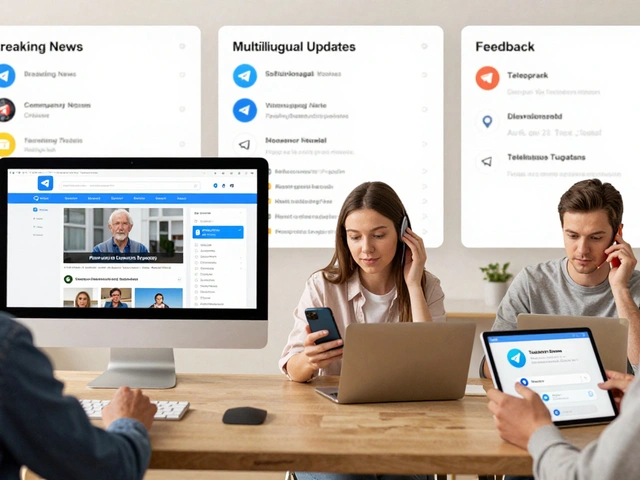
Traditional social media has become a minefield of algorithms. For years, journalists have fought a losing battle against "black box" systems that decide who sees their breaking news and when. But a massive shift happened. Telegram is a cloud-based instant messaging service that has evolved from a privacy tool into a powerhouse for direct news distribution. With over 800 million monthly active users as of 2025, it has fundamentally rewritten the rules of how newsrooms talk to their readers in real-time.
Breaking the Algorithmic Chain
If you've run a news page on Facebook or X (formerly Twitter), you know the frustration: you post a critical update, but only 5% of your followers see it unless you pay for a boost. Telegram operates on a completely different logic. It uses a linear, chronological feed. When a journalist posts to a channel, the message goes out to everyone subscribed. There is no hidden filter deciding if your story is "relevant" enough to appear in a feed.
This unfiltered access creates a high-trust environment. Because users choose to join a Telegram Channel-a one-way broadcasting tool-they are essentially opting in to a direct line of communication. This means the audience is already pre-filtered for interest. You aren't fighting for attention; you're delivering value to people who specifically asked for it. This is why engagement rates on the platform often dwarf those of traditional social networks.
The Mechanics of High-Impact Engagement
Engagement on Telegram isn't just about a "like" button. It's about a cycle of visibility. When a post gets a high volume of views, it naturally triggers more reactions. Those reactions signal value to other users, leading to more shares, which then fuels organic growth. If a channel lacks these signals-low views and zero comments-it loses credibility as social proof, making it harder to attract new followers.
To keep this cycle spinning, savvy news organizations use specific interactive tools. Instead of just posting a link, they use rich formatting and a variety of content types to stop the scroll:
- Interactive Polls and Quizzes: These turn passive readers into active participants, providing instant feedback on public opinion.
- Custom Call-to-Action (CTA) Buttons: Publishers can embed buttons that lead users directly to a subscription page or a detailed report.
- Rich Media Mix: Combining short-form text bursts with high-resolution images, video clips, and the "spoiler" feature to create curiosity.
- Audio Integration: Daily news podcasts delivered directly into the chat interface, catering to the mobile-first audience.
| Feature | Algorithm-Based Platforms | Telegram Distribution |
|---|---|---|
| Visibility | Determined by AI/Algorithm | Chronological / Direct Delivery |
| Audience Intent | Passive discovery | Active opt-in subscription |
| Engagement Rate | Generally lower due to noise | Significantly higher (pre-filtered) |
| Content Control | Subject to platform "shadow-banning" | Direct and unfiltered access |

Turning Engagement into Revenue: The Telegram.hr Case
One of the biggest hurdles for digital journalism is the "payment gap"-the fact that people expect news for free. However, the success of Telegram.hr in Croatia proves that direct engagement can bypass this reluctance. In a market where only 6% of the population typically pays for online news (per 2025 Digital News reports), this organization managed to grow its subscription revenue by 54% in 2025.
How did they do it? They didn't just post links; they built a community. By launching a 10th-anniversary campaign directly through the app, they acquired over 3,200 new subscribers with an incredible 80% retention rate. They diversified their offering by adding a daily news podcast and expanding into book publishing, proving that when you own the direct relationship with your audience, you can monetize a "low-payment culture" market.
Scaling with Automation and Bots
Managing a news channel for thousands of people manually is impossible. This is where Telegram Bots come into play. These are essentially small applications that run inside Telegram, allowing journalists to automate their workflows.
Modern newsrooms use these tools to track reactions in real-time, schedule posts for peak activity windows, and format content for maximum readability. Automation allows a small team to maintain the illusion of a 24/7 news desk, ensuring that breaking stories hit the feed within seconds of happening, while scheduled deep-dives keep the audience engaged during slower periods.

The New Era of "Conditional" Access
It isn't all smooth sailing. As we move through 2026, Telegram's status has shifted. It was once seen as a borderless, untouchable sanctuary for free speech. Now, it is becoming "conditional." Governments in multiple regions are increasing regulatory pressure, leading to localized restrictions and legal scrutiny.
For news organizations, this creates a paradox. The platform offers the best engagement and most direct path to revenue, but the long-term stability is no longer guaranteed. Relying solely on Telegram for distribution is risky. The smart move now is using the platform as a high-conversion funnel to move users toward owned assets, like email lists or proprietary apps, while still leveraging the app's real-time reach.
Why is engagement higher on Telegram than on Facebook or X?
Engagement is higher because Telegram users must actively choose to subscribe to a channel. Unlike a Facebook feed where content is pushed by an algorithm, Telegram subscribers have already expressed a specific interest in the topic, meaning they are far more likely to interact with the content when it arrives.
Can news organizations actually make money via Telegram?
Yes. As seen with the Telegram.hr case study, organizations can use the platform to drive paid subscriptions, memberships, and donations. The key is using the channel to build deep trust and then utilizing CTA buttons and targeted campaigns to convert free followers into paying subscribers.
What are the risks of using Telegram for journalism in 2026?
The primary risk is regulatory instability. Many jurisdictions are introducing stricter laws regarding content moderation and data access, making the platform "conditional." This means a news outlet could potentially lose access to its audience in certain countries due to government bans or legal pressures.
What is the best way to grow a news channel organically?
The best strategy is creating a "virtuous cycle" of engagement. Post high-value, timely content that encourages views and reactions. Since reactions lead to shares and shares lead to more views, focusing on highly shareable, interactive content (like polls or breaking news alerts) is the fastest way to grow.
How do bots help journalists on the platform?
Bots automate the tedious parts of publishing. They can be used for scheduling posts to hit peak audience times, tracking which stories get the most reactions, and providing automated navigation menus for users to find archived news stories.
Next Steps for Newsrooms
If you are just starting with Telegram or looking to optimize your current presence, focus on these three moves:
- Diversify Content: Stop posting only links. Start using polls, short audio clips, and rich text to keep the audience from getting bored.
- Audit Your Timing: Use analytics to find when your specific audience is most active and schedule your heaviest hits for those windows.
- Build an Exit Strategy: Use your Telegram channel to grow a secondary, owned database (like an email list) so you aren't vulnerable to potential platform regulatory shifts.