Imagine waking up and checking your phone. Instead of opening five different apps to catch up on world events, you open one chat. It greets you with headlines in Japanese, German, and English, filtered exactly to the topics you care about-finance, tech, or sports. This isn't science fiction; it's what a multi-language news bot on Telegram can do for you today.
We live in a fragmented information landscape. Most people speak more than one language or consume media across borders. Yet, most news apps force you into a single-language silo. Telegram bots bridge this gap by combining real-time messaging with powerful localization tools. They turn a simple chat window into a personalized, multilingual newsroom.
| Aspect | Detail |
|---|---|
| Core Technology | Telegram Bot API (launched 2015) combined with external News APIs |
| Audience Reach | Access to Telegram's 700M+ monthly active users globally |
| Implementation Options | Code-first (Python/Node.js), Low-code (n8n), or No-code (RSS.app) |
| Key Challenge | Managing notification fatigue and ensuring translation quality |
Why Telegram Is the Ideal Platform for Multilingual News
You might wonder why build a bot on Telegram instead of creating a standalone app. The answer lies in friction. Installing an app takes time, storage space, and often requires account creation. A Telegram bot requires only a tap on "Start."
Telegram has grown explosively since its launch. By mid-2022, founder Pavel Durov announced the platform had surpassed 700 million monthly active users. Crucially, this growth happened outside traditional English-speaking markets. Users in Japan, Korea, Brazil, and across Europe rely heavily on Telegram for daily communication. This global footprint makes it the perfect distribution channel for content that needs to cross linguistic boundaries.
Furthermore, the open nature of the Telegram Bot API is a public interface launched in 2015 that allows developers to create automated accounts capable of sending messages, receiving commands, and interacting with users programmatically. Unlike closed ecosystems, Telegram allows bots to handle complex logic, store user preferences, and integrate with external services seamlessly. You aren't just building a feed; you're building a conversational interface that remembers who the user is and what they prefer.
Choosing Your Technical Approach: Code vs. Low-Code
There is no single way to build these bots. Your choice depends entirely on your technical skills and how much control you want over the final product. Generally, there are three paths: the developer route, the low-code automation route, and the no-code service route.
The Developer Route: Full Control with Python or Node.js
If you know how to code, building a custom bot gives you maximum flexibility. A popular example is the open-source project multitrue-bot. This bot supports five languages (English, Japanese, Traditional Chinese, Simplified Chinese, and Korean) using flag icons for easy selection.
Here is how a typical code-based architecture works:
- API Keys: You need a token from BotFather is the official Telegram bot used to create new bots and manage their settings and an API key from a news provider like NewsAPI.org.
- Containerization: Developers often use Docker to package the bot. This ensures it runs consistently whether on your laptop or a cloud server.
- Logic: When a user sends a command like `/language ja`, the bot updates their profile in a database and fetches news specifically tagged for Japanese sources or translates existing English feeds.
Languages like Python (using libraries such as `python-telegram-bot` or `aiogram`) and JavaScript (using `Telegraf` or `grammY`) are standard here. These libraries handle the heavy lifting of connecting to Telegram's servers, allowing you to focus on the news aggregation logic.
The Low-Code Route: Automation with n8n
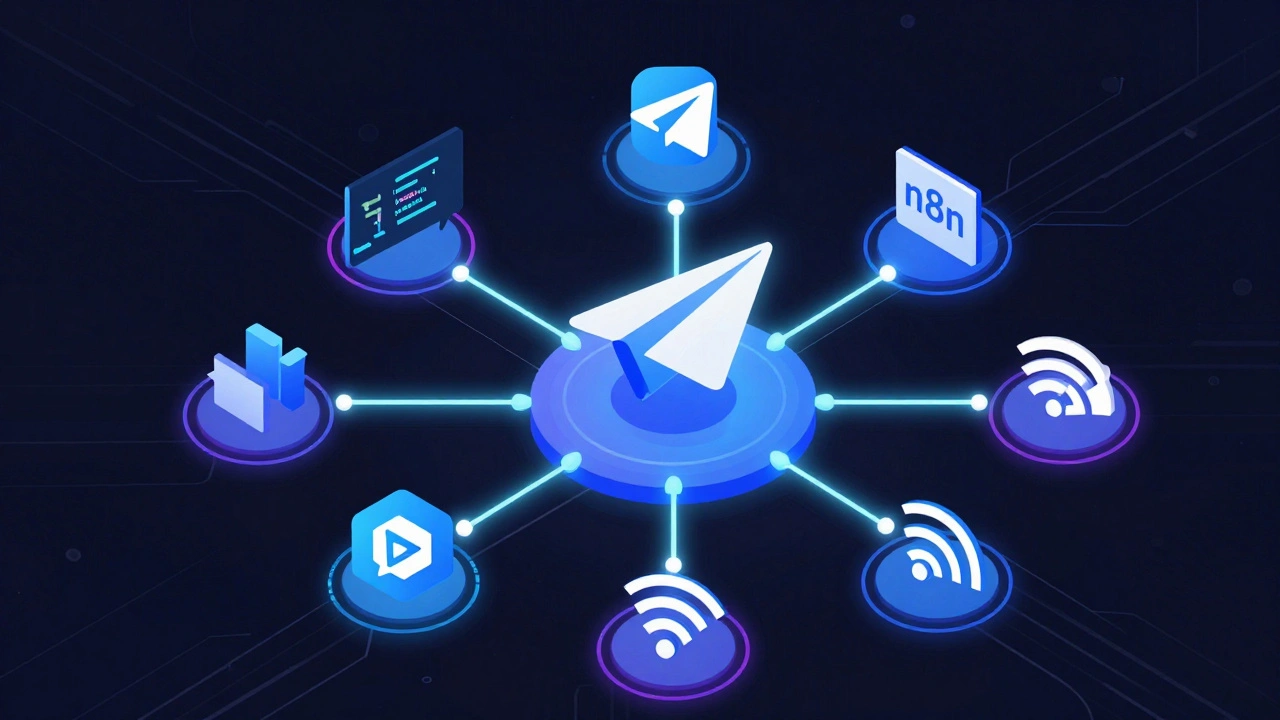
Not everyone wants to write hundreds of lines of code. Tools like n8n is an open-source workflow automation tool that allows users to connect various apps and services through visual nodes make this accessible. With n8n, you can build a multilingual bot in a few hours.
The workflow looks like this:
- Trigger: A Telegram node receives a message from a user.
- Database Check: The workflow checks a connected database (like NocoDB) to see if this user has set a preferred language.
- Conditional Logic: If the language is 'en', it fetches English news. If 'de', it fetches German news. You can even use AI nodes to summarize articles on the fly.
- Response: The bot sends the localized headline back to the user.
This approach is ideal for journalists or small media teams who want to automate distribution without hiring a full-time software engineer. It bridges the gap between rigid coding and inflexible no-code tools.
The No-Code Route: RSS Feeds and Services
For those who just want results immediately, services like RSS.app offer a "Google News to Telegram" bridge. You simply input a Google News query (e.g., "Technology in Berlin"), and the service automatically posts updates to your Telegram channel. While this doesn't give you a per-user interactive bot experience, it effectively automates multi-language distribution by setting up separate channels for different locales.
Handling Localization: More Than Just Translation
Delivering news in multiple languages sounds simple until you try it. True localization involves two distinct layers: the bot's interface and the news content itself.
Interface Localization means the menus, help texts, and buttons appear in the user's language. If a user selects Spanish, the button should say "Suscribirse" not "Subscribe." Developers achieve this using internationalization (i18n) libraries that load JSON files containing translations for each locale code (e.g., `es`, `fr`, `ja`).
Content Localization is trickier. You have two main options:
- Source-Level Filtering: Use news APIs that support country and language parameters. For example, NewsAPI allows you to request top headlines specifically for Japan (`country=jp`) in Japanese (`language=ja`). This provides authentic, culturally relevant news rather than translated Western perspectives.
- Machine Translation: Fetch English headlines and translate them dynamically using APIs like Google Cloud Translation or DeepL. While faster to implement, this carries risks. Poor translations can distort meaning, especially in nuanced political or financial reporting. DeepL is often cited for higher quality in European languages, but Asian language support varies.
A hybrid approach often works best: pull primary sources from local outlets where possible, and use translation only when necessary to fill gaps.
Integrating AI for Personalization and Summarization
The latest evolution in news bots involves Large Language Models (LLMs). Instead of just dumping raw headlines, modern bots can summarize articles, adjust tone, and remember user interests.
Consider a bot that integrates with OpenAI's GPT models. Here is the value add:
- Summarization: A user receives a 50-word summary of a 1,000-word article in their preferred language. This saves time and reduces data usage.
- Conversational Follow-ups: Users can reply to a headline with "Tell me more about the economic impact," and the LLM generates a deeper explanation based on the source text.
- Dynamic Ranking: By tracking which stories a user clicks on, the bot can use vector embeddings to rank future news items based on individual interest scores, not just general popularity.
Cost is a consideration here. LLM APIs charge per token. However, for text-heavy tasks like summarization, the cost remains low-often fractions of a cent per interaction. This makes AI-enhanced personalization viable even for small-scale projects.
Common Pitfalls and How to Avoid Them
Building the bot is only half the battle. Keeping users engaged is the other half. Many news bots fail because they annoy their audience. Here is how to avoid common mistakes.
Notification Fatigue: Do not send a push notification for every single article published. If you cover "World News," that could be dozens of alerts an hour. Users will mute or block you. Instead, implement digests. Send a curated list of the top 5-10 stories every morning and evening. Allow users to opt-in for real-time alerts only for critical breaking news.
Source Bias: If your bot only pulls from US-based agencies, your non-US users will feel disconnected. Ensure your news ingestion layer includes diverse regional publishers. A user in Tokyo cares about Nikkei, not just Reuters.
Legal and Licensing Risks: Be careful with copyright. Most news APIs allow headlines and short excerpts but prohibit redistributing full-text articles. Violating these terms can get your API keys revoked instantly. Always read the Terms of Service of your news providers.
Future Trends: What's Next for News Bots?
The landscape is shifting toward richer experiences. Telegram introduced "Web Apps" in 2022, allowing bots to open full-screen HTML5 interfaces within the chat. Imagine a news bot that opens an interactive chart of stock prices or a video player for a documentary clip, all without leaving Telegram.
Monetization is also evolving. Some publishers are experimenting with premium bot subscriptions, offering ad-free summaries or exclusive deep-dive analysis for paying users. As Telegram Premium grows, integrating payment flows directly into bots will become standard.
Finally, regulatory pressure will increase. Governments are scrutinizing online news distribution. Multi-language bots operating across borders may need to implement geo-fencing or content filters to comply with local laws. Staying compliant will require ongoing attention to legal developments in your target regions.
What is the best programming language for building a Telegram news bot?
Python and JavaScript (Node.js) are the most popular choices. Python offers robust libraries like `python-telegram-bot` and excellent data processing capabilities for news aggregation. JavaScript is ideal if you prefer asynchronous handling and want to leverage npm packages like `Telegraf`. Both have large communities and extensive documentation.
Can I build a multilingual news bot without coding?
Yes, you can use low-code platforms like n8n or no-code services like RSS.app. n8n allows you to visually connect Telegram triggers with databases and news APIs, requiring minimal JavaScript for custom logic. RSS.app simplifies this further by automatically posting RSS feeds (like Google News) to Telegram channels.
How do I handle translation costs for a news bot?
Translation APIs charge per character or token. To minimize costs, prioritize fetching news from native-language sources via APIs that support country/language filters (like NewsAPI). Use machine translation only when native sources are unavailable. Additionally, cache translated content to avoid re-translating the same article for multiple users.
What are the legal risks of aggregating news in a bot?
The primary risk is copyright infringement. Most news APIs prohibit distributing full-text articles. Stick to headlines, short excerpts, and links to the original source. Also, be aware of regional regulations regarding political content and misinformation, which may vary by country.
How can I prevent users from being overwhelmed by notifications?
Implement digest modes. Instead of real-time pushes for every article, send curated lists at specific times (e.g., 8 AM and 6 PM). Allow users to customize frequency and topics. Provide clear instructions on how to mute or change preferences within the bot.
Latest Posts