Telegram has become one of the most popular platforms for news channels, citizen journalists, and independent creators. But with great reach comes a big problem: piracy. Your original reports, videos, or investigative content can appear on dozens of other Telegram channels within hours - often without your permission. And unlike YouTube or Facebook, Telegram doesn’t automatically detect or remove this content. If you’re a creator trying to protect your work, you need to know exactly how to file a takedown request - and how to avoid the common mistakes that make it fail.
Why Telegram Takedown Requests Are So Different
Telegram doesn’t have a Content ID system like YouTube. There’s no automated scanner that flags copied videos or articles. Instead, the platform relies entirely on human-reviewed email submissions. This means you can’t just click a button and wait. You have to gather precise evidence, follow legal formatting rules, and submit everything through one email address:[email protected].
According to Telegram’s own transparency report from December 2025, they received over 14,300 DMCA notices in Q4 2025. But 37% of those were rejected - not because the content wasn’t infringing, but because the requester didn’t include the right details. The most common error? Missing exact message links.
Telegram’s architecture is built for privacy. That’s great for users. But it makes life hard for copyright holders. Unlike other platforms, Telegram doesn’t let you report content from within the app. There’s no in-app “Report” button that works for copyright. Even if you find your content copied, you can’t flag it directly. You have to leave the app, collect evidence, and send an email.
The 7-Step Takedown Process That Actually Works
Here’s the exact process used by professionals who successfully remove pirated content from Telegram. Skip any step, and your request will likely be ignored.- Find the exact message link - This is non-negotiable. Right-click the copied message in Telegram and select “Copy Link.” The link will look like this:
t.me/c/1234567890/789. The numbers after/c/are the channel ID. The last number is the message ID. Without both, Telegram cannot locate the content. Screenshots alone won’t work - they’re rejected in 83% of cases. - Verify your copyright ownership - If you’re in the U.S., your work must be registered with the U.S. Copyright Office before you can file a DMCA notice. Unregistered works can still be protected under international law, but U.S.-based claims get faster results if registered. Keep your registration number handy.
- Write a legally valid notice - Your email must include all 7 elements required by 17 U.S.C. §512(c)(3): your contact info, a description of the copyrighted work, the infringing material’s location (the exact link), a statement that you have a good faith belief the use is unauthorized, a statement that the information in the notice is accurate, your physical or electronic signature, and your name and title. Use plain language. Don’t copy-paste legal jargon.
- Send it to [email protected] - Use the subject line: “DMCA Takedown Request.” Don’t add extra words. Don’t send it to any other address. Telegram doesn’t respond to requests sent to [email protected] or any other email.
- Track your email thread - Telegram doesn’t give you a ticket number or portal. You’ll get a reply via email. Save every message. If you don’t hear back in 14 days, send a follow-up. Don’t resubmit the same request - just reply to the original thread.
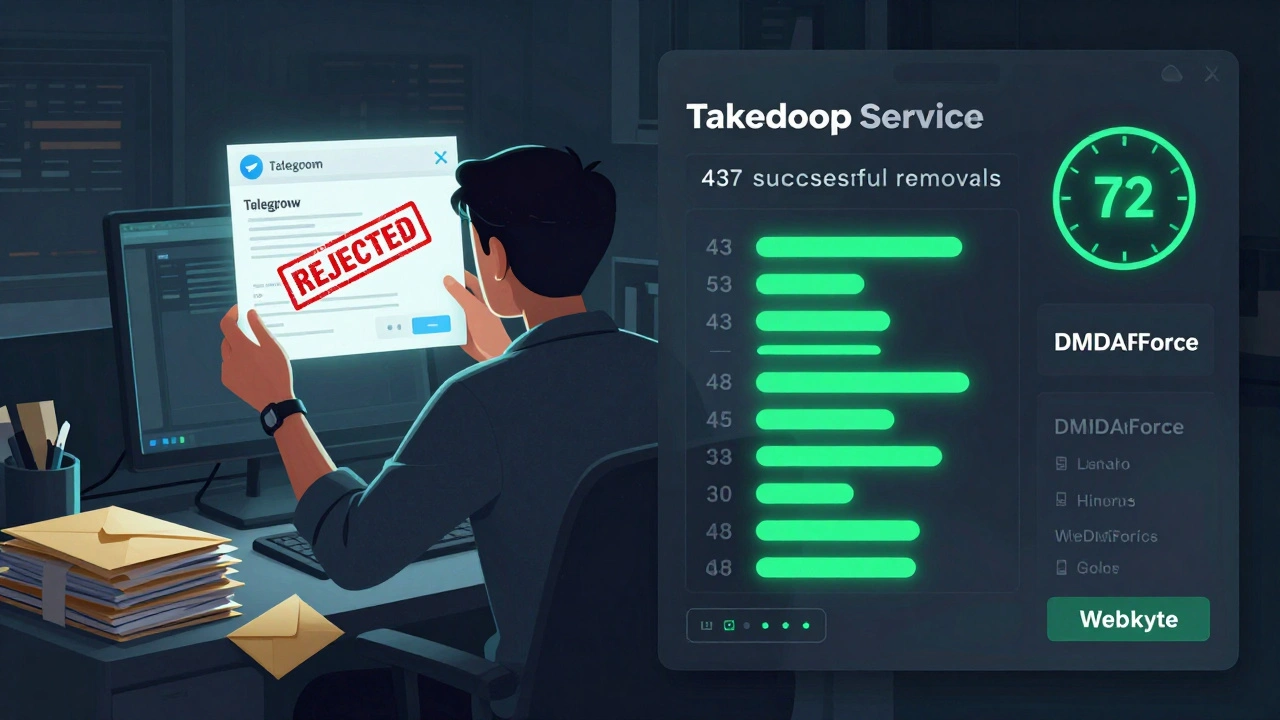
- Resubmit if rejected - About 41% of first-time submissions get rejected. Most rejections happen because the message link was wrong, the copyright proof was missing, or the timestamp wasn’t clear. If you get a rejection, fix the issue and reply to the same email thread.
- Use a professional service if it’s still not resolved - If you’ve waited 14+ days and nothing’s moved, consider hiring a takedown service. Companies like DMCAForce, WebKyte, and VdoCipher specialize in Telegram. They handle the entire process for you. Costs range from $150 to $500 per month, depending on volume. For creators with multiple channels or frequent violations, this pays for itself.
What Telegram Won’t Tell You (But You Need to Know)
Most people assume that if they file a takedown, the content will disappear. But Telegram’s system has serious gaps.- No bulk processing - If your content appears in 15 different channels, you need to submit 15 separate requests. Each one must have its own message link. There’s no way to upload a list.
- 30-day maximum response time - Telegram’s policy says they’ll respond within 30 days. But in practice, complex cases (like private groups or multi-channel piracy) can take 18-25 business days. Simple public channel violations take 5-9 days.
- No escalation path - If Telegram ignores your request, you can’t call them. You can’t tweet at them. You can’t file a complaint with a regulator unless you’re in the EU or U.S. and have legal standing.
- AI content is harder to remove - If someone takes your video, changes the voice, adds filters, or re-encodes it, Telegram’s human reviewers often can’t tell it’s your content. AI-modified piracy is growing fast - up 200% in Q4 2025 - and current takedown tools are 63% less effective against it.
- Channels come back - Even if Telegram removes your content, the same channel can reappear within hours with the same name and posts. Telegram has no repeat-infringer policy. You’ll have to file again.
Real Stories: What Happens When You Don’t Do It Right
Filmmaker Alex Morgan spent weeks documenting a corruption case in rural Texas. His 45-minute film was posted on 17 Telegram channels. He filed 17 takedown requests - all with perfect links and copyright registration. It took 22 days for Telegram to remove 9 of them. The other 8? Still up. He never got a reply. Sarah Kim, an online course creator, lost $147,000 in sales after her course appeared in 39 Telegram groups. She sent three takedown requests. Each one was rejected because she used channel names instead of message links. By the time she figured out the correct format, the damage was done. On the flip side, a user named “ContentGuardian” removed 43 infringing channels in 72 hours using DMCAForce’s service. Cost? $299. He didn’t waste a single hour trying to figure out the process himself.How to Protect Yourself Before It Happens
Waiting until your content is stolen is too late. Here’s how to reduce your risk:- Watermark your content - Add your name, logo, or website to every video or image. It doesn’t stop theft, but it makes it harder for others to claim it as their own.
- Use Telegram’s Forwarded From feature - When you post original content, use the “Forwarded From” label. It shows the original source, which can help in disputes.
- Log every post - Keep a spreadsheet with timestamps, links, and file hashes of your original content. This makes it easier to prove ownership later.
- Register key works - If you’re producing regular content, register your most valuable pieces with the U.S. Copyright Office. It costs $45-$65 per work. It’s cheap insurance.
- Know your jurisdiction - If you’re outside the U.S., your copyright laws may differ. In the EU, the Digital Services Act gives you more leverage. In some countries, you may need to file through a local copyright office first.
The Bigger Picture: Why Telegram Is Still a Risk
Telegram has 800 million users. And it’s growing. But its moderation team is tiny - estimated at just 12-15 people handling all copyright requests worldwide. Meanwhile, the number of piracy channels on Telegram jumped 47% in 2025, hitting 227,000 active channels by December. The EU fined Telegram €5.2 million in November 2025 for slow takedowns. The U.S. Copyright Office called their compliance “inconsistent.” And Harvard Law professor Dr. Elena Rodriguez says the platform’s privacy-first design creates an enforcement gap 3.8 times wider than industry standards. If you’re a serious creator, you can’t rely on Telegram to protect your work. You have to protect it yourself.What’s Next? The Future of Takedowns on Telegram
Telegram’s leaked roadmap shows they’re planning a limited Content ID system by Q3 2026 - but only for major studios and publishers. Regular creators won’t benefit from this. They’re also testing a new web portal for tracking requests, which will help. But there’s no API. No automation. No shortcuts. For now, the only reliable way to handle takedown requests on Telegram is to do it manually, carefully, and persistently. It’s not easy. But if you’re serious about your content, it’s the only way.There’s no magic fix. No app that does it for you. Just a process - and the discipline to follow it.
Can I report copyright infringement directly in the Telegram app?
No. Telegram does not allow users to report copyright violations through the app. The only way to file a takedown request is by emailing [email protected] with exact message links and proper documentation. In-app reporting features are designed for spam or abuse, not copyright.
How long does it take Telegram to remove pirated content?
Simple cases - like a single copied message in a public channel - take 5 to 9 business days. Complex cases involving multiple channels, private groups, or unclear ownership can take 18 to 25 business days. Telegram’s official policy allows up to 30 days for response, but delays beyond that are common and have no formal appeal process.
Do I need to register my copyright in the U.S. to file a takedown on Telegram?
You don’t legally need to, but U.S.-based creators who have registered their work with the U.S. Copyright Office see much faster results. Unregistered works can still be protected under international treaties, but Telegram’s team prioritizes notices that include a valid registration number. For maximum effectiveness, register your key content before publishing.
What if Telegram ignores my takedown request?
Telegram has no escalation system. If you don’t get a response after 14 days, reply to your original email thread with a polite follow-up. If it’s still ignored, you can consider legal action - but only if you’re in a jurisdiction with strong copyright enforcement (like the U.S. or EU). Otherwise, your best option is to use a professional takedown service.
Can I remove content from private Telegram groups?
Yes - but it’s harder. Private groups don’t appear in public search, so you need to find the exact message link (t.me/c/...), which requires being a member of the group. If you’re not a member, you can’t get the link. In that case, you’ll need to ask someone inside the group to help you copy the link or report it to you.
Is it worth hiring a professional takedown service for Telegram?
If you’re a news channel, educator, or content creator with more than 3-5 violations per month, yes. Professional services like DMCAForce or WebKyte know exactly what Telegram requires. They handle the links, documentation, follow-ups, and resubmissions. For most creators, it saves 8-12 hours of work per case and increases success rates from under 40% to over 85%.
Can I file a takedown request if I’m not in the U.S.?
Yes. Telegram accepts DMCA-style notices from anywhere in the world. But if you’re outside the U.S., you may need to provide local copyright documentation. In the EU, you can reference the Digital Services Act. In Canada, Australia, or the UK, you can use your national copyright office’s certification. Always include proof of ownership from your country’s official registry.