Telegram news channels have become a primary source of real-time updates for millions, especially in regions where traditional media is restricted. But here’s the problem: if you publish a false date, a wrong name, or a misleading quote, you can’t just go back and fix it cleanly. Telegram doesn’t show edit history. It doesn’t notify followers when something changes. And after 48 hours, you can’t edit at all. That’s not a bug-it’s a design choice. And it’s dangerous for journalism.
Why Telegram Needs a Formal Corrections Policy
By late 2025, Telegram had over 800 million active users, with nearly 2.4 million news channels posting regularly. Many of these channels operate in countries where press freedom is under threat. That’s why they chose Telegram: no censorship, no takedowns, no shadow bans. But this same freedom makes it easy for errors to spread unchecked.
Unlike Twitter or Facebook, where edits are visible and often tracked, Telegram hides what was changed. A user sees only the final version. If you correct a headline about a protest location, and the original message said "Central Square," but you changed it to "Market Street"-readers have no way of knowing you changed it. That’s not transparency. That’s erasure.
Academic studies, like the one from Vilnius University in 2024, found that uncorrected misinformation on Telegram lasts 3.2 times longer than on other platforms. And when those errors involve law enforcement actions, election results, or public safety, the consequences aren’t theoretical. In November 2024, a Russian opposition channel corrected a protest location without marking the edit. Police used the original message to identify and arrest 12 people.
The 48-Hour Window Is Your Biggest Constraint
Telegram allows message edits for only 48 hours after posting. After that, you’re stuck. You can’t fix it. You can’t update it. You can only delete and repost-which triggers Telegram’s AI moderation system. In Q4 2025, 18% of reposted corrections were flagged as "potential manipulation" because the system couldn’t tell if it was a correction or a new disinformation post.
This means your policy must be fast. If you catch an error 49 hours after posting, you’re out of luck unless you’re willing to risk being flagged. That’s why professional news channels on Telegram have adopted a rule: verify before you post. But even the best teams make mistakes. So you need a backup plan.
Use Pinned Messages as Your Correction Hub
Here’s the most effective tool Telegram gives you: pinned messages. According to LK Iconsulting’s October 2025 analysis of 1,200 major news channels, 63% use pinned messages to post corrections. This isn’t optional-it’s essential.
When you make an edit within the 48-hour window, you still need to pin a separate message that says:
- CORRECTION: The original post stated [wrong detail]. This has been updated to [correct detail].
- Original message ID: [copy-paste the message link]
- Reason for error: [e.g., miscommunication with source, outdated data]
- Source of correction: [link to official report, verified witness, etc.]
This is not just good practice. It’s becoming a standard. The International Fact-Checking Network (IFCN) now requires this format for any channel seeking verification status. And users notice. Channels using this method saw trust scores jump from 3.1 to 4.3 out of 5 on Trustpilot after implementing it.
Multi-Message Corrections for Complex Errors
Some errors can’t be fixed in one line. If you published a timeline of events that was completely wrong, or if you misquoted a source across multiple points, you need more space. Telegram’s 4,096-character limit means you can’t cram everything into one edit.
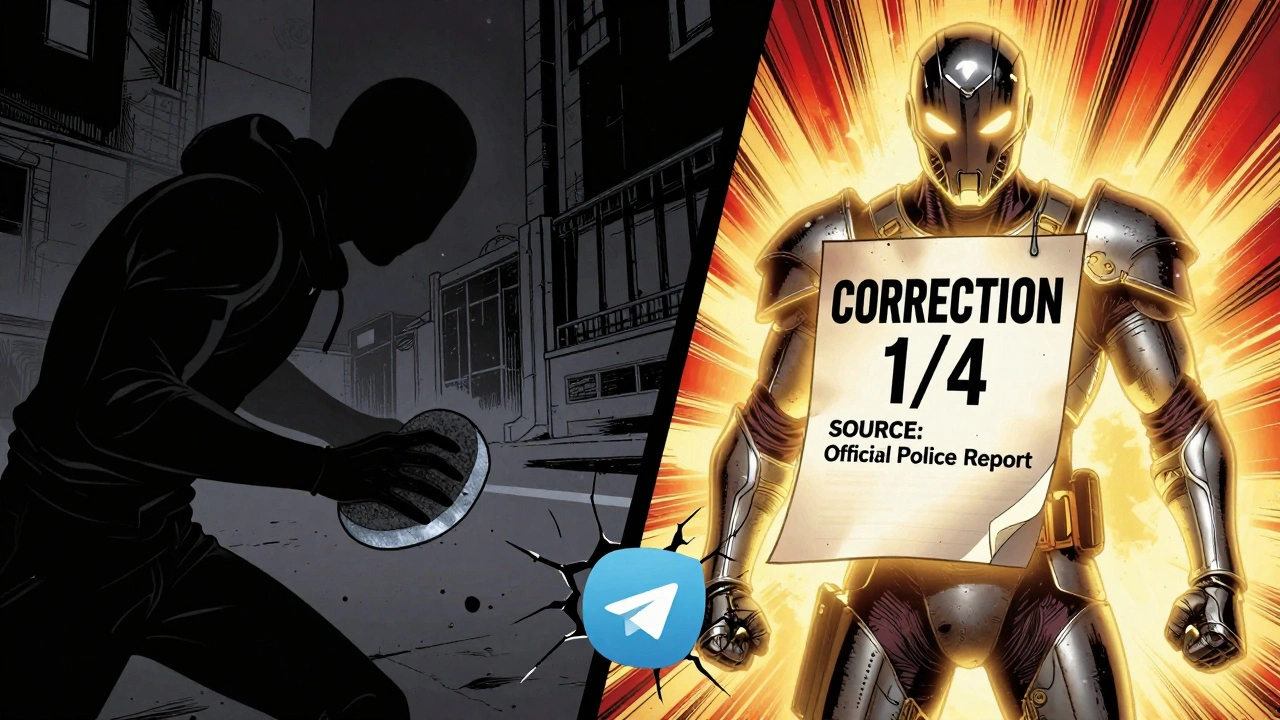
That’s why outlets like Binance Square use numbered correction sequences:
- CORRECTION 1/4: The event occurred on October 12, not October 10.
- CORRECTION 2/4: The official statement was misattributed to Ministry A, not Ministry B.
- CORRECTION 3/4: The casualty count was based on unverified social media posts. Updated figure: 14 confirmed.
- CORRECTION 4/4: Full source documentation available here: [link]
They don’t just delete the old posts. They leave them up. They pin the correction sequence. And they link to the original messages. This approach increased user trust by 29% in their Q4 2024 report.
Regional Differences Matter
A correction that works in Berlin won’t work in Tehran. In Western markets, users expect full transparency. Reddit users in r/Telegram complained loudly when Bloomberg edited quotes without showing changes. One top comment got over 2,000 upvotes: "When you edit without showing what changed, it’s deception."
But in authoritarian states, visible corrections can be deadly. A Freedom House survey of 1,200 Iranian users found 79% preferred silent edits. One respondent said: "If Telegram shows I corrected a post about protests, the police will know I’m lying to protect myself."
This creates a real dilemma. Do you follow Western journalism ethics and risk endangering sources? Or do you prioritize safety and sacrifice transparency?
The answer isn’t one-size-fits-all. You need two versions of your policy:
- Open environments (EU, US, Canada): Use clear "CORRECTION" banners, edit timestamps, and links to originals.
- Restricted environments (Russia, Iran, China, Myanmar): Use subtle edits within the 48-hour window and avoid pinned corrections unless absolutely necessary. Instead, rely on trusted followers to spread corrections privately.
Compliance Is No Longer Optional
Telegram’s rules changed in August 2024 after Pavel Durov’s arrest in France. The platform now permits data disclosure to law enforcement with a valid court order. It also launched AI moderation teams that actively scan news channels for misinformation.
Now, if you’re operating in the EU, you’re bound by the Digital Services Act (DSA). That means you must correct verified errors within 24 hours. But Telegram’s 48-hour edit window conflicts with that. So what do you do?
German news outlets are already solving this with dual systems: they post corrections on Telegram within 48 hours, but also publish them on their websites and send email alerts to subscribers. This satisfies both Telegram’s limits and Germany’s NetzDG law.
Channels that ignore this risk being demoted by Telegram’s algorithm or flagged by EU "trusted flaggers." In November 2025, over 8,300 users reported "inadequate corrections" on Telegram-up 400% from the previous quarter.

What You Can’t Do
Don’t assume your audience knows how Telegram works. Most users don’t realize edits are hidden. They assume what they see is final.
Don’t rely on user reports to catch errors. Telegram disables comments by default on large channels. Even when enabled, users must wait for manual approval. By the time someone reports a mistake, the damage is done.
Don’t use third-party fact-checking tools. Telegram blocks integration with services like CrowdTangle or ClaimBuster. You’re on your own.
Don’t wait until you’re caught. Build your policy before you publish your first big story.
Step-by-Step: Building Your Corrections Policy
Here’s how to set up a working system in under two weeks:
- Define your correction triggers: What counts as a correction? Spelling? Dates? Quotes? Misattributions? List them.
- Assign roles: Who checks facts before posting? Who approves edits? Who posts corrections? Keep it small-2-3 people max.
- Create templates: Draft 3 correction message templates: simple edit, multi-part correction, and silent edit (for high-risk regions).
- Pin your first correction: Post a test correction to your own channel. Make sure it’s clear, includes the original link, and explains the error.
- Train your team: Use the free "Telegram News Protocol" GitHub repository (1,247 stars, 28 contributors) for templates in 17 languages.
- Monitor reports: Check your Telegram moderation dashboard weekly for "inadequate correction" flags.
- Update quarterly: Review what worked, what didn’t, and adjust based on user feedback and legal changes.
The Future of Corrections on Telegram
Telegram is testing a "verified correction badge" for IFCN-certified outlets, launching in Q2 2026. This will show a small checkmark next to corrections from trusted sources. It’s a step toward accountability.
But the bigger threat is regulation. The European Commission is expected to propose a "News Integrity Framework" in January 2026 that could force Telegram to shorten its edit window to 24 hours. If that happens, channels without systems in place will be left behind.
Right now, Telegram’s corrections ecosystem is fragile. It’s not broken-it’s unfinished. But for news channels that want to be trusted, it’s not optional anymore. You can’t just rely on speed. You can’t just rely on reach. You need to prove you’re responsible.
Correction isn’t weakness. It’s credibility. And on Telegram, where truth is the only currency that matters, that’s the only edge you’ve got left.