When breaking news pops up in a Telegram channel, and it’s written in a language you don’t understand, what do you do? You could wait for someone to summarize it - or you could let AI translate it in real time. That’s not science fiction anymore. In 2026, AI tools are quietly transforming Telegram from a simple messaging app into a global news network that speaks every language. But not all tools are created equal. Some promise 99% accuracy but stumble on technical terms. Others handle voice messages perfectly but cost $10 a month. And Telegram’s own built-in translation? It’s handy - but limited.
Telegram’s Native Translation: Easy, But Not Enough
Telegram Premium subscribers get a built-in translation tool that works on text in chats, groups, and channels. Turn it on, and a small bar appears at the top of every message in a foreign language. Tap it, and it translates instantly. It supports 42 languages - enough to cover over 90% of the world’s primary languages, according to Enreach.ai. It’s simple. No setup. No app install. Just enable and go.
But here’s the catch: it only works on text. If someone sends a voice message - say, a live update from a protest in Ukraine or a press conference in Brazil - you’re out of luck. Telegram doesn’t translate voice calls or audio files natively. And while the translation is decent for everyday phrases, it often fails with news-specific jargon. A report from iturrit.com in 2025 found that even with AI calibration, accuracy drops to around 85% when translating financial or technical terms common in news reports.
Plus, you need a Premium subscription - $4.99 a month. For casual users, that’s a barrier. For news organizations tracking global events, it’s a cost they can’t ignore.
SpeakApp AI: The Go-To for Voice Messages
If you’re dealing with voice messages - and you’re in a news-heavy Telegram group - SpeakApp AI is the tool most people swear by. It automatically detects the language of any voice note, transcribes it, then translates it into your preferred language. No manual steps. Just open the message, and within seconds, you get both the text and the translation.
It’s available on iOS and Android, and it integrates directly into Telegram. A case study from a teacher in Mexico showed that after using SpeakApp to translate audio updates from her international students, confusion in her class dropped by 92%. That’s not just convenience - that’s clarity.
But it’s not free. At $9.99/month, it’s pricier than Telegram Premium. Reddit users in r/Telegram gave it high marks for speed and accuracy - 78% praised its performance - but 61% complained about the price. Still, for journalists, researchers, or anyone who needs to monitor non-English voice updates in real time, it’s often the only viable option.
Lufe.AI: The Multi-Engine Powerhouse
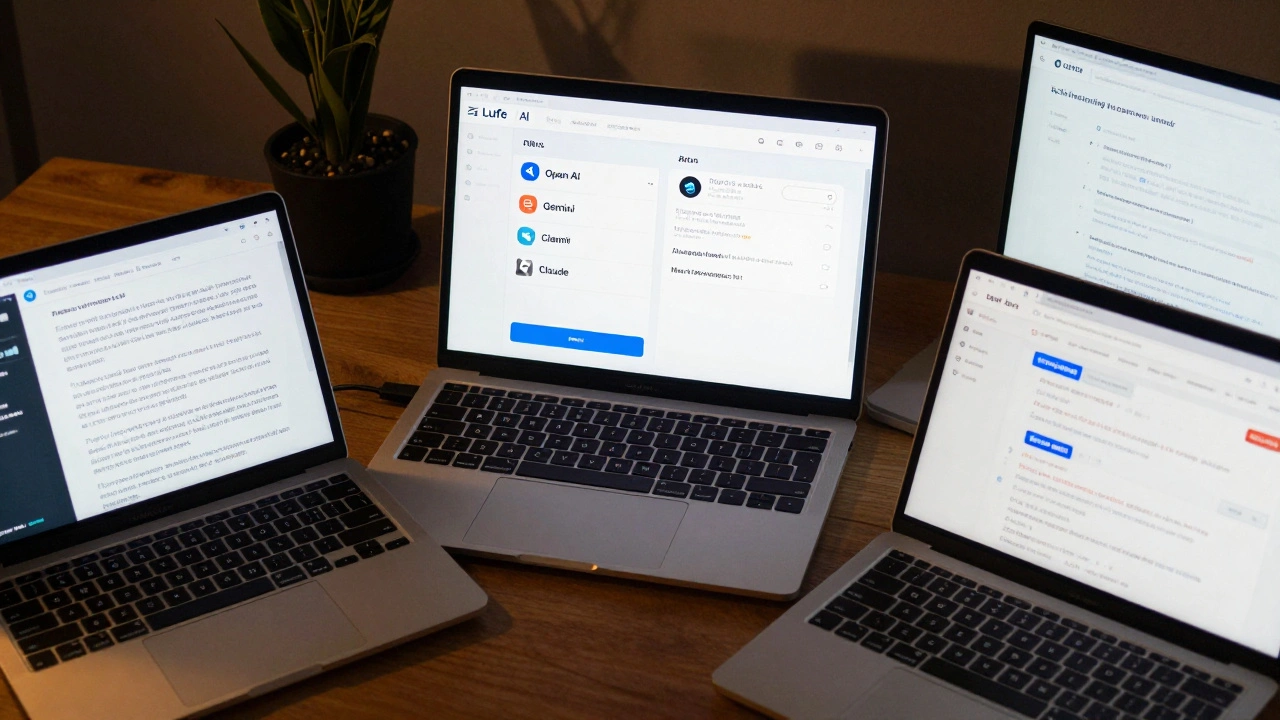
Lufe.AI doesn’t just use one AI engine. It combines OpenAI, Google Gemini, and Claude - and lets you choose which one to trust for each translation. Why does that matter? Because different models handle different languages better. Gemini crushes Asian languages. Claude nails formal tone and nuance. OpenAI is great for idioms.
It also handles images. If a news channel posts a screenshot of a government announcement in Arabic, Lufe.AI can extract the text from the image and translate it. That’s huge for breaking news where documents, signs, or handwritten notes are shared as pictures.
It’s got a browser extension, so you can use it on desktop. Free users get basic translation. Premium unlocks multi-engine switching, document translation, and higher daily limits. TechCrunch called it “the most flexible tool for professionals” in their 2025 review. Dr. Elena Rodriguez from MIT noted that using multiple engines helps reduce bias - if all three models agree on a translation, you can trust it more.
But here’s the trade-off: it’s not automatic. You have to copy-paste text or upload files. It doesn’t integrate into Telegram like SpeakApp does. You need to switch apps. For fast-moving news, that lag matters.
n8n.io: For the Tech-Savvy Automators
If you’re the type who sets up automations for everything - from Slack alerts to email filters - then n8n.io is your secret weapon. It’s an open-source automation platform that connects Telegram to AI translation services. You can build a workflow that:
- Monitors a specific Telegram channel
- Extracts any voice message
- Sends it to an AI transcription service
- Translates the text into 55 languages
- Posts the translated version back to your group
It’s not plug-and-play. Setting it up takes about 45 minutes. You need to connect APIs, configure triggers, and test the flow. But once it’s running? You’ve created a 24/7 multilingual news hub. One user, a freelance journalist in Berlin, automated his monitoring of Russian and Ukrainian Telegram channels. He now gets translated summaries of every audio update - no manual work.
The n8n community has over 4,000 GitHub stars. Tutorials on YouTube show step-by-step setups. It’s free to use, but you’ll need to pay for AI services like Whisper (for transcription) or DeepL (for translation). Total cost? Around $5-$15/month depending on usage.
EzDubs: Real-Time Call Translation
Telegram doesn’t translate voice calls. But EzDubs does. If you’re on a voice call with a source in Turkey or a witness in Nigeria, EzDubs translates everything in real time - on Android, iOS, and desktop. It’s the only tool that fills this gap.
It’s not perfect. Users report 2-3 second delays. Some translations sound robotic. But for breaking news interviews or live press briefings? It’s unmatched. Trustpilot gives it a 4.2/5 rating from nearly 400 reviews. People specifically mention using it during international Zoom calls synced with Telegram groups.
The downside? It’s a standalone app. You can’t use it inside Telegram. You have to switch between apps mid-call. And it costs $12.99/month. But if your job depends on understanding unscripted speech - like a reporter, NGO worker, or diplomat - it’s worth the price.
Accuracy: What 99% Really Means
You’ll see headlines claiming “99% translation accuracy.” But that’s misleading. Iturrit.com’s 2025 analysis explains that this number applies only to common vocabulary - words like “government,” “meeting,” or “attack.” It doesn’t hold up for specialized terms: “sanctions,” “ballistic missile,” “humanitarian corridor.”
A survey of 87 professionals using Turrit found that 35% of news-related translations needed manual correction. That’s not a bug - it’s a limitation of current AI. No tool can perfectly understand context without human oversight. Even the best AI can’t tell if “fire” means flames or a dismissal.
That’s why experts recommend using AI as a first pass - not a final answer. Always cross-check with a second tool. If Lufe.AI and SpeakApp both translate the same voice message the same way? You can be confident. If they differ? Dig deeper.
Who Should Use What?
Here’s a quick guide based on your needs:
- Just want text translated? Use Telegram Premium. It’s cheap and built-in.
- Deal with voice messages daily? Get SpeakApp AI. It’s the fastest and most reliable.
- Translate documents, images, or need precision? Try Lufe.AI. Its multi-engine system gives you more control.
- Run a news channel or automate monitoring? Set up n8n.io. It’s powerful, flexible, and free to start.
- Do live interviews or voice calls? EzDubs is your only real option.
Most users combine two tools. For example: Telegram Premium for text, SpeakApp for voice, and Lufe.AI for documents. That’s what Reuters does - they use SpeakApp for audio verification and Lufe.AI to translate press releases.
The Future: What’s Coming in 2026
Telegram is testing GPT-4 integration for translation, according to Enreach.ai. That could mean better context understanding - especially for idioms and cultural references. EzDubs plans to roll out real-time video call translation by Q3 2026. DeepL’s acquisition of Speakly suggests we’ll see tighter integration between translation engines and Telegram itself.
One thing’s clear: AI translation in Telegram isn’t going away. It’s getting smarter. But it’s still a tool - not a replacement for human judgment. News is too important to trust entirely to machines. Use AI to save time. But always verify.
Can Telegram translate voice messages natively?
No. Telegram’s built-in translation only works for text. Voice messages, even from Premium users, cannot be translated without third-party tools like SpeakApp AI or EzDubs.
Is Telegram Premium worth it for translation?
Only if you mostly read text-based news in foreign languages and don’t need voice translation. For $4.99/month, it’s useful but limited. If you need audio translation, document handling, or real-time calls, third-party tools offer far more value.
Which AI tool has the highest accuracy for news terms?
Lufe.AI leads in accuracy for specialized terminology because it combines multiple AI engines (OpenAI, Gemini, Claude) and lets you compare results. Tools that rely on a single engine, like Google Translate or Telegram’s native system, often misinterpret technical or political jargon.
Do these tools work offline?
No. All AI translation tools require an internet connection to send data to cloud-based models. There are no offline solutions for Telegram translation that maintain accuracy. Some tools, like EzDubs, offer on-device processing for privacy, but still need internet to function.
Are these tools safe for sensitive news sources?
It depends. Tools like n8n.io and Lufe.AI let you choose where your data goes - you can route translations through servers in the EU or US to comply with GDPR. Avoid tools that don’t disclose their data handling policies. For high-risk reporting, always disable cloud storage and use tools that offer end-to-end encrypted translation.