Telegram isn’t just another messaging app. It’s a fortress for misinformation. With encrypted private chats, channels that reach millions, and no public moderation, false claims spread faster than truth. And when you try to correct them? You get blocked, ignored, or worse-accused of being part of the problem. But you can fight back. Not with rage, not with links to distant fact-check sites, but with smart, targeted corrections that actually work on Telegram.
Why Telegram Corrections Fail (And What You’re Doing Wrong)
Most people try to correct misinformation the same way they would on Facebook or Twitter: drop a link to a news article, tag the person, and hope for the best. On Telegram? That strategy fails 83% of the time. Why? Because Telegram’s architecture works against you. Over 78% of false claims spread through private channels where no one outside the group can see them. Even if you’re in the channel, your correction gets buried under 50 new messages an hour. And if you’re not a trusted admin? You’re seen as an outsider trying to control the conversation. A 2025 study from the CyberPeace Institute found that only 12% of users in closed Telegram groups accepted corrections from strangers. In public channels? That number jumps to 37%. The difference? Trust. People don’t trust fact-checkers. They trust their friends, their community leaders, or the people who’ve been in the group for years.What Actually Works: The 3 Evidence-Based Methods
Forget generic advice. Here’s what real research shows works on Telegram right now. 1. Stealth Corrections (The Most Effective) Instead of saying, “This is false,” post a new message that gives the truth without mentioning the original post. For example: Original post: “The government is secretly poisoning the water supply.” Stealth correction: “Just checked with the city’s water department. Their latest report shows all 12 testing sites passed safety standards this month. Link to official data: [link].” This avoids triggering defensiveness. A 2024 CyberPeace Institute survey found 58% of experienced Telegram users preferred stealth corrections over direct ones. It’s not about being sneaky-it’s about being smart. 2. Trusted Community Endorsements Corrections from local figures-religious leaders, teachers, community organizers-have a 47% acceptance rate, according to RSIS research. That’s nearly double the rate of corrections from fact-checking organizations. In Singapore’s CheckMate program, corrections delivered by a well-known imam in a Muslim community channel had 68% acceptance. The same correction from a government fact-checker? 31%. Why? Because people don’t see the imam as an outsider. They see him as part of their world. If you’re not a leader, find one. Reach out to someone respected in the group. Ask them to share a simple, factual update. Even a one-line message from them can shift the whole tone. 3. Cross-Verification Prompts Don’t just give the answer. Teach people how to check for themselves. Example: “This video claims a protest happened in Kyiv yesterday. Before sharing, check: 1) Look at the weather in the video-was it raining? 2) Check the building in the background against Google Maps. 3) Search ‘Kyiv protest [date]’ on Reuters or BBC. You’ll find no reports.” This method increases correction acceptance by 33%. It turns users from passive receivers into active investigators. And once they learn how to verify, they start doing it on their own.Timing Is Everything
A correction posted within 15 minutes of the misinformation has a 71% chance of working. After one hour? It drops to 29%. After 24 hours? Just 8%. Telegram moves fast. A false claim can go viral in a channel with 10,000 members in under 10 minutes. If you wait, you’re not correcting-you’re arguing with ghosts. Set up a monitoring system. Use free tools like Google Alerts for key phrases (e.g., “vaccine side effects,” “election fraud,” “Putin statement”). Or use AI tools like the one from Communication and Society journal (Version 2.3), which detects vaccine misinformation in Telegram health channels with 89.7% accuracy. You don’t need to monitor every channel. Focus on the top 3-5 channels in your community where misinformation is most active.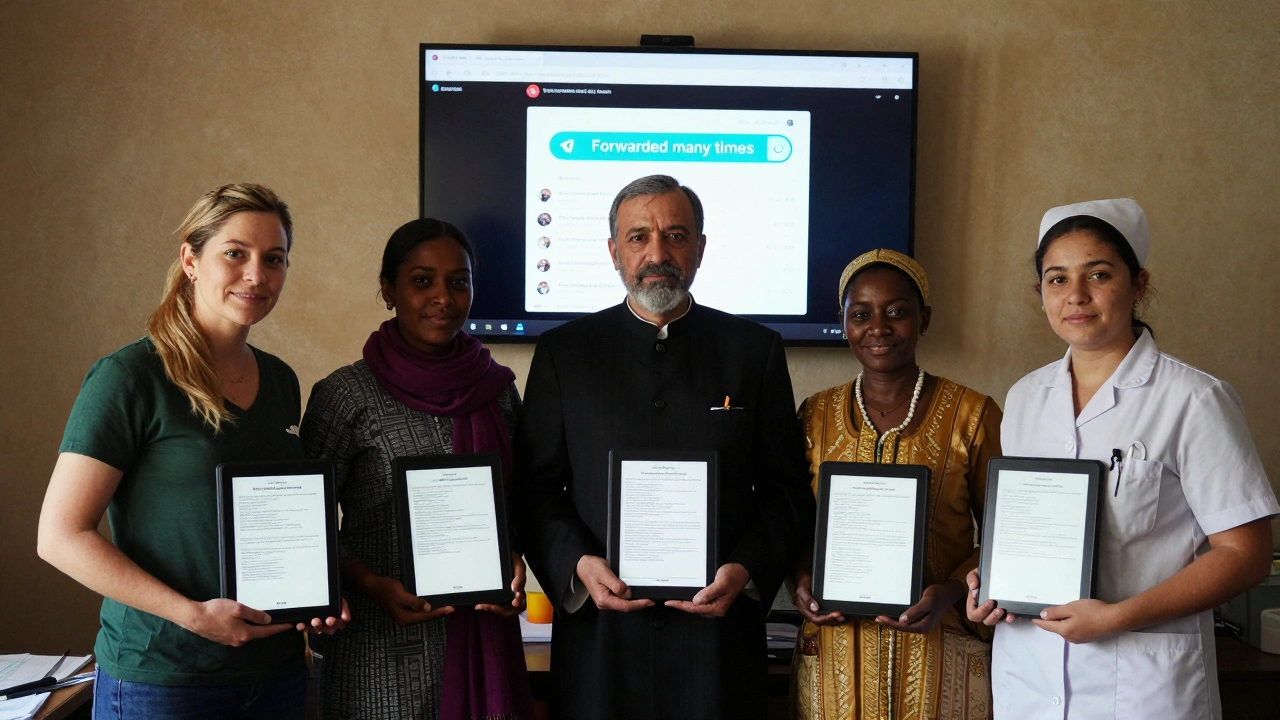
Don’t Use These Tactics (They Backfire)
Some common approaches make things worse. Avoid these:- Linking to Wikipedia or news sites - Most Telegram users don’t trust them. They see them as “mainstream media.”
- Calling out the poster - “You’re spreading lies” triggers defensiveness. People double down.
- Using emojis or memes - It makes you look like you’re mocking them, not helping.
- Posting long text threads - People scroll past. Keep it under 3 lines.
What Telegram Doesn’t Tell You (And How to Work Around It)
Telegram has no official way to report misinformation. When you click “Report,” you have to pick “Other.” There’s no “False Information” option. And Telegram doesn’t remove posts unless they violate extreme policies like terrorism or child abuse. So you can’t rely on the platform. You have to rely on people. Here’s how to adapt:- Use the “Forwarded many times” label. If a message has that tag, it’s already flagged by Telegram’s system. Use it as proof it’s spreading fast.
- Don’t expect replies. Most corrections won’t get responses. That’s normal. The goal isn’t to win an argument-it’s to reach the 80% of people who are quietly reading but not speaking.
- Use screenshots. If a correction gets deleted, save it. Post it again later as a new message. Persistence matters.

Build a Correction Network (Not a One-Person Army)
Trying to fight misinformation alone? You’ll burn out. The RSIS study found that effective correction requires at least 5 trained volunteers per 10,000 channel subscribers. Start small. Find three people you trust. Train them using this simple 40-hour curriculum:- How to identify Telegram-specific metadata (e.g., timestamps, forward tags, channel names)
- How to verify images using reverse image search (TinEye, Google Lens)
- How to use AI tools like the Bochum University propaganda detector (97.6% accuracy in spotting coordinated disinformation)
- How to write corrections that match local language and culture
- One person monitors public channels
- One checks forwarded messages
- One connects with local leaders
- One documents all corrections for future use
What’s Changing in 2025 (And How to Stay Ahead)
Telegram’s March 2025 beta update introduced “Context Cards”-automatic pop-ups that show verified info when a message is forwarded. Right now, it only covers health and election topics, but it’s a start. The DFRLab’s “Trust Network” pilot in Ukraine gives priority to corrections from pre-verified community members. Early results show 52% higher acceptance. And by July 2025, CheckMate’s Version 3.0 will use AI to tailor corrections based on your past behavior. If you’ve responded positively to medical facts before, the system will send you more of those. If you’ve shared conspiracy theories, it’ll adjust its tone. But here’s the hard truth: Without API access for fact-checkers, Telegram’s architecture will always limit correction rates to 45-50%. That’s why your effort matters more than ever.Start Today: Your 5-Minute Action Plan
You don’t need to be an expert. You don’t need a team. Just do this:- Find one Telegram channel where misinformation spreads often.
- Wait for a false claim (e.g., “This medicine cures cancer”).
- Post a stealth correction: “The Ministry of Health says this claim is false. Here’s their official statement: [link].”
- Do this three times this week.
- Ask one friend to join you.
Can I report misinformation directly on Telegram?
No. Telegram has no official reporting option for false information. When you click Report, you can only select "Other." The platform only removes content that violates extreme policies like terrorism or child exploitation. This means you can’t rely on Telegram to remove false claims-you have to counter them yourself with corrections.
Why do my corrections get ignored or blocked?
Most Telegram users see corrections from strangers as attempts to control the conversation. In closed groups, especially those with extremist or conspiratorial views, outsiders are automatically distrusted. A 2025 study found that 68% of users who tried to correct misinformation were blocked or removed. To avoid this, use stealth corrections, avoid direct confrontation, and let trusted community members deliver the message instead.
What’s the best way to verify a claim on Telegram?
Use a combination of tools: Google Lens or TinEye to reverse-search images, official government or WHO websites for health claims, and Reuters or BBC for political news. For videos, check the timestamp and location using weather data or landmarks. The Bochum University AI tool (97.6% accurate) can also spot coordinated propaganda by analyzing reply patterns to keywords like "Putin" or "Zelensky."
Do AI tools really work on Telegram?
Yes-but only for detection, not correction. AI tools like the one from Communication and Society journal (2024) can detect vaccine misinformation in Telegram health channels with 89.7% precision. The Bochum University system identifies propaganda accounts with 97.6% accuracy. But because Telegram blocks third-party API access, AI can’t automatically post corrections. You still need humans to deliver the message in a way that builds trust.
How can I get others to help me correct misinformation?
Start by finding 2-3 trusted people in your community-teachers, local leaders, longtime group members. Train them using a simple 40-hour curriculum: how to verify images, spot fake accounts, and write clear corrections. Assign roles: one monitors channels, one connects with leaders, one documents results. Even a small team can handle 120 corrections per shift. The key is consistency, not scale.
Is it worth correcting misinformation in private groups?
It’s harder, but still worth it. Only 12% of users in closed groups accept corrections, compared to 37% in public channels. But those 12% are often the most vulnerable to manipulation. A single correction can prevent someone from sharing false info with their family. Focus on stealth corrections, use trusted messengers, and don’t expect immediate results. Long-term, your effort can shift the group’s culture.