When a major event breaks-earthquake, political coup, corporate collapse-you don’t want to wait. You want the truth, fast. And that’s where Telegram and Twitter (X) come into play. Both are used by millions to chase headlines, but they work in totally different ways. One is a public square with loudspeakers. The other is a private pipeline with no filters. Which one actually gets you the news first? And more importantly, which one do you trust?
Speed: Who Delivers News First?
Twitter (X) used to be the go-to for breaking news. Journalists tweet live from the scene. Newsrooms monitor trending hashtags. A major story can go viral in minutes. But here’s the catch: X’s algorithm doesn’t care if you’re the first to report-it cares if people engage. If your tweet doesn’t get likes or retweets fast enough, it gets buried. That’s why 46% fewer people are clicking through to news sites from X today than three years ago. The platform still has 619 million users, but the flow of news has slowed. Telegram doesn’t play by those rules. No algorithm. No feed. If you subscribe to a news channel, every message hits your phone instantly. No delay. No filtering. That’s why Telegram’s 1 billion monthly users-500 million daily-get updates faster than almost anyone else. A channel like @BBCNews or @Reuters can blast out a 500-word update, and every subscriber sees it the moment it’s posted. There’s no waiting for the algorithm to decide if it’s "worth seeing."Tools: What Each Platform Lets You Do
Twitter (X) is built for conversation. You can reply, quote, retweet, thread, and tag. That’s great for context. If a politician makes a statement, you can instantly see experts, fact-checkers, and critics respond. Newsrooms use X as a live newsroom: reporters verify sources, share video clips, and link to full articles. It’s messy, but it’s layered. Telegram is built for broadcasting. Channels are one-way. You can’t comment on a post. You can’t reply to the source. But you can create your own channel, add bots, schedule posts, and even embed media-rich updates. A local news outlet in Jakarta or Kyiv might use Telegram to send out a 10-minute audio summary, a map of affected areas, and a live Google Doc-all in one message. That’s not possible on X. Telegram also lets you join groups where users discuss the news, but those are separate from the broadcast channel. It’s like having a TV station with a live chat room attached.
Trust: Who’s Actually Reliable?
This is where things get risky. On X, you see blue checkmarks. You see @CNN, @APNews, @TheNewYorkTimes. These are verified accounts backed by institutions. Journalists use X to distribute news with editorial oversight. 82% of professional journalists have an X account. That’s not just popularity-it’s credibility. Even if the platform’s moderation is inconsistent, there’s still a structure. If someone spreads a lie, it’s often quickly called out by other reporters. Telegram has no such system. Anyone can create a channel called "Breaking News Today" and post anything. No verification. No oversight. Some channels are run by real newsrooms-@BBC, @DWNews, @AlJazeera-but many aren’t. In places like Ukraine, India, or Nigeria, Telegram is full of citizen reporters, anonymous leaks, and unverified rumors. Because there’s no algorithm pushing engagement, false stories don’t spread as fast… but they also don’t get corrected. You have to judge the source yourself. And here’s the trade-off: Telegram’s lack of moderation is why some people love it. No bans. No shadowing. No deplatforming. But it’s also why extremist groups, fraudsters, and disinformation networks thrive there. Telegram doesn’t track you for ads. That’s privacy. But it also means no one’s monitoring what’s being shared.Where People Use Them
X is global, but its news strength is strongest in the U.S., U.K., Canada, and Western Europe. That’s where journalists live, work, and tweet. If you’re following global politics, X is still the hub. Telegram dominates elsewhere. In Eastern Europe, Central Asia, and parts of Southeast Asia, it’s the main news platform. In Germany, Russia, Kazakhstan, and Indonesia, more people get their news from Telegram than from Facebook or Twitter. In Latin America, crypto communities and independent journalists use Telegram to bypass censorship. If you’re trying to reach audiences outside the West, Telegram isn’t just an option-it’s often the only one.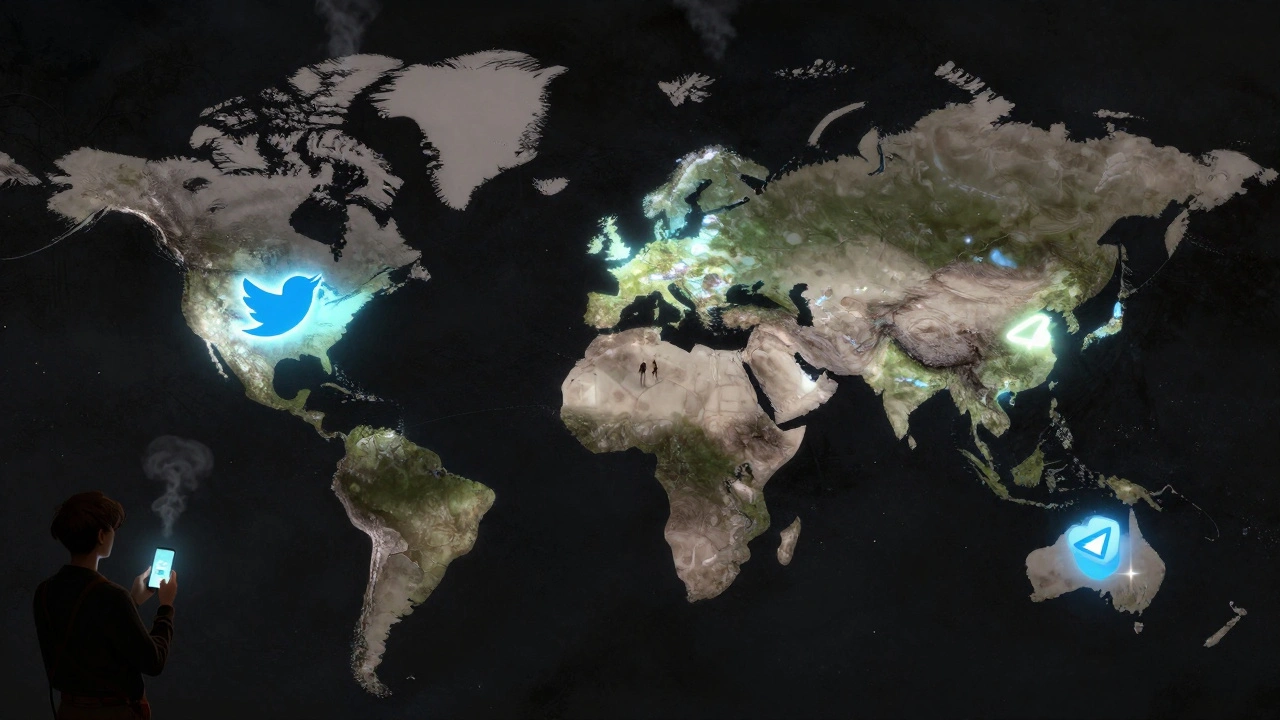
Who’s Paying for This?
Twitter (X) makes money the old way: ads. Advertisers pay $7-$12 per thousand impressions. Newsrooms rely on that traffic to fund reporting. But as fewer people click through from X to news sites, publishers are losing revenue. That’s why many now use X as a teaser-to drive people to their own websites. Telegram’s ad market is tiny. Only 0.4% of global advertisers use it. But that’s changing fast. CPM rates are as low as $0.10 in some regions. For a small news outlet in Uzbekistan or Peru, that means they can run targeted ads for pennies and reach thousands. Telegram’s ad revenue is projected to hit $2.5 billion in 2026. That’s not Google money-but it’s enough to keep independent outlets alive.What This All Means for You
If you’re a journalist, researcher, or policy watcher: Twitter (X) is still your best bet for real-time verification, expert commentary, and institutional sources. Use it to track who’s saying what, and follow verified accounts. If you’re a citizen in a region with censorship, or you want to get news before anyone else: Telegram is your lifeline. Subscribe to trusted channels. Avoid ones with no clear source. Use it for speed, but double-check everything. If you’re trying to reach an audience: If you’re targeting Western professionals, use X. If you’re targeting Asia, Eastern Europe, or Latin America, start with Telegram. You might need both. Neither platform is perfect. X is losing its grip on news distribution. Telegram is growing fast but lacks accountability. The truth isn’t on one side or the other-it’s in how you use both.Is Telegram faster than Twitter (X) for breaking news?
Yes, in practice. Telegram delivers messages instantly to subscribers with no algorithmic delay. Twitter (X) can be slower because its feed prioritizes engagement over timing. If a breaking story doesn’t get quick likes or retweets, it may not show up in your feed at all. Telegram doesn’t care about popularity-it just sends.
Can I trust news on Telegram?
You can’t automatically trust it. Telegram has no verification system for channels. Anyone can create a "Breaking News" channel and post false information. Some channels are run by real news organizations like BBC or Reuters, but many aren’t. Always check the channel’s history, look for official logos, and cross-reference with trusted sources before believing anything.
Why are journalists still on Twitter (X)?
Because 82% of journalists use it as their primary tool for sourcing, verifying, and distributing news. It’s where press conferences happen, where sources leak info, and where fact-checkers respond in real time. Even though traffic to news sites has dropped 46%, X remains the central nervous system of professional journalism.
Should I use Telegram if I live in the U.S.?
It depends. If you want to follow international news, especially from regions like Eastern Europe or Southeast Asia, Telegram is essential. For U.S.-focused news, Twitter (X) is still more useful because of the density of verified journalists and official accounts. Many Americans use both: X for mainstream updates, Telegram for niche or global sources.
Which platform is better for avoiding misinformation?
Neither is perfect. Twitter (X) has moderation policies, but they’re inconsistent and often politicized. Telegram has almost no moderation, which means misinformation spreads unchecked. The best defense is your own skepticism: check multiple sources, look for official channels, and avoid anything that feels too urgent or too emotional. Speed doesn’t equal accuracy.